Choose an Insurance Quote
Compare the Best Mortgage Rates in Guelph, Ontario
Find a mortgage that fits your next home purchase, renewal or refinance.
Today's Best Mortgage Rates in Guelph, Ontario
Evaluate Guelph’s best mortgage rates in one place. You can compare the most current mortgage rates and monthly payments from 175+ banks and lenders across Ontario.

Rates are based on an average mortgage of $500,000 and subject to change based on filter criteria.
Lender  | Insured | Insurable | Uninsured |
|---|---|---|---|
 nesto inc. | 3.40%  $2,470.03 / month | 3.50% $2,496.35 / month | 3.45% $2,483.17 / month |
 Mortgage Associates Ontario Inc. | 3.45% $2,483.17 / month | 3.60% $2,522.81 / month | 3.60% $2,522.81 / month |
 Mortgage Alliance | 3.50% $2,496.35 / month | 3.60% $2,522.81 / month | 3.60% $2,522.81 / month |
 Affinity Mortgage Solutions | 3.55% $2,509.57 / month | 3.45% $2,483.17 / month | 3.45% $2,483.17 / month |
 Pineapple Financial Inc – Kinetix Mortgages Team | 3.55% $2,509.57 / month | 3.65% $2,536.10 / month | 3.55% $2,509.57 / month |
 DUCA Financial | 3.89% $2,600.37 / month | 3.89% $2,600.37 / month | 3.89% $2,600.37 / month |
 Dominion Lending Centres | 3.9% $2,603.07 / month | 3.9% $2,603.07 / month | 3.9% $2,603.07 / month |
 Alterna Savings | 3.94% $2,613.86 / month | 3.94% $2,613.86 / month | 3.94% $2,613.86 / month |
 Copperfin Credit Union | 4.04% $2,640.95 / month | 4.04% $2,640.95 / month | 4.04% $2,640.95 / month |
 CIBC | 4.19% $2,681.85 / month | 4.19% $2,681.85 / month | 4.19% $2,681.85 / month |
 Healthcare and Municipal Employees' Credit Union | 4.19% $2,681.85 / month | 4.19% $2,681.85 / month | 4.19% $2,681.85 / month |
 Bayview Financial Services | 4.29% $2,709.29 / month | 4.29% $2,709.29 / month | 4.29% $2,709.29 / month |
 First National Financial | 4.3% $2,712.04 / month | 4.3% $2,712.04 / month | 4.3% $2,712.04 / month |
 Ganaraska Credit Union | 4.49% $2,764.59 / month | 4.49% $2,764.59 / month | 4.49% $2,764.59 / month |
 CMLS | 6.99% $3,498.99 / month | 6.99% $3,498.99 / month | 6.99% $3,498.99 / month |

Written By Shivani Kaul
Content manager
How much down payment do you need to buy a home in Guelph?
Using a reported average selling price of $756,427 in Guelph in July 2026, the minimum down payment would be approximately $50,643. Your actual minimum down payment will depend on the purchase price of the home you buy.
For a home priced around Guelph's current market average, the minimum down payment would be more than 5% of the total purchase price. For example, on a $756,427 home, the minimum down payment would be approximately $50,643. This example uses the average selling price in Guelph in July 2026.
The minimum down payment depends on the home's purchase price. For homes costing $500,000 or less, you need at least 5% down. For homes costing more than $500,000 but less than $1.5 million, you need 5% on the first $500,000 and 10% on the remaining amount. For homes costing $1.5 million or more, you need at least 20% down.
Minimum down payment calculation: $25,000 on the first $500,000 + $25,643 on the remaining $256,427 = $50,643.
Down payment options on a $756,427 Guelph home
| Down payment option | Down payment amount | Mortgage amount* | Mortgage default insurance |
|---|---|---|---|
| Minimum required (~6.7%) | $50,643 | $705,784 | Required |
| 10% | $75,643 | $680,784 | Required |
| 20% | $151,285 | $605,142 | Not required |
*Mortgage amount shown before any mortgage default insurance premium is added.
Putting less than 20% down on this Guelph example would generally mean paying for mortgage default insurance. The insurance protects the lender, and its premium can usually be added to the mortgage rather than paid entirely at closing.
Increasing the down payment from the minimum to 20% would require about $100,642 more upfront on this Guelph home. It would also bring the mortgage before insurance down from $705,784 to $605,142 and eliminate the need for mortgage default insurance.
Read more: How much down payment do I need?
What should you know before getting a mortgage in Guelph?
When planning a home purchase in Guelph, budget for closing costs as well as your down payment. The expenses below explain what you may need to pay separately and which costs can usually be added to your mortgage.
- Land transfer tax: Guelph buyers are subject to Ontario's provincial land transfer tax.
- Legal fees: Budget approximately $1,500–$2,500 for the legal work associated with a typical residential purchase.
- Home inspection: An inspection will often cost around $400–$600, although the price can vary based on the home and what is included.
- Title insurance: This may cost approximately $250–$400, depending on the property and policy.
- Mortgage default insurance: If your down payment is less than 20%, you will generally need mortgage default insurance. The insurance premium can usually be added to your mortgage, but Ontario's sales tax on that premium cannot be added to the loan and must be paid separately at closing.
Estimated Ontario land transfer tax on a $756,427 Guelph home
| Purchase price portion | Rate | Estimated tax |
|---|---|---|
| First $55,000 | 0.5% | $275 |
| $55,000–$250,000 | 1.0% | $1,950 |
| $250,000–$400,000 | 1.5% | $2,250 |
| $400,000–$756,427 | 2.0% | $7,129 |
| Total estimated land transfer tax | $11,604 |
Based on a $756,427 purchase price, the estimated Ontario land transfer tax would be approximately $11,604. Since a Guelph purchase isn't subject to Toronto's municipal land transfer tax, there isn't a second land transfer tax added on top.
Eligible first-time homebuyers can receive an Ontario land transfer tax refund of up to $4,000. If a buyer qualified for the full refund in this example, the estimated land transfer tax would fall to approximately $7,604.
Read more: How much down payment do I need?
What is the average mortgage amount in Guelph?
In 2025Q4, the average new mortgage in Guelph was $403,645. The Canadian average was $360,597 during the same period. The local average changed by -0.57% from the previous quarter.
The average mortgage amount in Guelph was 11.94% higher than the national average and 0.19% higher than in the same quarter a year earlier.
The local average shows what borrowers financed on average, but your mortgage amount will depend on the home’s price, your down payment and how much you qualify to borrow. It isn’t an amount you need to aim for.
Use the local average as a reference point, then work out what fits your budget:
- Estimate how much you may need to borrow: Subtract your planned down payment from the price of homes you’re considering.
- Check the monthly cost: Calculate payments at a few mortgage amounts and include property taxes, insurance, utilities and other homeownership costs in your budget.
- Compare mortgage options: Look at rates, terms, payment flexibility and prepayment options before choosing an offer.
Average loan amount in Guelph
| Period | Guelph average mortgage loan | Changes from previous quarter | YoY Changes |
|---|---|---|---|
| 2025Q4 | $403,645 | -0.57% | 0.19% |
| 2025Q3 | $405,942 | +4.03% | -2.90% |
| 2025Q2 | $390,207 | -5.56% | 2.72% |
| 2025Q1 | $413,199 | +2.56% | 13.26% |
| 2024Q4 | $402,872 | -3.63% | 6.54% |
| 2024Q3 | $418,052 | +10.05% | -1.33% |
| 2024Q2 | $379,877 | +4.12% | 1.12% |
| 2024Q1 | $364,835 | -3.52% | 1.53% |
| 2023Q4 | $378,151 | -10.75% | -2.26% |
| 2023Q3 | $423,679 | +12.78% | 0.17% |
| 2023Q2 | $375,668 | +4.55% | -18.66% |
| 2023Q1 | $359,329 | -7.12% | -18.26% |
| 2022Q4 | $386,884 | -8.53% | -5.23% |
| 2022Q3 | $422,947 | -8.43% | |
| 2022Q2 | $461,860 | +5.07% | |
| 2022Q1 | $439,580 | +7.68% | |
| 2021Q4 | $408,223 | - |
What happens when you renew your mortgage in Guelph?
When your mortgage term ends, renewal is a good time to review whether your current rate, lender and mortgage features still work for you. Guelph homeowners can accept a renewal offer, negotiate with their existing lender or compare mortgages elsewhere before committing to another term.
Your options may include:
- Negotiating with your current lender — the first renewal offer isn't necessarily the only rate or terms available.
- Switching to a different lender — comparing rates, prepayment options and other features can help you decide whether moving your mortgage makes sense.
- Restructuring your mortgage — if your financial needs have changed, you may want to adjust certain features, although larger changes could require you to requalify.
Starting the process before your Guelph mortgage reaches its maturity date gives you time to compare offers and negotiate without being rushed into a renewal decision.
If you have an eligible uninsured mortgage, switching lenders may also be simpler at renewal. Under OSFI's straight-switch rules, the prescribed minimum qualifying rate does not apply when an uninsured mortgage is transferred between federally regulated lenders without increasing the loan amount or remaining amortization period. The new lender will still review your income, debts and credit history to decide whether you qualify.
Renewal and refinancing aren't the same thing. If you want to increase your mortgage balance to access equity from your Guelph home, the transaction would generally be considered a refinance and may require a new property valuation and full mortgage qualification.
Read more: Mortgage Renewal Guide
Compare fixed and variable mortgage rates by term in Guelph
Compare fixed and variable mortgage rates in Guelph across different terms using the Rates.ca Rate Matrix. See how rates vary by mortgage type, term and loan-to-value ratio to find an option that fits your needs.

Rates are based on an average mortgage of $500,000 and subject to change based on filter criteria.
Updated 16:08 on Oct 20, 2026| Placeholder | Insured The rates in this column apply to borrowers who have purchased mortgage default insurance. This is required when you purchase a home with less than a 20% down payment. The home must be owner-occupied and the amortization must be 25 years or less. | 80% LTV The rates in this column apply to mortgage amounts between 65.01% and 80% of the property value. The home must be owner-occupied and have an amortization of 25 years or less. You must have purchased it for less than $1 million. These rates are not available on refinances. Refinances require "Uninsured" rates. | 65% LTV The rates in this column apply to mortgage amounts that are 65% of the property value or less. The home must be owner-occupied and have an amortization of 25 years or less. You must have purchased it for less than $1 million. These rates are not available on refinances. Refinances require "Uninsured" rates. | Uninsured The rates in this column apply to purchases over $1 million, refinances and amortizations over 25 years. More info on the differences between insured and uninsured rates. | Bank Rate Bank Rate is the mortgage interest rate posted by the big banks in Canada. |
|---|---|---|---|---|---|
| 1-year fixed rate | 4.99% | 4.59% | 4.59% | 4.99% | 4.99%  |
| 2-years fixed rate | 3.99% | 4.14% | 4.14% | 4.44% | 4.53%  |
| 3-years fixed rate | 3.86% | 3.79% | 3.79% | 3.90% | 4.39% |
| 4-years fixed rate | 4.19% | 4.09% | 4.09% | 4.39% | 4.44% |
| 5-years fixed rate | 3.69% | 3.94% | 3.69% | 3.69% | 4.19% |
| 7-years fixed rate | 4.89% | 4.89% | 4.89% | 4.89% | 5.00%  |
| 10-years fixed rate | 5.24% | 5.24% | 5.24% | 5.24% | 6.09% |
| 3-years variable rate | 3.90% | 4.05% | 3.90% | 3.90% | 5.95%  |
| 5-years variable rate | 3.45% | 3.54% | 3.50% | 3.50% | 4.24%  |
| HELOC rate | N/A | N/A | N/A | N/A | N/A |
| Stress Test | 5.45% | 5.45% | 5.45% | 5.50% | N/A |
Should you choose a fixed or variable mortgage rate?
A fixed-rate mortgage keeps the same interest rate for the length of your term. A variable-rate mortgage changes when your lender's prime rate changes. Fixed gives you payment certainty. Variable can start lower, but your costs can rise.
The Bank of Canada's policy rate is 2.25%, unchanged at its September 2, 2026 announcement. Lenders use their prime rate, currently 4.45% at major banks, as the benchmark for variable-rate mortgages. Your actual rate is set as a discount or premium to prime, so it won't match the Bank of Canada rate. The next announcement is scheduled for October 28, 2026 and could affect prime and variable mortgage pricing.
For example, using the lowest 5-year insured rates in the Rate Matrix above:
| Comparison | Fixed mortgage | Variable mortgage |
|---|---|---|
| Starting mortgage rate | 3.69% | 3.45% |
| How the rate is set | Locked in when you sign | Prime (4.45%) minus 1.00% |
| What happens if the Bank of Canada raises rates? | Fixed rate stays at 3.69% for the term | Variable rate may increase |
| What happens if the Bank of Canada lowers rates? | Fixed rate stays at 3.69% for the term | Variable rate may decrease |
Rate change example
What if rates rise by 0.50%?
If the Bank of Canada raised its policy rate by 0.50 percentage points and lenders raised prime by the same amount, prime would go from 4.45% to 4.95%. A variable rate set at prime minus 1.00% would rise from 3.45% to about 3.95%.
The example below assumes a variable-rate mortgage with payments that adjust when the interest rate changes. With a fixed-payment variable mortgage, a rate increase may instead mean more of your payment goes toward interest and less toward paying down your mortgage.
On a $500,000 mortgage with a 25-year amortization, that is roughly $2,483 per month at 3.45% and $2,617 per month at 3.95%, about $134 more each month. The 3.69% fixed rate would stay at about $2,547 per month.
The variable-rate borrower could pay more if rates rise, but could also save money if rates stay low or fall. Fixed rates don't change during the term, but you may face a different rate at renewal.
Which one suits you?
- Fixed may suit you if you want predictable payments and have a tight monthly budget.
- Variable may suit you if you can handle payment changes and want to benefit if rates fall.
Learn more: Fixed vs. variable mortgages. Compare today's 5-year fixed and 5-year variable rates.
This example is for illustration only. Payments are estimates. Mortgage rates vary by lender, borrower, mortgage type and eligibility.
How does mortgage refinancing work in Guelph?
For Guelph homeowners, refinancing can be a way to turn some of the equity built up in a property into additional borrowing. A mortgage refinance replaces your existing mortgage with a new one and may be used for renovations, debt consolidation, a major expense or to change your mortgage terms.
The amount available is tied to the value of your home and how much you still owe. Homeowners can generally borrow against their property up to 80% of its appraised value, subject to lender approval. Your loan-to-value (LTV) ratio helps determine how much room is left after your existing mortgage and other secured borrowing are taken into account.
Refinancing usually means qualifying for a new mortgage rather than simply extending your current one. Your lender may therefore review your income, debts and credit profile and may require an updated appraisal of your Guelph home.
How much could you borrow when refinancing a Guelph home?
Take a Guelph property valued at $756,427. Using an 80% loan-to-value limit, the maximum amount secured against the property would be approximately $605,142. Your remaining mortgage balance would reduce how much additional money you could potentially access.
| Refinancing example | Amount |
|---|---|
| Estimated home value | $756,427 |
| 80% of home value | $605,142 |
| Existing mortgage balance | $450,000 |
| Potential additional borrowing | Up to $155,142 |
The $155,142 represents potential additional borrowing before any applicable mortgage penalties, legal fees, appraisal costs or other refinancing charges. Any other loans secured against your home would also reduce the amount available.
In this example, having $450,000 left on the mortgage could leave approximately $155,142 of borrowing room below the 80% limit. That doesn't mean the homeowner will automatically qualify for the full amount; the lender will also consider the property's appraised value and the borrower's finances.
Exploring a refinance in Guelph? Compare mortgage rates in Guelph before deciding on a new mortgage.
Read more: Mortgage Refinancing Guide
Frequently asked questions about mortgages in Guelph
Here's everything you would need to know more about mortgage rates in Guelph, Ont.

Should I get mortgage preapproval before looking for a home in Guelph?
Getting pre-approved before you start viewing Guelph homes can help you set a realistic price range. A lender reviews your finances to estimate how much you could borrow and may hold an interest rate while you shop. Pre-approval does not guarantee final approval: the lender must also accept the property you choose.
Ask how long the rate hold lasts and whether you can receive a lower rate if rates fall before closing. Treat the pre-approved amount as a borrowing limit, then decide what payment leaves you comfortable room for everyday expenses, savings and home maintenance.
Can I pay my Guelph property taxes monthly alongside my mortgage?
Yes. The City of Guelph offers pre-authorized monthly property tax payments, as well as automatic withdrawals on tax instalment due dates. Some mortgage lenders also collect property taxes with your mortgage payments and pay the municipality for you.
Before setting up payments with the City, confirm whether your lender will handle the taxes. When comparing mortgage payments, check whether property taxes are included in the quoted amount so you can budget for the full monthly cost.
Can I keep my current mortgage rate when moving to Guelph?
You may be able to keep your existing rate if your mortgage is portable and your lender approves the transfer. Porting lets you move your existing mortgage balance, rate and contract terms to another property. Eligibility and restrictions depend on your lender and mortgage agreement.
If your Guelph purchase requires a larger mortgage, ask how the extra borrowing would be priced. Before committing, compare the cost of porting with the cost of taking a new mortgage, including any penalty for ending your current contract.
Could a Guelph home’s appraisal affect my mortgage approval?
Yes. Your final mortgage approval depends partly on the property’s value and whether it meets the lender’s requirements. Even with preapproval, the lender may approve a smaller mortgage or require a larger down payment if the property does not support the financing you requested.
Before committing to a Guelph purchase, ask whether the lender needs an appraisal and when the property review will be completed. If the valuation creates a financing shortfall, confirm the revised borrowing amount and discuss your options with your lender and lawyer.

Shivani Kaul, Content manager
Shivani is a Content Manager at Rates.ca, focusing on mortgages. She is an experienced communication and marketing professional who specializes in content strategy and SEO optimization. Shivani ensures that our written materials meet the highest standards of quality and relevance.
She holds a Digital Marketing Management certificate from the University of Toronto, a Business Communications certificate from the University of British Columbia, a Masters degree in Mass Communication from Symbiosis Institute of Media and Communications and a Bachelor's degree in English from the University of Delhi.
Shivani has previously worked as a deputy digital productions editor with PMNA-The Canadian Press, and as an editor with The Globe and Mail, Toronto Star, and the Investor's Digest of Canada. She has also worked in reputed news media groups in India and the Middle East.
Mortgage Calculators

Home Closing Cost Calculator

Home Sale Proceeds Calculator
Mortgage Payment Calculator

Mortgage Renewal Calculator

Mortgage Affordability Calculator

Mortgage Stress Test Calculator

Mortgage Insurance Calculator
Land Transfer Tax Calculator
Latest mortgage articles:
What is mortgage insurance in Canada?
Mortgage insurance is mandatory in Canada if your down payment is under 20%. Here's what it costs, who qualifies, and how to lower your premium.

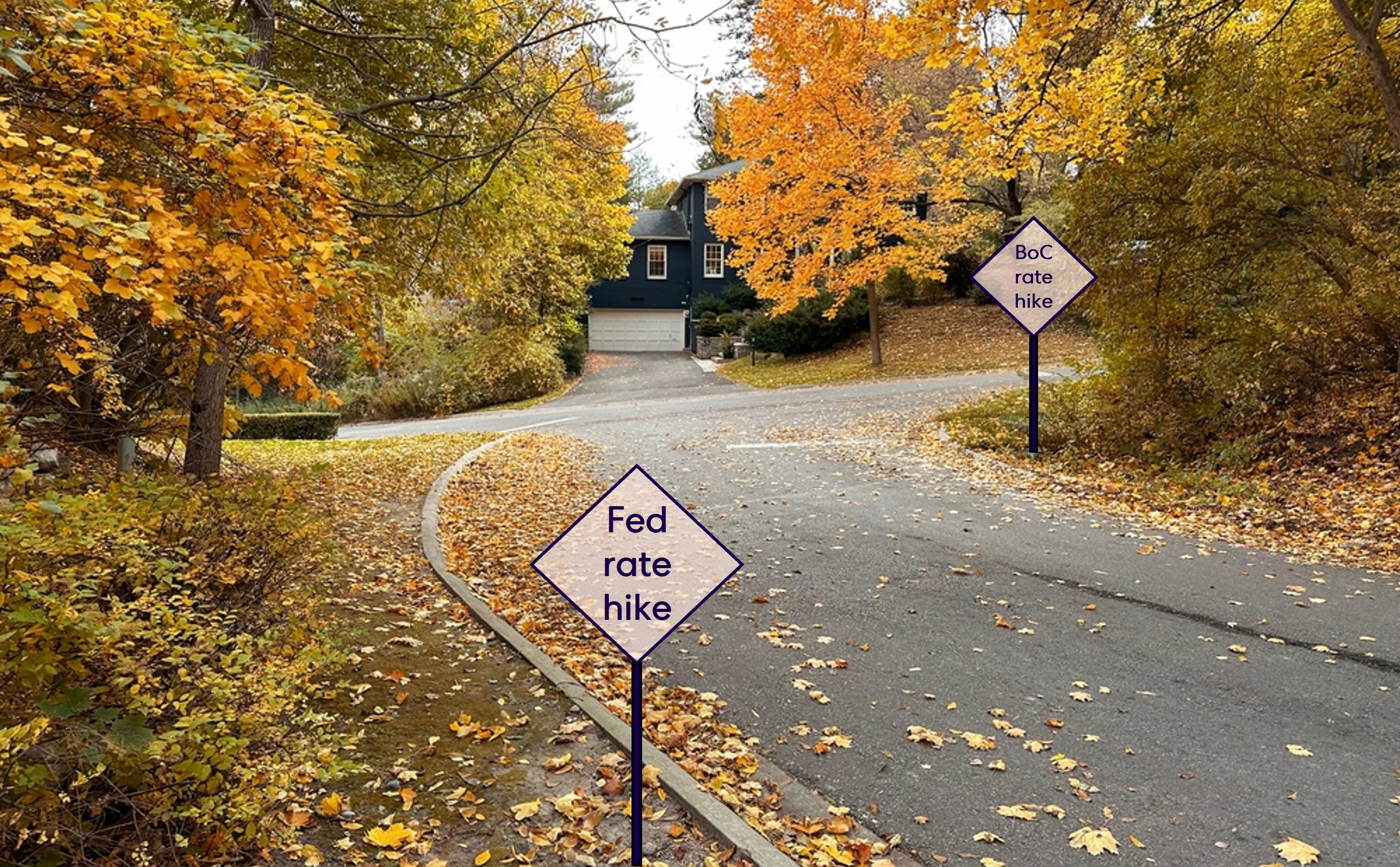
Ask the mortgage expert: What a U.S. Fed rate hike could imply for Canadian mortgage rates
An analysis of U.S and Canada central bank hiking cycles over 30 years to help you plan and navigate a long-term mortgage strategy.
Does debt affect how much mortgage you qualify for in Canada?
Personal debt shrinks the mortgage you may qualify for—every extra $100 in monthly payments can reduce total loan amount by $15,000–$20,000.

How to secure a mortgage as a single parent
An overview of important considerations when applying for a mortgage as a single parent.

Bank of Canada holds rates at 2.25% amidst tariff uncertainty, persistent energy inflation
BoC overnight lending rates remain unchanged, but higher gas prices, new U.S. tariffs, and a slowing economy could shape what's next for Canadians.
Nearly half of Canadians renewing mortgages spend over 50% of their budget on housing
Canada's mortgage renewal wave has nearly half of homeowners spending 50%+ of monthly outgoings on housing; younger Canadians and newcomers most strained.

Find a better mortgage rate
Ajax Brampton Burlington Calgary Edmonton Guelph Halifax Hamilton Kitchener London Moncton Mississauga Newmarket North York Oakville Oshawa Ottawa Regina Saskatoon Surrey Toronto Vancouver Victoria Windsor Winnipeg
Alberta British Columbia Manitoba New Brunswick Newfoundland and Labrador Nova Scotia Ontario Prince Edward Island Quebec Saskatchewan
Bank of Montreal CIBC MCAP Neo Financial Scotiabank Simplii Financial Tangerine Bank TD Canada Trust True North Mortgage National Bank Royal Bank of Canada Desjardins
6 month fixed closed 6 month fixed open 1 year fixed 1 year variable 1 year fixed open 1 year fixed closed 2 year fixed 3 year fixed 3 year variable 3 year open variable 4 year fixed 5 year fixed 5 year variable 5 year variable open 7 year fixed closed 10 year fixed 10 year fixed closed 15 year fixed 25 year fixed HELOC Renewal Reverse mortgage High ratio mortgage Second mortgages Self-employed Prime rate Bank of Canada