

Choose an Insurance Quote
Compare Mortgage Rates in Brampton, Ontario
The best mortgage rates in Brampton, Ontario from major banks, credit unions and brokers.
Today's Best Mortgage Rates in Brampton, Ontario
Evaluate Brampton’s best mortgage rates in one place. You can compare the most current mortgage rates and monthly payments from 175+ banks and lenders across Ontario.

Rates are based on an average mortgage of $500,000 and subject to change based on filter criteria.
Lender | Insured | Insurable | Uninsured |
|---|---|---|---|
 nesto inc. | 3.40% $2,470.03 / month | 3.50% $2,496.35 / month | 3.45% $2,483.17 / month |
 Mortgage Associates Ontario Inc. | 3.45% $2,483.17 / month | 3.60% $2,522.81 / month | 3.60% $2,522.81 / month |
 Mortgageline Inc. | 3.45% $2,483.17 / month | 3.65% $2,536.10 / month | 3.45% $2,483.17 / month |
 Mortgage Alliance | 3.50% $2,496.35 / month | 3.60% $2,522.81 / month | 3.60% $2,522.81 / month |
 Affinity Mortgage Solutions | 3.55% $2,509.57 / month | 3.45% $2,483.17 / month | 3.45% $2,483.17 / month |
 MMG Mortgages | 3.55% $2,509.57 / month | 3.60% $2,522.81 / month | 3.55% $2,509.57 / month |
 Pineapple Financial Inc – Kinetix Mortgages Team | 3.55% $2,509.57 / month | 3.65% $2,536.10 / month | 3.55% $2,509.57 / month |
 Verico MortgagePal Inc. | 3.55% $2,509.57 / month | 3.60% $2,522.81 / month | 3.55% $2,509.57 / month |
 West Capital Mortgage Ltd | 3.68% $2,544.09 / month | 3.70% $2,549.42 / month | 3.65% $2,536.10 / month |
ATB Financials | 3.65% $2,536.10 / month | 3.65% $2,536.10 / month | 3.65% $2,536.10 / month |
 Alterna Savings | 3.94% $2,613.86 / month | 3.94% $2,613.86 / month | 3.94% $2,613.86 / month |
 Bayview Credit Union | 4.44% $2,750.71 / month | 4.44% $2,750.71 / month | 4.44% $2,750.71 / month |

Written By Lubna Umar
How much down payment do you need to buy a home in Brampton?
The minimum down payment on an $854,322 home in Brampton would be approximately $60,432. That’s based on the average selling price in Brampton in September 2026 and current Canadian minimum down payment requirements: 5% on the first $500,000 and 10% on the portion above $500,000.
Minimum down payment calculation: $25,000 on the first $500,000 + $35,432 on the remaining $354,322 = $60,432.
Down payment options for an $854,322 home in Brampton
| Down payment % | Down payment $ | Mortgage amount* | Mortgage insurance |
|---|---|---|---|
| Minimum (~7.1%) | $60,432 | $793,890 | Required |
| 10% | $85,432 | $768,890 | Required |
| 20% | $170,864 | $683,458 | Not required |
*Mortgage amount shown before any mortgage insurance premium is added.
If you put down less than 20%, you will typically need mortgage default insurance. The premium can usually be added to your mortgage, which increases the amount you borrow.
On an $854,322 Brampton home, increasing your down payment from $60,432 to $170,864 (20%) requires approximately $110,432 more upfront, but reduces the amount you need to borrow by the same amount before any mortgage insurance premium is added.
Read more: How much down payment do I need?
What should you know before getting a mortgage in Brampton?
Beyond your down payment, budget for additional closing costs. These are separate from your mortgage and are generally paid at or before closing.
- Land transfer tax: A one-time provincial tax based on the purchase price. Brampton buyers pay Ontario's provincial land transfer tax, without the additional municipal land transfer tax that applies in Toronto.
- Legal fees: Budget approximately $1,500–$2,500 for a typical residential purchase, although the final cost will depend on the lawyer, property and transaction.
- Home inspection: A typical inspection may cost approximately $400–$600, depending on the property's size, age and inspection scope.
- Title insurance: A typical policy may cost approximately $250–$500, depending on the property and coverage.
- Mortgage default insurance: Generally required when your down payment is below 20%. Mortgage loan insurance can help eligible buyers purchase a home with a smaller down payment, although the insurance premium increases the overall amount borrowed if it is added to the mortgage.
Fixed vs. variable rate: You'll also need to decide whether you prefer the payment stability of a fixed mortgage or a variable mortgage with a rate that can change over the term. Your choice can affect both your monthly payment and total interest costs.
Learn more: Fixed vs. variable mortgages
Estimated Ontario land transfer tax on Brampton's average home price ($854,322)
| Purchase price portion | Rate | Tax |
|---|---|---|
| First $55,000 | 0.5% | $275 |
| $55,000–$250,000 | 1.0% | $1,950 |
| $250,000–$400,000 | 1.5% | $2,250 |
| $400,000–$854,322 | 2.0% | $9,086 |
| Total | $13,561 |
Ontario's land transfer tax rates are applied in brackets based on the purchase price. On an $854,322 Brampton home, the estimated provincial land transfer tax is approximately $13,561.
If you're a qualifying first-time homebuyer, you may be eligible for an Ontario land transfer tax refund of up to $4,000. On an $854,322 Brampton home, the full refund could reduce the estimated land transfer tax from $13,561 to $9,561.
Read more: Land Transfer Tax Guide
What government programs help first-time buyers in Brampton save for a down payment?
Two federal programs can help first-time buyers build a down payment: the First Home Savings Account (FHSA) and the Home Buyers' Plan (HBP). Both are run by the Canada Revenue Agency (CRA).
| First Home Savings Account (FHSA) | Home Buyers' Plan (HBP) | |
|---|---|---|
| What it is | A registered account for saving toward your first home | A way to withdraw money from your RRSP for a first home |
| Limit | $8,000 per year, $40,000 lifetime | Up to $60,000 per person |
| Tax treatment | Contributions are generally tax-deductible, and qualifying withdrawals are tax-free | Withdrawals aren't taxed if you repay them on schedule |
| Repayment | None | Over 15 years, back into your RRSP |
You may be able to use both programs. Together, the limits add up to as much as $100,000 per buyer, before any investment growth.
For example, a single buyer with $60,000 in an RRSP could cover nearly all of the $60,432 minimum down payment on a Brampton home at the average price of $854,322.
Both programs have eligibility rules. For example, you generally can't have owned and lived in a home in the past four calendar years. Check the CRA pages for the First Home Savings Account and the Home Buyers' Plan before you apply.
Ontario also offers a land transfer tax refund of up to $4,000 for first-time buyers. See closing costs above.
Should you choose a fixed or variable mortgage rate?
A fixed-rate mortgage keeps the same interest rate for the length of your term. A variable-rate mortgage changes when your lender's prime rate changes. Fixed gives you payment certainty. Variable can start lower, but your costs can rise.
The Bank of Canada's policy rate is 2.25%, unchanged at its September 2, 2026 announcement. Lenders use their prime rate, currently 4.45% at major banks, as the benchmark for variable-rate mortgages. Your actual rate is set as a discount or premium to prime, so it won't match the Bank of Canada rate. The next announcement is scheduled for October 28, 2026 and could affect prime and variable mortgage pricing.
For example, using the lowest 5-year insured rates in the Rate Matrix above:
| Comparison | Fixed mortgage | Variable mortgage |
|---|---|---|
| Starting mortgage rate | 3.69% | 3.45% |
| How the rate is set | Locked in when you sign | Prime (4.45%) minus 1.00% |
| What happens if the Bank of Canada raises rates? | Fixed rate stays at 3.69% for the term | Variable rate may increase |
| What happens if the Bank of Canada lowers rates? | Fixed rate stays at 3.69% for the term | Variable rate may decrease |
Rate change example
What if rates rise by 0.50%?
If the Bank of Canada raised its policy rate by 0.50 percentage points and lenders raised prime by the same amount, prime would go from 4.45% to 4.95%. A variable rate set at prime minus 1.00% would rise from 3.45% to about 3.95%.
The example below assumes a variable-rate mortgage with payments that adjust when the interest rate changes. With a fixed-payment variable mortgage, a rate increase may instead mean more of your payment goes toward interest and less toward paying down your mortgage.
On a $500,000 mortgage with a 25-year amortization, that is roughly $2,483 per month at 3.45% and $2,617 per month at 3.95%, about $134 more each month. The 3.69% fixed rate would stay at about $2,547 per month.
The variable-rate borrower could pay more if rates rise, but could also save money if rates stay low or fall. Fixed rates don't change during the term, but you may face a different rate at renewal.
Which one suits you?
- Fixed may suit you if you want predictable payments and have a tight monthly budget.
- Variable may suit you if you can handle payment changes and want to benefit if rates fall.
Learn more: Fixed vs. variable mortgages. Compare today's 5-year fixed and 5-year variable rates.
This example is for illustration only. Payments are estimates. Mortgage rates vary by lender, borrower, mortgage type and eligibility.
Brampton Mortgage Rates by Term and Type
Compare fixed and variable mortgage rates in Brampton across different mortgage terms using the Rates.ca Rate Matrix.

Rates are based on an average mortgage of $500,000 and subject to change based on filter criteria.
Updated 22:00 on Oct 17, 2026| Placeholder | Insured The rates in this column apply to borrowers who have purchased mortgage default insurance. This is required when you purchase a home with less than a 20% down payment. The home must be owner-occupied and the amortization must be 25 years or less. | 80% LTV The rates in this column apply to mortgage amounts between 65.01% and 80% of the property value. The home must be owner-occupied and have an amortization of 25 years or less. You must have purchased it for less than $1 million. These rates are not available on refinances. Refinances require "Uninsured" rates. | 65% LTV The rates in this column apply to mortgage amounts that are 65% of the property value or less. The home must be owner-occupied and have an amortization of 25 years or less. You must have purchased it for less than $1 million. These rates are not available on refinances. Refinances require "Uninsured" rates. | Uninsured The rates in this column apply to purchases over $1 million, refinances and amortizations over 25 years. More info on the differences between insured and uninsured rates. | Bank Rate Bank Rate is the mortgage interest rate posted by the big banks in Canada. |
|---|---|---|---|---|---|
| 1-year fixed rate | 4.99% | 4.59% | 4.59% | 4.99% | 4.99%  |
| 2-years fixed rate | 3.99% | 4.14% | 4.14% | 4.44% | 4.53%  |
| 3-years fixed rate | 3.86% | 3.79% | 3.79% | 3.90% | 4.39% |
| 4-years fixed rate | 4.19% | 4.09% | 4.09% | 4.39% | 4.44% |
| 5-years fixed rate | 3.69% | 3.94% | 3.69% | 3.69% | 4.19% |
| 7-years fixed rate | 4.89% | 4.89% | 4.89% | 4.89% | 5.00%  |
| 10-years fixed rate | 5.24% | 5.24% | 5.24% | 5.24% | 6.09% |
| 3-years variable rate | 3.90% | 4.05% | 3.90% | 3.90% | 5.95%  |
| 5-years variable rate | 3.45% | 3.54% | 3.50% | 3.50% | 4.24%  |
| HELOC rate | N/A | N/A | N/A | N/A | N/A |
| Stress Test | 5.45% | 5.45% | 5.45% | 5.50% | N/A |
What happens when you renew your mortgage in Brampton?
At renewal, you can stay with your lender, switch to a new one, or change your mortgage terms.
When your mortgage term ends, you have options. You can:
- Renew with your current lender — you may be able to negotiate a better rate or terms.
- Switch to another lender — compare rates, features and fees before deciding.
- Change your mortgage — depending on your needs, you may adjust your payment, amortization or other features.
You're not required to accept your lender's first renewal offer. If your mortgage term is coming to an end in Brampton, start comparing a few months beforehand so you have time to negotiate or explore other lenders.
Switching lenders at renewal is often easier than people expect. According to the Office of the Superintendent of Financial Institutions (OSFI), you generally don't have to pass the mortgage stress test again if you move an uninsured mortgage to another federally regulated lender, like a bank, without borrowing more or extending your amortization.
If you do borrow more or extend your amortization, you will likely need to qualify under the stress test. Rules can differ at credit unions, so check with the new lender before you switch.
Brampton home values vary considerably by neighbourhood and property type. If you're refinancing at renewal, the lender's current valuation of your home can affect your available equity and the amount you're able to borrow.
Read more: Mortgage Renewal Guide
Let's get started

Quick stats on Brampton
Here's a quick look at Brampton's key mortgage and housing metrics.
- Population (2021): 656,480
- Average home price (September 2026): $854,322
- Home price change (year-over-year): -8.0%
- Minimum down payment with mortgage insurance: approximately $60,432
- 20% down payment: approximately $170,864
- Estimated monthly payment with the minimum down payment: approximately $4,205
- Estimated monthly payment with a 20% down payment: approximately $3,481
* Housing market data is based on September 2026 figures. Down payment amounts are calculated using an average Brampton home price of $854,322. Estimated monthly payments assume a 25-year amortization and a 3.69% five-year fixed mortgage rate. The insured example includes the applicable mortgage insurance premium added to the mortgage. Actual mortgage rates, insurance premiums and payments will vary.
How do Brampton's prices and housing rules affect your mortgage?
Three details can change which mortgage options are open to Brampton buyers.
- Brampton's average price is under the insured mortgage cap. At $854,322, the average home is below the $1.5 million cap for insured mortgages, so a down payment under 20% is possible.
- New builds may qualify for a longer amortization. First-time buyers and anyone buying a newly built home can get a 30-year amortization on an insured mortgage. Ask your lender if a new Brampton home qualifies.
- Legal second units may help you qualify. Brampton permits second and third units in detached, semi-detached and townhouse dwellings, subject to zoning. They must be registered with the City to be legal. Some lenders may count part of the rental income from a legal unit, but policies vary, so ask early.
How does mortgage refinancing work in Brampton?
Mortgage refinancing replaces your existing mortgage with a new one, usually to access home equity, consolidate debt, borrow for renovations or change your mortgage terms. In Canada, homeowners can generally refinance up to 80% of their home's appraised value, subject to lender qualification requirements. Learn more about how loan-to-value (LTV) affects refinancing.
Unlike a straight renewal, refinancing can increase your mortgage balance. You'll generally need to requalify for the new mortgage, and your lender may require a current appraisal or property valuation.
How much equity could you access from a Brampton home?
For illustration, consider a Brampton home valued at $910,000. At an 80% loan-to-value limit, the maximum mortgage would be about $728,000.
| Example | Amount |
|---|---|
| Current home value | $910,000 |
| 80% of home value | $728,000 |
| Existing mortgage balance | $550,000 |
| Potential additional borrowing | Up to $178,000 |
In this example, a homeowner with a $550,000 mortgage balance could potentially access up to $178,000 in additional borrowing through refinancing. The amount you actually qualify for will depend on your income, debts, credit profile, current mortgage balance, property value and lender requirements.
Considering refinancing? Compare mortgage rates in Brampton to see what rates are available.
Frequently asked questions about mortgages in Brampton


Lubna Umar,
Lubna Umar is a former SEO Content Manager at Rates.ca. She has produced a wide variety of content, including academic essays, pieces of fiction and financial literacy guides. In her free time, she can be found exploring the caf culture in Toronto or any other major city.
Mortgage Calculators

Home Closing Cost Calculator

Home Sale Proceeds Calculator
Mortgage Payment Calculator

Mortgage Renewal Calculator

Mortgage Affordability Calculator

Mortgage Stress Test Calculator

Mortgage Insurance Calculator

Land Transfer Tax Calculator
Home Closing Cost Calculator
Home Sale Proceeds Calculator
Latest mortgage articles:
What is mortgage insurance in Canada?
Mortgage insurance is mandatory in Canada if your down payment is under 20%. Here's what it costs, who qualifies, and how to lower your premium.

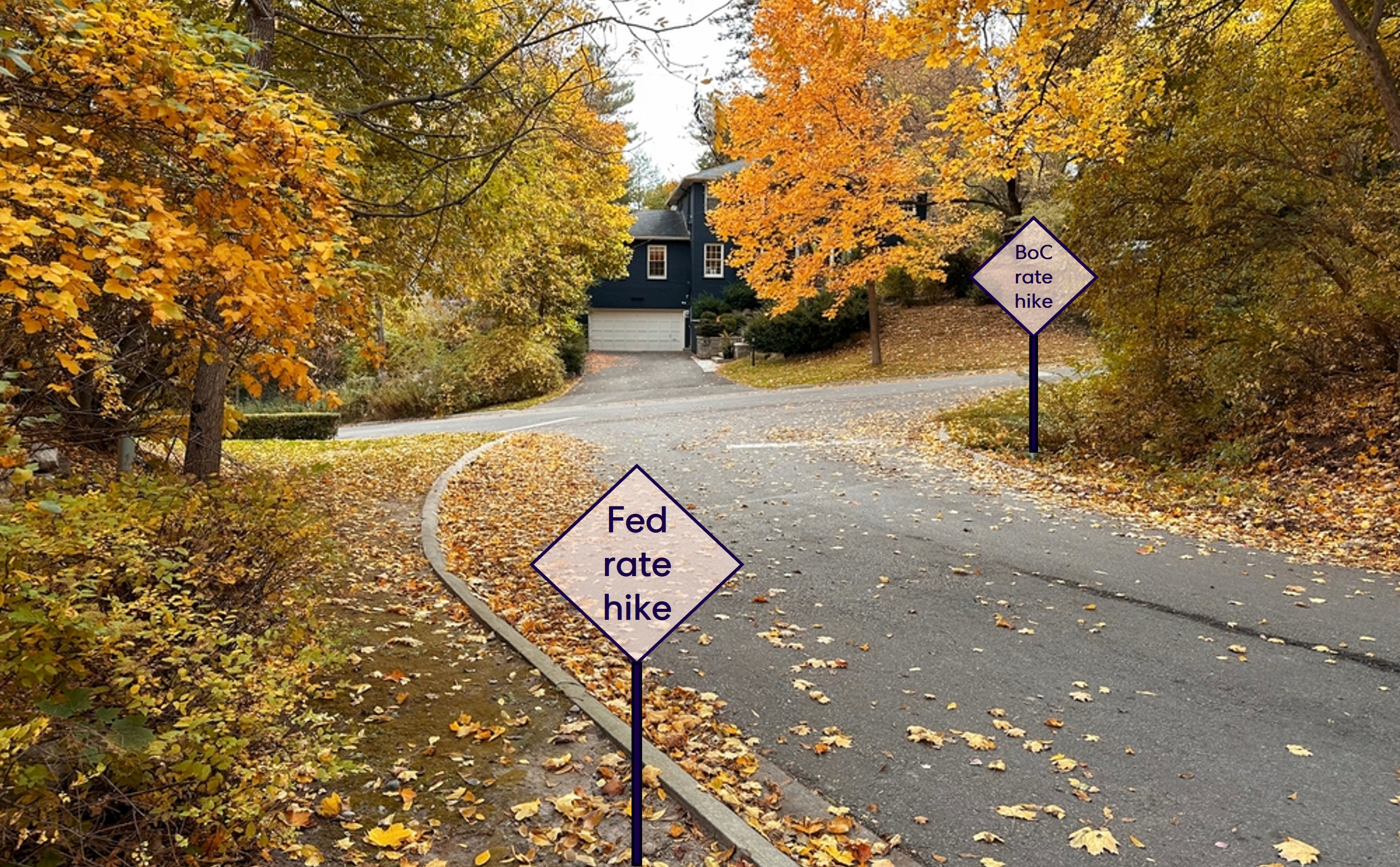
Ask the mortgage expert: What a U.S. Fed rate hike could imply for Canadian mortgage rates
An analysis of U.S and Canada central bank hiking cycles over 30 years to help you plan and navigate a long-term mortgage strategy.
Does debt affect how much mortgage you qualify for in Canada?
Personal debt shrinks the mortgage you may qualify for—every extra $100 in monthly payments can reduce total loan amount by $15,000–$20,000.

How to secure a mortgage as a single parent
An overview of important considerations when applying for a mortgage as a single parent.

Bank of Canada holds rates at 2.25% amidst tariff uncertainty, persistent energy inflation
BoC overnight lending rates remain unchanged, but higher gas prices, new U.S. tariffs, and a slowing economy could shape what's next for Canadians.
Nearly half of Canadians renewing mortgages spend over 50% of their budget on housing
Canada's mortgage renewal wave has nearly half of homeowners spending 50%+ of monthly outgoings on housing; younger Canadians and newcomers most strained.

Find a better mortgage rate
Ajax Brampton Burlington Calgary Edmonton Guelph Halifax Hamilton Kitchener London Moncton Mississauga Newmarket North York Oakville Oshawa Ottawa Regina Saskatoon Surrey Toronto Vancouver Victoria Windsor Winnipeg
Alberta British Columbia Manitoba New Brunswick Newfoundland and Labrador Nova Scotia Ontario Prince Edward Island Quebec Saskatchewan
Bank of Montreal CIBC MCAP Neo Financial Scotiabank Simplii Financial Tangerine Bank TD Canada Trust True North Mortgage National Bank Royal Bank of Canada Desjardins
6 month fixed closed 6 month fixed open 1 year fixed 1 year variable 1 year fixed open 1 year fixed closed 2 year fixed 3 year fixed 3 year variable 3 year open variable 4 year fixed 5 year fixed 5 year variable 5 year variable open 7 year fixed closed 10 year fixed 10 year fixed closed 15 year fixed 25 year fixed HELOC Renewal Reverse mortgage High ratio mortgage Second mortgages Self-employed Prime rate Bank of Canada