Choose an Insurance Quote
Compare the Best Mortgage Rates in Burlington
The best mortgage rates in Burlington, ON from major banks, credit unions and brokers.
Today's Best Mortgage Rates in Burlington, Ontario
Evaluate Burlington’s best mortgage rates in one place. You can compare the most current mortgage rates and monthly payments from 175+ banks and lenders across Ontario.

Rates are based on an average mortgage of $500,000 and subject to change based on filter criteria.
Lender  | Insured | Insurable | Uninsured |
|---|---|---|---|
 nesto inc. | 3.40%  $2,470.03 / month | 3.50% $2,496.35 / month | 3.45% $2,483.17 / month |
 Mortgage Associates Ontario Inc. | 3.45% $2,483.17 / month | 3.60% $2,522.81 / month | 3.60% $2,522.81 / month |
 Mortgage Alliance | 3.50% $2,496.35 / month | 3.60% $2,522.81 / month | 3.60% $2,522.81 / month |
 Affinity Mortgage Solutions | 3.55% $2,509.57 / month | 3.45% $2,483.17 / month | 3.45% $2,483.17 / month |
 Pineapple Financial Inc – Kinetix Mortgages Team | 3.55% $2,509.57 / month | 3.65% $2,536.10 / month | 3.55% $2,509.57 / month |
 DUCA Financial | 3.89% $2,600.37 / month | 3.89% $2,600.37 / month | 3.89% $2,600.37 / month |
 Dominion Lending Centres | 3.9% $2,603.07 / month | 3.9% $2,603.07 / month | 3.9% $2,603.07 / month |
 Alterna Savings | 3.94% $2,613.86 / month | 3.94% $2,613.86 / month | 3.94% $2,613.86 / month |
 Copperfin Credit Union | 4.04% $2,640.95 / month | 4.04% $2,640.95 / month | 4.04% $2,640.95 / month |
 CIBC | 4.19% $2,681.85 / month | 4.19% $2,681.85 / month | 4.19% $2,681.85 / month |
 Healthcare and Municipal Employees' Credit Union | 4.19% $2,681.85 / month | 4.19% $2,681.85 / month | 4.19% $2,681.85 / month |
 Bayview Financial Services | 4.29% $2,709.29 / month | 4.29% $2,709.29 / month | 4.29% $2,709.29 / month |
 First National Financial | 4.3% $2,712.04 / month | 4.3% $2,712.04 / month | 4.3% $2,712.04 / month |
 Ganaraska Credit Union | 4.49% $2,764.59 / month | 4.49% $2,764.59 / month | 4.49% $2,764.59 / month |
 CMLS | 6.99% $3,498.99 / month | 6.99% $3,498.99 / month | 6.99% $3,498.99 / month |

Written By Lubna Umar
How much down payment do you need to buy a home in Burlington?
Burlington's higher home prices can push the minimum down payment well above the standard 5% often associated with buying a home. Using a $1,050,887 Burlington home as an example, a buyer would need approximately $80,089 for the minimum down payment. This price is close to the average selling price in Burlington in July 2026.
Under Canadian minimum down payment requirements, buyers put down 5% on the first $500,000 and 10% on the portion above $500,000.
Minimum down payment calculation: $25,000 on the first $500,000 + $55,089 on the remaining $550,887 = $80,089.
Down payment options on a $1,050,887 Burlington home
| Down payment option | Down payment amount | Mortgage amount* | Mortgage default insurance |
|---|---|---|---|
| Minimum required (~7.6%) | $80,089 | $970,798 | Required |
| 10% | $105,089 | $945,798 | Required |
| 20% | $210,177 | $840,710 | Not required |
*Mortgage amount shown before any mortgage default insurance premium is added.
A Burlington buyer putting down less than 20% will typically need mortgage default insurance. This coverage protects the lender if the borrower is unable to repay the mortgage, and the premium can usually be added to the mortgage balance.
For a Burlington home at this price, the gap between the minimum and a 20% down payment is substantial. Putting down 20% requires an additional $130,089 upfront, but reduces the mortgage before insurance from $970,798 to $840,710 and removes the need for mortgage default insurance.
Read more: How much down payment do I need?
What should you know before getting a mortgage in Burlington?
Your down payment is only one part of the upfront cost of buying a home in Burlington. Buyers should also plan for land transfer tax, legal expenses and other closing costs that are generally due around the time the purchase closes.
- Land transfer tax: Burlington buyers pay Ontario's provincial land transfer tax. Unlike buyers in Toronto, they do not pay an additional municipal land transfer tax, which can make this particular closing cost lower on a similarly priced home.
- Legal fees: A residential purchase will typically involve legal costs of around $1,500–$2,500.
- Home inspection: An inspection may cost approximately $400–$600, depending on the property and the scope of the inspection.
- Title insurance: Buyers may pay roughly $250–$400, depending on the property and type of coverage.
- Mortgage default insurance: If you put down less than 20%, mortgage default insurance will generally be required. CMHC mortgage loan insurance allows eligible buyers to purchase a home with a smaller down payment.
Estimated Ontario land transfer tax on a $1,050,887 Burlington home
| Purchase price portion | Rate | Estimated tax |
|---|---|---|
| First $55,000 | 0.5% | $275 |
| $55,000–$250,000 | 1.0% | $1,950 |
| $250,000–$400,000 | 1.5% | $2,250 |
| $400,000–$1,050,887 | 2.0% | $13,018 |
| Total estimated land transfer tax | $17,493 |
On a $1,050,887 Burlington home, the estimated Ontario land transfer tax would be approximately $17,493. Because Burlington is outside the City of Toronto, there is no second municipal land transfer tax added to this amount.
Qualifying first-time homebuyers may receive an Ontario land transfer tax refund of up to $4,000. If eligible for the full refund, the estimated tax on this Burlington example would fall from $17,493 to $13,493.
Read more: Mortgage Guide: Land Transfer Tax
Compare fixed and variable mortgage rates by term in Burlington
Compare fixed and variable mortgage rates in Burlington across different terms using the Rates.ca Rate Matrix. See how rates vary by mortgage type, term and loan-to-value ratio to find an option that fits your needs.

Rates are based on an average mortgage of $500,000 and subject to change based on filter criteria.
Updated 00:09 on Oct 27, 2026| Placeholder | Insured The rates in this column apply to borrowers who have purchased mortgage default insurance. This is required when you purchase a home with less than a 20% down payment. The home must be owner-occupied and the amortization must be 25 years or less. | 80% LTV The rates in this column apply to mortgage amounts between 65.01% and 80% of the property value. The home must be owner-occupied and have an amortization of 25 years or less. You must have purchased it for less than $1 million. These rates are not available on refinances. Refinances require "Uninsured" rates. | 65% LTV The rates in this column apply to mortgage amounts that are 65% of the property value or less. The home must be owner-occupied and have an amortization of 25 years or less. You must have purchased it for less than $1 million. These rates are not available on refinances. Refinances require "Uninsured" rates. | Uninsured The rates in this column apply to purchases over $1 million, refinances and amortizations over 25 years. More info on the differences between insured and uninsured rates. | Bank Rate Bank Rate is the mortgage interest rate posted by the big banks in Canada. |
|---|---|---|---|---|---|
| 1-year fixed rate | 4.99% | 4.59% | 4.59% | 4.99% | 4.99%  |
| 2-years fixed rate | 3.99% | 4.14% | 4.14% | 4.44% | 4.53%  |
| 3-years fixed rate | 3.86% | 3.79% | 3.79% | 3.90% | 4.39% |
| 4-years fixed rate | 4.19% | 4.09% | 4.09% | 4.39% | 4.44% |
| 5-years fixed rate | 3.69% | 3.94% | 3.69% | 3.69% | 4.19% |
| 7-years fixed rate | 4.89% | 4.89% | 4.89% | 4.89% | 5.00%  |
| 10-years fixed rate | 5.24% | 5.24% | 5.24% | 5.24% | 6.09% |
| 3-years variable rate | 3.90% | 4.05% | 3.90% | 3.90% | 5.95%  |
| 5-years variable rate | 3.45% | 3.54% | 3.50% | 3.50% | 4.24%  |
| HELOC rate | N/A | N/A | N/A | N/A | N/A |
| Stress Test | 5.45% | 5.45% | 5.45% | 5.50% | N/A |
Should you choose a fixed or variable mortgage rate?
A fixed-rate mortgage keeps the same interest rate for the length of your term. A variable-rate mortgage changes when your lender's prime rate changes. Fixed gives you payment certainty. Variable can start lower, but your costs can rise.
The Bank of Canada's policy rate is 2.25%, unchanged at its September 2, 2026 announcement. Lenders use their prime rate, currently 4.45% at major banks, as the benchmark for variable-rate mortgages. Your actual rate is set as a discount or premium to prime, so it won't match the Bank of Canada rate. The next announcement is scheduled for October 28, 2026 and could affect prime and variable mortgage pricing.
For example, using the lowest 5-year insured rates in the Rate Matrix above:
| Comparison | Fixed mortgage | Variable mortgage |
|---|---|---|
| Starting mortgage rate | 3.69% | 3.45% |
| How the rate is set | Locked in when you sign | Prime (4.45%) minus 1.00% |
| What happens if the Bank of Canada raises rates? | Fixed rate stays at 3.69% for the term | Variable rate may increase |
| What happens if the Bank of Canada lowers rates? | Fixed rate stays at 3.69% for the term | Variable rate may decrease |
Rate change example
What if rates rise by 0.50%?
If the Bank of Canada raised its policy rate by 0.50 percentage points and lenders raised prime by the same amount, prime would go from 4.45% to 4.95%. A variable rate set at prime minus 1.00% would rise from 3.45% to about 3.95%.
The example below assumes a variable-rate mortgage with payments that adjust when the interest rate changes. With a fixed-payment variable mortgage, a rate increase may instead mean more of your payment goes toward interest and less toward paying down your mortgage.
On a $500,000 mortgage with a 25-year amortization, that is roughly $2,483 per month at 3.45% and $2,617 per month at 3.95%, about $134 more each month. The 3.69% fixed rate would stay at about $2,547 per month.
The variable-rate borrower could pay more if rates rise, but could also save money if rates stay low or fall. Fixed rates don't change during the term, but you may face a different rate at renewal.
Which one suits you?
- Fixed may suit you if you want predictable payments and have a tight monthly budget.
- Variable may suit you if you can handle payment changes and want to benefit if rates fall.
Learn more: Fixed vs. variable mortgages. Compare today's 5-year fixed and 5-year variable rates.
This example is for illustration only. Payments are estimates. Mortgage rates vary by lender, borrower, mortgage type and eligibility.
What happens when you renew your mortgage in Burlington?
When your Burlington mortgage reaches the end of its term, you don't have to simply accept the renewal offered by your existing lender. This is an opportunity to review your rate, mortgage features and whether your current lender still fits your needs.
Your main options are to:
- Renew with your existing lender — you can review the renewal offer and try to negotiate a lower rate or different terms.
- Move your mortgage to another lender — comparing competing offers may help you find a different rate, prepayment privileges or mortgage features.
- Make changes to your mortgage — depending on your circumstances, you may want to change your payment schedule, amortization or other terms.
It can be useful to start comparing mortgage rates before your Burlington renewal date rather than waiting until the term expires. Giving yourself more time lets you compare lenders and use competing offers when negotiating with your current provider.
If you have an eligible uninsured mortgage, an uninsured straight switch to another federally regulated lender does not require OSFI's prescribed minimum qualifying rate, as long as you don't increase the remaining amortization period or mortgage amount.
Renewal can also be a useful time to reassess the equity in your Burlington property. If you're planning to refinance rather than complete a straight renewal, your lender may use the home's current appraised value to determine how much equity may be available, rather than relying on what you originally paid for the property.
Read more: Mortgage Renewal Guide
How does mortgage refinancing work in Burlington?
Burlington homeowners may choose to refinance their mortgage to access built-up equity, consolidate higher-interest debt, pay for renovations or change their mortgage terms. Refinancing replaces your current mortgage with a new one and can allow you to borrow against your property's current value.
In Canada, homeowners can generally refinance up to 80% of the home's appraised value, subject to lender qualification requirements. The difference between that limit and your outstanding mortgage balance helps determine how much additional borrowing may be available. Learn more about loan-to-value (LTV) and how it affects refinancing.
Because refinancing is different from simply renewing your mortgage, you'll generally need to requalify. Your lender may also request a new appraisal to establish the current value of your Burlington property.
How much equity could you access from a Burlington home?
Using a Burlington home valued at $1,050,887 as an example, 80% of the property's value is approximately $840,710. The amount potentially available to refinance depends on how much of your existing mortgage is still outstanding.
| Example | Amount |
|---|---|
| Current home value | $1,050,887 |
| 80% of home value | $840,710 |
| Existing mortgage balance | $600,000 |
| Potential additional borrowing | Up to $240,710 |
In this scenario, a Burlington homeowner who still owes $600,000 could potentially have room for up to $240,710 in additional borrowing. This is only an illustration: the amount available will depend on the home's appraised value, your remaining mortgage balance, income, debts, credit profile and lender requirements.
Thinking about refinancing your Burlington home? Compare mortgage rates in Burlington to see what options are available.
Read more: Mortgage Refinancing Guide
What Burlington-specific rules and costs affect your mortgage?
A few local and provincial rules shape how much you can borrow, what you pay at closing and whether a home can help carry its own costs. These are the four that matter most for Burlington buyers.
- Your property tax bill counts toward your housing costs. The City of Burlington collects property tax for three payees: the City, Halton Region and Ontario's education system. According to the City, your bill is your property's assessment multiplied by the rates each of them sets. Lenders include property taxes when they calculate your housing costs, so a higher bill can reduce the mortgage you qualify for. Ask for the home's most recent tax bill when you make an offer.
- There is no municipal land transfer tax. Burlington buyers pay only Ontario's provincial land transfer tax. The additional municipal tax applies in Toronto. First-time buyers may qualify for a refund of up to $4,000.
- The $1.5 million cap matters for larger homes. Mortgage default insurance is only available on homes priced under the $1.5 million insured mortgage cap. At $1.5 million or more, you need at least 20% down.
- You may be able to add rental units. Burlington's zoning allows up to three additional residential units (ARUs) on an eligible urban residential lot, on top of the main home. Examples include basement apartments, garage conversions and coach houses. Not every property qualifies, so the City recommends starting with its pre-building approval application and ARU look-up tool. You need a building permit, and parking rules apply: none for the first ARU and one space for each second or third unit. Detached ARUs may also carry Education Development Charges set by the school boards. Some lenders count part of the rental income when you apply, but policies vary, so ask yours before you build.
The City's ARU incentive program closed on October 1, 2025, and its municipal fee waivers ended on December 31, 2025.
Mortgage Calculators

Home Closing Cost Calculator

Home Sale Proceeds Calculator
Mortgage Payment Calculator

Mortgage Renewal Calculator

Mortgage Affordability Calculator

Mortgage Stress Test Calculator

Mortgage Insurance Calculator
Land Transfer Tax Calculator

Lubna Umar,
Lubna Umar is a former SEO Content Manager at Rates.ca. She has produced a wide variety of content, including academic essays, pieces of fiction and financial literacy guides. In her free time, she can be found exploring the caf culture in Toronto or any other major city.
Latest mortgage articles:
How much down payment do I need for my mortgage?
Homebuyers often assume “bigger is better” for a down payment. But buyers should balance between having savings left vs. high monthly payments.

What is mortgage insurance in Canada?
Mortgage insurance is mandatory in Canada if your down payment is under 20%. Here's what it costs, who qualifies, and how to lower your premium.

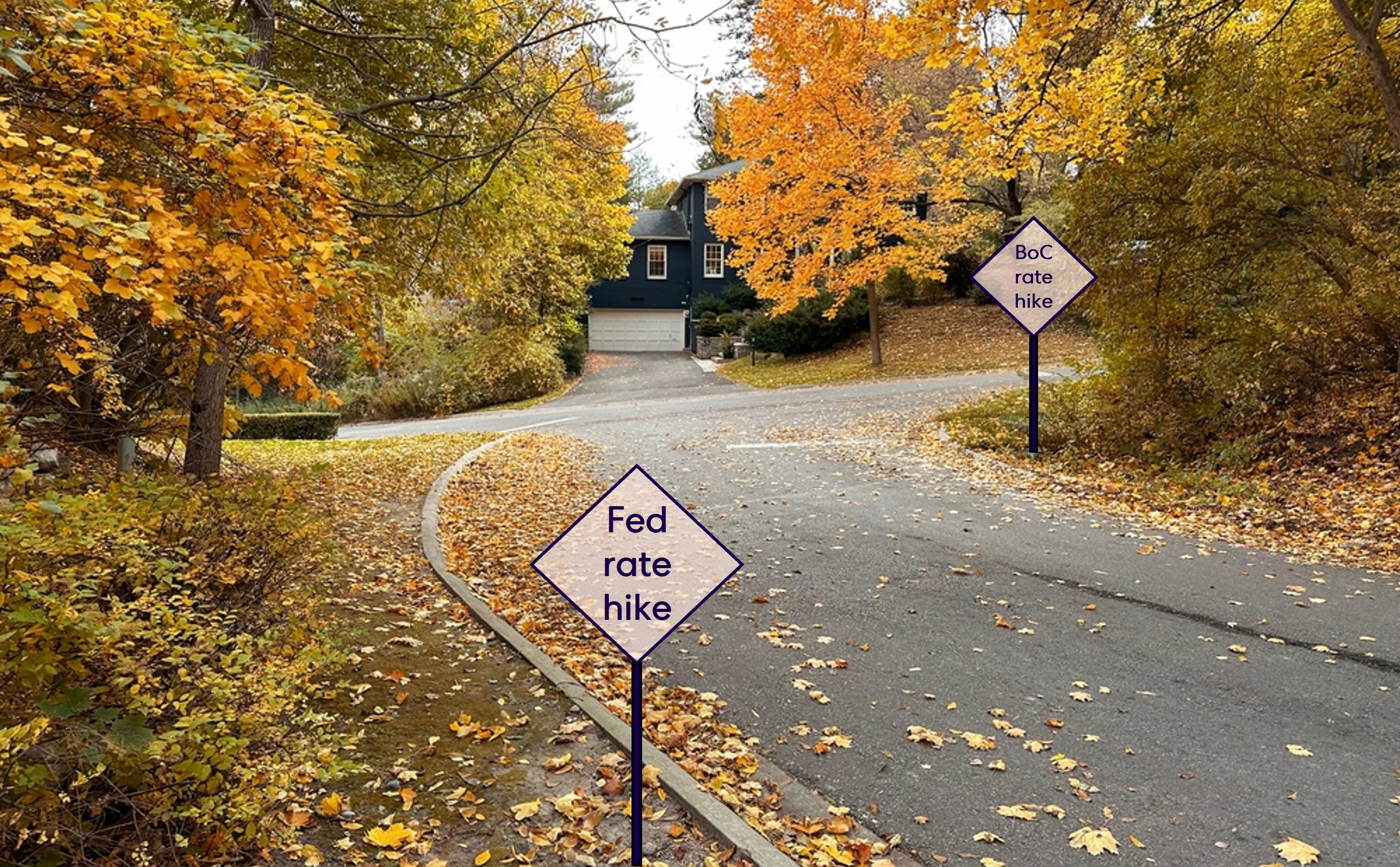
Ask the mortgage expert: What a U.S. Fed rate hike could imply for Canadian mortgage rates
An analysis of U.S and Canada central bank hiking cycles over 30 years to help you plan and navigate a long-term mortgage strategy.
Does debt affect how much mortgage you qualify for in Canada?
Personal debt shrinks the mortgage you may qualify for—every extra $100 in monthly payments can reduce total loan amount by $15,000–$20,000.

How to secure a mortgage as a single parent
An overview of important considerations when applying for a mortgage as a single parent.

Bank of Canada holds rates at 2.25% amidst tariff uncertainty, persistent energy inflation
BoC overnight lending rates remain unchanged, but higher gas prices, new U.S. tariffs, and a slowing economy could shape what's next for Canadians.
Find a better mortgage rate
Ajax Brampton Burlington Calgary Edmonton Guelph Halifax Hamilton Kitchener London Moncton Mississauga Newmarket North York Oakville Oshawa Ottawa Regina Saskatoon Surrey Toronto Vancouver Victoria Windsor Winnipeg
Alberta British Columbia Manitoba New Brunswick Newfoundland and Labrador Nova Scotia Ontario Prince Edward Island Quebec Saskatchewan
Bank of Montreal CIBC MCAP Neo Financial Scotiabank Simplii Financial Tangerine Bank TD Canada Trust True North Mortgage National Bank Royal Bank of Canada Desjardins
6 month fixed closed 6 month fixed open 1 year fixed 1 year variable 1 year fixed open 1 year fixed closed 2 year fixed 3 year fixed 3 year variable 3 year open variable 4 year fixed 5 year fixed 5 year variable 5 year variable open 7 year fixed closed 10 year fixed 10 year fixed closed 15 year fixed 25 year fixed HELOC Renewal Reverse mortgage High ratio mortgage Second mortgages Self-employed Prime rate Bank of Canada