Choose an Insurance Quote
The Best Current Newmarket Mortgage Rates in Canada
Get 20+ mortgage quotes from top banks and lenders.
Today's Best Mortgage Rates in Newmarket, Ontario
Evaluate Newmarket’s best mortgage rates in one place. You can compare the most current mortgage rates and monthly payments from 175+ banks and lenders across Ontario.

Rates are based on an average mortgage of $500,000 and subject to change based on filter criteria.
Lender  | Insured | Insurable | Uninsured |
|---|---|---|---|
 nesto inc. | 3.40%  $2,470.03 / month | 3.50% $2,496.35 / month | 3.45% $2,483.17 / month |
 Mortgage Associates Ontario Inc. | 3.45% $2,483.17 / month | 3.60% $2,522.81 / month | 3.60% $2,522.81 / month |
 Mortgage Alliance | 3.50% $2,496.35 / month | 3.60% $2,522.81 / month | 3.60% $2,522.81 / month |
 Morra | Mortgage Architects | 3.54% $2,506.92 / month | 3.78% $2,570.81 / month | 3.78% $2,570.81 / month |
 Juno Mortgages | 3.55% $2,509.57 / month | 3.60% $2,522.81 / month | 3.55% $2,509.57 / month |
 Pineapple Financial Inc – Kinetix Mortgages Team | 3.55% $2,509.57 / month | 3.65% $2,536.10 / month | 3.55% $2,509.57 / month |
 Centum Financial Services LP | 3.80% $2,576.17 / month | 3.80% $2,576.17 / month | 3.70% $2,549.42 / month |
 Dominion Lending Centres | 3.9% $2,603.07 / month | 3.9% $2,603.07 / month | 3.9% $2,603.07 / month |
 Alterna Savings | 3.94% $2,613.86 / month | 3.94% $2,613.86 / month | 3.94% $2,613.86 / month |
 Copperfin Credit Union | 4.04% $2,640.95 / month | 4.04% $2,640.95 / month | 4.04% $2,640.95 / month |
 CIBC | 4.19% $2,681.85 / month | 4.19% $2,681.85 / month | 4.19% $2,681.85 / month |
 Bayview Financial Services | 4.29% $2,709.29 / month | 4.29% $2,709.29 / month | 4.29% $2,709.29 / month |
 CMLS | 6.99% $3,498.99 / month | 6.99% $3,498.99 / month | 6.99% $3,498.99 / month |

Written By Shivani Kaul
Content manager
How much down payment do you need to buy a home in Newmarket?
Using a $1,072,683 home in Newmarket as an example, you would need a minimum down payment of approximately $82,268. This is close to the average selling price in Newmarket in May 2026.
For homes priced below $1.5 million, the minimum down payment is 5% on the first $500,000 and 10% on any portion above $500,000. Homes priced at $1.5 million or more require a minimum down payment of 20%.
Minimum down payment calculation: $25,000 on the first $500,000 + approximately $57,268 on the remaining $572,683 = approximately $82,268.
Down payment options on a $1,072,683 Newmarket home
| Down payment option | Down payment amount | Mortgage amount* | Mortgage default insurance |
|---|---|---|---|
| Minimum required (~7.7%) | $82,268 | $990,415 | Required |
| 10% | $107,268 | $965,415 | Required |
| 20% | $214,537 | $858,146 | Not required |
*Mortgage amount shown before any mortgage default insurance premium is added. Figures are rounded to the nearest dollar.
Because the example home is below $1.5 million, a Newmarket buyer may qualify for an insured mortgage with less than 20% down, subject to lender and mortgage insurer requirements. Buyers putting down less than 20% will generally need mortgage default insurance.
Putting 20% down on this Newmarket home would require about $132,269 more upfront than the minimum down payment, but would reduce the mortgage before insurance from about $990,415 to $858,146.
Read more: How much down payment do I need?
What should you know before getting a mortgage in Newmarket?
Your down payment isn't the only upfront cost to plan for when buying a home in Newmarket. You'll also need to budget for closing costs, which are generally paid separately from your mortgage at or before closing.
- Land transfer tax: Newmarket buyers pay Ontario's provincial land transfer tax based on the home's purchase price. Unlike Toronto, Newmarket does not have an additional municipal land transfer tax.
- Legal fees: These cover the legal work involved in transferring ownership, reviewing documents and registering your mortgage.
- Home inspection: An inspection can help identify potential problems with the property before you complete the purchase.
- Title insurance: This can protect you and your lender against certain title-related risks, such as title defects or fraud.
- Mortgage default insurance and tax: If your down payment is less than 20%, you’ll generally need mortgage default insurance. The premium can usually be added to your mortgage, but Ontario’s 8% sales tax on the premium must be paid upfront as part of your closing costs. CMHC’s mortgage insurance guidance confirms that provincial sales tax cannot be added to the mortgage.
Estimated Ontario land transfer tax on a $1,072,683 Newmarket home
| Purchase price portion | Rate | Tax |
|---|---|---|
| First $55,000 | 0.5% | $275 |
| $55,000–$250,000 | 1.0% | $1,950 |
| $250,000–$400,000 | 1.5% | $2,250 |
| $400,000–$1,072,683 | 2.0% | $13,454 |
| Total | Approx. $17,929 |
Ontario's land transfer tax rates increase as the purchase price moves through different tax brackets. On a $1,072,683 Newmarket home, the estimated provincial land transfer tax would be approximately $17,929.
If you're an eligible first-time homebuyer, Ontario offers a land transfer tax refund of up to $4,000. In this example, the maximum refund could reduce the estimated land transfer tax from about $17,929 to $13,929.
Read more: How much down payment do I need?
Should you choose a fixed or variable mortgage rate?
A fixed-rate mortgage keeps the same interest rate for the length of your term. A variable-rate mortgage changes when your lender's prime rate changes. Fixed gives you payment certainty. Variable can start lower, but your costs can rise.
The Bank of Canada's policy rate is 2.50%, after a 25 basis point increase at its October 28, 2026 announcement. It was the first rate hike since 2023, following seven consecutive holds at 2.25%. Lenders use their prime rate as the benchmark for variable-rate mortgages, and the major banks raised prime from 4.45% to 4.70% effective October 29. Your actual rate is set as a discount or premium to prime, so it won't match the Bank of Canada rate. The next announcement is scheduled for December 9, 2026, and the Bank has left the door open to further increases.
For example, using the lowest 5-year insured rates in the Rate Matrix above:
| Comparison | Fixed mortgage | Variable mortgage |
|---|---|---|
| Starting mortgage rate | 3.69% | 3.45% |
| How the rate is set | Locked in when you sign | Prime (4.70%) minus 1.25% |
| What happens if the Bank of Canada raises rates? | Fixed rate stays at 3.69% for the term | Variable rate may increase |
| What happens if the Bank of Canada lowers rates? | Fixed rate stays at 3.69% for the term | Variable rate may decrease |
Rate change example
What if rates rise by 0.50%?
If the Bank of Canada raised its policy rate by 0.50 percentage points and lenders raised prime by the same amount, prime would go from 4.70% to 5.20%. A variable rate set at prime minus 1.25% would rise from 3.45% to about 3.95%.
The example below assumes a variable-rate mortgage with payments that adjust when the interest rate changes. With a fixed-payment variable mortgage, a rate increase may instead mean more of your payment goes toward interest and less toward paying down your mortgage.
On a $500,000 mortgage with a 25-year amortization, that is roughly $2,483 per month at 3.45% and $2,617 per month at 3.95%, about $134 more each month. The 3.69% fixed rate would stay at about $2,547 per month.
The variable-rate borrower could pay more if rates rise, but could also save money if rates stay low or fall. Fixed rates don't change during the term, but you may face a different rate at renewal.
Which one suits you?
- Fixed may suit you if you want predictable payments and have a tight monthly budget.
- Variable may suit you if you can handle payment changes and want to benefit if rates fall.
Learn more: Fixed vs. variable mortgages. Compare today's 5-year fixed and 5-year variable rates.
This example is for illustration only. Payments are estimates. Mortgage rates vary by lender, borrower, mortgage type and eligibility.
Compare fixed and variable mortgage rates by term in Newmarket
Compare fixed and variable mortgage rates in Newmarket across different terms using the Rates.ca Rate Matrix. See how rates vary by mortgage type, term and loan-to-value ratio to find an option that fits your needs.

Rates are based on an average mortgage of $500,000 and subject to change based on filter criteria.
Updated 09:47 on Nov 11, 2026| Placeholder | Insured The rates in this column apply to borrowers who have purchased mortgage default insurance. This is required when you purchase a home with less than a 20% down payment. The home must be owner-occupied and the amortization must be 25 years or less. | 80% LTV The rates in this column apply to mortgage amounts between 65.01% and 80% of the property value. The home must be owner-occupied and have an amortization of 25 years or less. You must have purchased it for less than $1 million. These rates are not available on refinances. Refinances require "Uninsured" rates. | 65% LTV The rates in this column apply to mortgage amounts that are 65% of the property value or less. The home must be owner-occupied and have an amortization of 25 years or less. You must have purchased it for less than $1 million. These rates are not available on refinances. Refinances require "Uninsured" rates. | Uninsured The rates in this column apply to purchases over $1 million, refinances and amortizations over 25 years. More info on the differences between insured and uninsured rates. | Bank Rate Bank Rate is the mortgage interest rate posted by the big banks in Canada. |
|---|---|---|---|---|---|
| 1-year fixed rate | 4.99% | 4.59% | 4.59% | 4.99% | 4.99%  |
| 2-years fixed rate | 3.99% | 4.14% | 4.14% | 4.44% | 4.53%  |
| 3-years fixed rate | 3.86% | 3.79% | 3.79% | 3.90% | 4.39% |
| 4-years fixed rate | 4.19% | 4.09% | 4.09% | 4.39% | 4.44% |
| 5-years fixed rate | 3.69% | 3.94% | 3.69% | 3.69% | 4.19% |
| 7-years fixed rate | 4.89% | 4.89% | 4.89% | 4.89% | 5.00%  |
| 10-years fixed rate | 5.24% | 5.24% | 5.24% | 5.24% | 6.09% |
| 3-years variable rate | 3.90% | 4.05% | 3.90% | 3.90% | 5.95%  |
| 5-years variable rate | 3.45% | 3.54% | 3.50% | 3.50% | 4.24%  |
| HELOC rate | N/A | N/A | N/A | N/A | N/A |
| Stress Test | 5.45% | 5.45% | 5.45% | 5.50% | N/A |
What happens when you renew your mortgage in Newmarket?
When your mortgage term comes to an end, you don't have to automatically accept your lender's renewal offer. You can compare your options and decide whether to stay with your current lender, switch to another lender or make changes to your mortgage.
- Renew with your current lender — review the rate and terms you're being offered and consider negotiating before accepting.
- Switch lenders — compare mortgage rates, features and potential fees to see whether another lender offers a better fit.
- Change your mortgage — you may want to adjust your payment frequency, amortization or other mortgage features depending on your financial goals.
If your Newmarket mortgage is approaching renewal, it can help to start comparing rates before the term ends. That gives you time to review your lender's offer and see how it compares with other options.
Switching lenders at renewal does not always require the prescribed mortgage stress test. For eligible uninsured mortgages, OSFI’s straight-switch exemption applies to transfers between federally regulated lenders when the mortgage balance and remaining amortization are not increased. The receiving lender must still review your financial situation before approving the transfer.
If you're thinking about refinancing instead of completing a straight renewal, your home's current value will matter. Property values can change over the course of a mortgage term, so your lender may use a new appraisal or valuation to determine how much equity you have available.
Read more: Mortgage Renewal Guide
How does mortgage refinancing work in Newmarket?
Mortgage refinancing replaces your existing mortgage with a new one. Homeowners may refinance to access equity, consolidate debt, pay for renovations or change their mortgage terms.
In Canada, homeowners can generally refinance up to 80% of their home's appraised value, subject to lender qualification requirements. Your available equity will depend on your home's current value and how much you still owe on your mortgage. Learn more about how loan-to-value (LTV) affects refinancing.
Refinancing is different from a straight mortgage renewal because it can increase the amount you owe. You'll generally need to requalify for the new mortgage, and your lender may require an updated appraisal or property valuation.
How much equity could you access from a Newmarket home?
Using a Newmarket home valued at $1,072,683 as an example, 80% of the property's value would be approximately $858,146.
| Example | Amount |
|---|---|
| Current home value | $1,072,683 |
| 80% of home value | $858,146 |
| Existing mortgage balance | $500,000 |
| Potential additional borrowing | Up to approximately $358,146 |
With a home valued at $1,072,683 and a $500,000 mortgage balance, this example leaves approximately $358,146 in potential additional borrowing before costs, assuming there are no other debts secured against the property. Mortgage prepayment penalties, legal fees, appraisal costs and other refinancing charges would reduce the amount available to use.
Approval depends on your income, debts, credit profile and the property value accepted by your lender. The Financial Consumer Agency of Canada explains how borrowing against home equity works and which costs to consider.
Considering refinancing? Compare mortgage rates in Newmarket to see what rates are available.
Read more: Mortgage Refinancing Guide
Frequently asked questions about mortgages in Newmarket, Ontario
Find answers to all your Newmarket mortgage rate questions here...

How can I find the best mortgage rate for my Newmarket home?
Start by comparing mortgage offers that match your purchase price, down payment and preferred term. The lowest advertised rate is only useful if you qualify for it and the mortgage conditions fit your plans.
Use the Rates.ca Rate Matrix to compare Newmarket mortgage rates, then review fees, prepayment options and early repayment penalties. When you find an offer that interests you, confirm your eligibility and request a personalized quote.
Will I qualify for the lowest advertised mortgage rate?
Not necessarily. Your eligibility depends on the offer’s conditions and the lender’s assessment of your income, debts, credit history and property. Some advertised rates apply only to particular mortgage types or borrowing situations.
When requesting a quote, specify whether you are buying, renewing or refinancing, and provide your expected mortgage amount. This helps identify offers that apply to you. FCAC explains how lenders determine your mortgage interest rate.
What information should I have ready when comparing mortgage offers?
For an initial comparison, have an estimate of your property’s purchase price or current value, your down payment or remaining mortgage balance, and your expected purchase or renewal date. Consider which mortgage term and rate type you prefer.
For a personalized assessment, a lender or broker may also ask about your income, employment, debts and credit history. You do not need to upload every document just to review advertised rates, but preparing your mortgage application documents can help you move forward once you find a suitable offer.
Can I compare mortgage rates before making an offer on a Newmarket home?
Yes. You can compare advertised rates while you are still house hunting. Use an estimated purchase price and down payment to explore your options, then ask a lender or broker about preapproval when you are ready for a borrowing assessment.
Preapproval can help estimate your borrowing limit and may include a rate hold. It does not guarantee financing for a specific property. Before making an offer, confirm your preapproval conditions and rate-hold expiry date with your lender.

Shivani Kaul, Content manager
Shivani is a Content Manager at Rates.ca, focusing on mortgages. She is an experienced communication and marketing professional who specializes in content strategy and SEO optimization. Shivani ensures that our written materials meet the highest standards of quality and relevance.
She holds a Digital Marketing Management certificate from the University of Toronto, a Business Communications certificate from the University of British Columbia, a Masters degree in Mass Communication from Symbiosis Institute of Media and Communications and a Bachelor's degree in English from the University of Delhi.
Shivani has previously worked as a deputy digital productions editor with PMNA-The Canadian Press, and as an editor with The Globe and Mail, Toronto Star, and the Investor's Digest of Canada. She has also worked in reputed news media groups in India and the Middle East.
Mortgage Calculators

Home Closing Cost Calculator

Home Sale Proceeds Calculator
Mortgage Payment Calculator

Mortgage Renewal Calculator

Mortgage Affordability Calculator

Mortgage Stress Test Calculator

Mortgage Insurance Calculator
Land Transfer Tax Calculator
Latest mortgage articles:
How interest rate changes affect your variable rate mortgage
Variable-rate mortgages align with Bank of Canada’s policy rate. Interest rates changes have far-reaching implications for mortgage loan borrowers.
Are private mortgages a viable option as Bank of Canada turns hawkish?
Borrowing privately to buy a home should be a temporary option as interest rates can be as high as 20% in a market largely unregulated and opaque.

Persistent energy inflation, market signals drive Bank of Canada policy rate hike to 2.50%
The Bank of Canada raises key rate 25 bps to 2.50% on Oct. 28, ending seven straight holds as energy inflation persists and bond yields climb.

How much down payment do I need for my mortgage?
Homebuyers often assume “bigger is better” for a down payment. But buyers should balance between having savings left vs. high monthly payments.

What is mortgage insurance in Canada?
Mortgage insurance is mandatory in Canada if your down payment is under 20%. Here's what it costs, who qualifies, and how to lower your premium.

Ask the mortgage expert: What a U.S. Fed rate hike could imply for Canadian mortgage rates
An analysis of U.S and Canada central bank hiking cycles over 30 years to help you plan and navigate a long-term mortgage strategy.
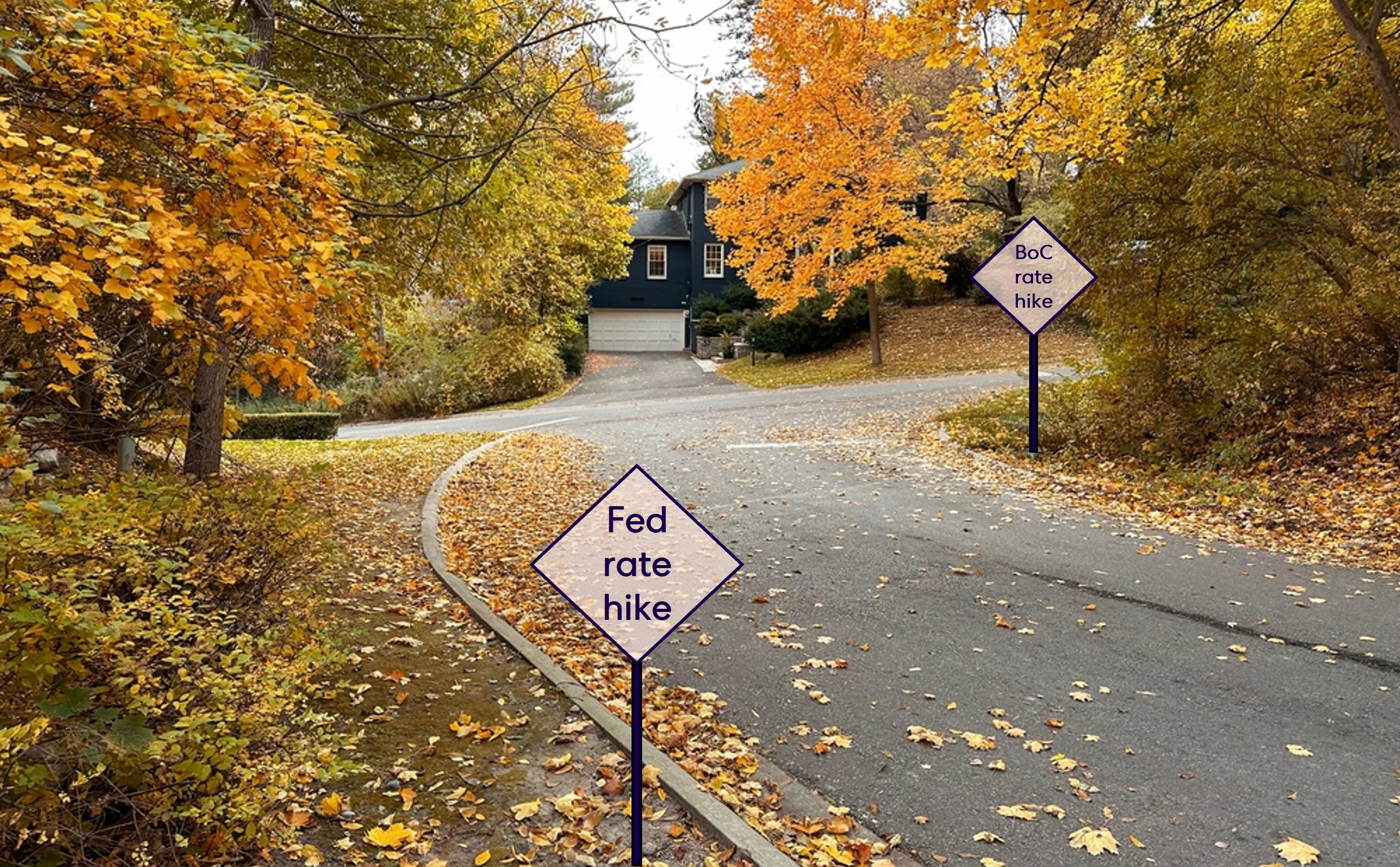
Find a better mortgage rate
Ajax Brampton Burlington Calgary Edmonton Guelph Halifax Hamilton Kitchener London Moncton Mississauga Newmarket North York Oakville Oshawa Ottawa Regina Saskatoon Surrey Toronto Vancouver Victoria Windsor Winnipeg
Alberta British Columbia Manitoba New Brunswick Newfoundland and Labrador Nova Scotia Ontario Prince Edward Island Quebec Saskatchewan
Bank of Montreal CIBC MCAP Neo Financial Scotiabank Simplii Financial Tangerine Bank TD Canada Trust True North Mortgage National Bank Royal Bank of Canada Desjardins
6 month fixed closed 6 month fixed open 1 year fixed 1 year variable 1 year fixed open 1 year fixed closed 2 year fixed 3 year fixed 3 year variable 3 year open variable 4 year fixed 5 year fixed 5 year variable 5 year variable open 7 year fixed closed 10 year fixed 10 year fixed closed 15 year fixed 25 year fixed HELOC Renewal Reverse mortgage High ratio mortgage Second mortgages Self-employed Prime rate Bank of Canada