Choose an Insurance Quote
How much more does premium cost than regular gasoline?

Premium gasoline presently costs nearly 30 cents more than the regular variety, based on average retail prices in Canada. That’s slightly higher than the year-to-date average difference of 28 cents, which has held fairly steady through 2026.
The wholesale price spread between the two gasoline grades typically ranges from 8–14 cents/litre. Gas stations charge the remaining markup for retail buyers.
Premium vs. regular gasoline prices across car segments
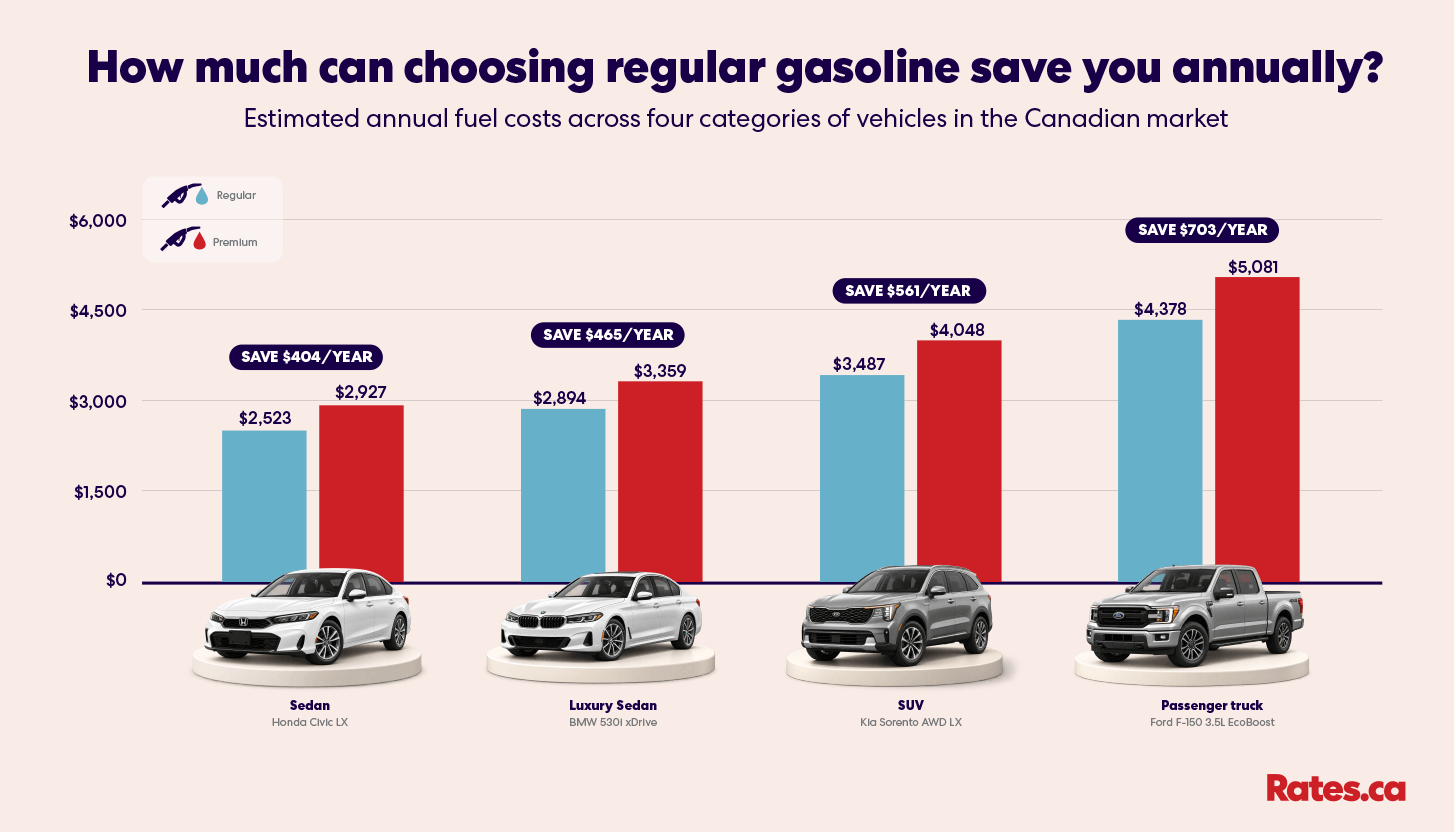
Source: Natural Resources Canada; gas prices as of Sep. 8, 2026; Rates.ca calculations based on 20,000 km of annual driving; AI-generated infographic
Patrick De Haan, head of petroleum analysis at GasBuddy notes that rising costs of premium fuel has been driven by more demand now than 10 to 20 years ago.
For an F150 3.5L EcoBoost V6 driver, with city and highway combined consumption at 11.8 litres/100 km, clocking 20,000 km per year could cost around $5,080 using premium gasoline. At today’s prices, a switch to the regular option would translate to savings just over $700 annually.
Your Kia Sorento LX AWD with estimated combined consumption of 9.4 litres/100 km could cost you $4,050 yearly if you choose to fill up with premium fuel. You’d save $560 annually using regular grade.
Driving a BMW 5 Series 2.0L AWD that consumes on average 7.8 litres/100 km costs nearly $3,360/year if you use only a premium brand. A switch to regular gasoline would translate to about $465 in savings per year.
A Honda Civic LX driver enjoys an extra $400 in savings per year consuming 6.8 litres/100 km of regular versus a top grade of gas.
Estimated gasoline costs for 20,000 km/year
| Category | Vehicle | Regular $1.855/litre | Premium $2.153/litre | Annual saving estimates using regular grade |
|---|---|---|---|---|
| Sedan | Honda Civic LX | $2,523 | $2,927 | $404 |
| Luxury Sedan | BMW 530i xDrive | $2,894 | $3,359 | $465 |
| SUV | Kia Sorento AWD LX | $3,487 | $4,048 | $560 |
| Truck | F-150 3.5L EcoBoost | $4,378 | $5,081 | $703 |
Source: Rates.ca calculations based on 20,000 km of annual driving and average Canadian fuel prices as of Sep. 8, 2026.
What is premium gasoline?
The amount of octane content in gasoline that helps reduce ‘knocking’ or uncontrolled combustion of fuel before a vehicle’s spark plug fires determines its grade. A higher octane rating aligns with more resistance to knocking and better engine performance. In Canada, regular gasoline is rated at 87 Anti-Knock Index (AKI), mid-grade at 89 AKI, and premium at 91–93 AKI.
Do benefits of premium gasoline outweigh the costs?
You can justify using more expensive premium gasoline over regular fuel if your vehicle’s manual specifically mentions that a higher grade is required. Premium fuel benefits high-performance or turbo-charged engines designed to use higher octane gas. For vehicles that require premium gasoline, a lower octane content fuel could result in engine knocking, damage, and warranty issues.
If your car manufacturer ‘recommends’ better quality fuel, chances are the engine won’t suffer from using regular unleaded gasoline. Premium gas may improve your engine’s longevity, performance, fuel efficiency, and assist drivers with hauling heavy loads. But if unspecified in your owner’s manual, paying for higher quality fuel doesn’t provide any benefits to your car engine. Under certain conditions and for temporary periods, using premium fuel helps:
- Tow heavy loads
- During extreme summer temperatures
- While driving on rugged uneven terrain
Using the type of fuel best suited for your engine can extract optimum performance while saving you nearly 30 cents/litre at today’s gas prices.
De Haan reiterates importance of paying close attention to manufacturer’s guidance, rather than wasting money on more expensive fuel that an engine isn’t designed to benefit from.
Would using premium fuel over regular gasoline impact my car insurance rate?
No, fuel grade does not impact car insurance rates that are typically driven by your driving record, location, usage, type of vehicle, and your policy coverage selections.
Save on Ontario auto insurance
Auto insurance rates change often, so how do you know if you're still getting the best deal? By comparing car insurance quotes upon renewal and at other key milestones (such as when you buy a new vehicle, or more to a different neighbourhood) you can make sure your rates remain competitive. Save money by comparing Ontario car insurance quotes today.

Joan Pinto
Joan Pinto, Managing Editor
Joan Pinto is a Managing Editor at Rates.ca. She is a seasoned publisher with over 15 years of experience managing and developing multi-asset financial markets content across platforms at leading Canadian banks. As a financial research analyst with a cross-asset strategy team, she specialized in energy markets. She also worked as a journalist/regional editor covering the volatile global environmental policy landscape for three years.
Featured Topics
How 'Dieselgate', stricter emissions rules, and changing economics reshaped Canada's passenger vehicle market away from diesel.
CEO of Rates.ca, Igal Mayer explains how Covid-era price increases reshaped the auto market and what could bring costs down for consumers.
Canada's mortgage renewal wave has nearly half of homeowners spending 50%+ of monthly outgoings on housing; younger Canadians and newcomers most strained.

With only 13% of Canadians open to buying autonomous vehicles, experts expect adoption to begin through ride-hailing services before widespread ownership.

As extreme weather intensifies, resilient Canadian homes sell for more: upgrades can add up to 5.6% to resale prices, yet many listings don’t mention them.

After a sluggish 2025, EV interest in Canada is climbing again: searches are up 40%, and nearly one‑third of Canadians say they’re open to buying an electric vehicle.

In Toronto, auto insurance eats up 70% of total insurance costs, compared to 60% in Ottawa and 65% in Hamilton.

Ontario households spent $14K–$21K on auto and home insurance in four years, city by city. 75% of insured households saw premium hikes in the past two years.

Despite recent interest rate cuts, 35% of Canadians now see condos as a poor investment, but they remain a key entry point for young and first-time buyers.