Choose an Insurance Quote



KEY FINDINGS
- Gas vehicles remain the cheapest option upfront. In three of four vehicle categories analyzed, gasoline models posted lowest total cost of ownership after one year, despite EVs offering significantly lower charging costs.
- Low electricity rates make EVs cheapest vehicles to fuel/charge. Based on Ontario electricity rates, annual EV charging costs were just 14% to 18% of comparable gasoline fuel costs, while hybrids were cheaper to refuel than gas vehicles in every segment analyzed.
- EVs become more competitive the longer you own them. Despite higher upfront purchase prices, lower EV charging costs narrow their ownership-cost gap over time.
- Ford's F-150 Lightning pricing is competitive. Only EV in dataset that is cheapest from year one, maintaining its advantage over comparable gas and hybrid trucks throughout a five-year analysis.
- Fuel prices alone rarely change buying behaviour. Fuel efficiency typically becomes major purchasing consideration when family fuel spend reaches roughly 2.5% to 3% of household income and elevated prices persist for 6–12 months.
Canada’s car market today offers drivers a choice between models powered by traditional gasoline, newer electric vehicles (EVs), or hybrids—a mix of both fuel sources. Our report showcases how the total cost profile across various vehicle segments changes over time. In reality, when you walk into a car dealership, you’re most likely weighing available options over a wholistic, multi-year timeframe.
In our analysis, we compared gas, hybrid, and EVs across four segments: compact sedan, luxury sedan, midsize SUV, and passenger truck. We tracked ownership cost estimates over one, three, four, and five years, factoring in purchase price, taxes, rebates, insurance, licensing, maintenance, and fuel or charging costs, without more arbitrary depreciation averages, personalized financing and leasing variables, or accounting for geopolitical volatility or inflation in any of the metrics. Please refer to methodology for details on comparative car models we selected to represent each segment.
While EVs generally cost less to charge and maintain, steep purchase price, insurance, and other expenses can outweigh those savings in year one of ownership. By year five, however, the payback profile of EVs catches up with most comparable gas models except SUVs.
Vehicle category | Lowest cost after 1 year | Lowest cost after 5 years |
|---|---|---|
Compact sedan | Gas: Honda Civic LX | Hybrid: Honda Civic Sport HEV 4DR |
Luxury sedan | Gas: BMW 530i xDrive | EV: BMW i5 xDrive40 |
SUV | Gas: Kia Sorento AWD LX | Gas: Kia Sorento AWD LX |
Truck | EV: Ford F‑150 Lightning 4WD | EV: Ford F‑150 Lightning 4WD |
Source: Rates.ca analysis of total ownership costs. Winners are based on lowest cumulative ownership cost after one and five years.
Throughout this report, ‘fuel cost’ refers to estimates of powering a vehicle, whether through gasoline, diesel, electricity—a vehicle’s powertrain, or a combination of gasoline and electricity in a hybrid.
BEYOND THE DATA
Our analysis led us down a few interesting paths. Here are three related articles worth exploring.
- Premium vs. regular gasoline: Are you paying hundreds more a year for fuel your engine doesn't need? With premium gas costing nearly 30 cents more per litre, drivers could save roughly between $400 and $700 annually by using regular fuel where appropriate.
- Diesel phaseout: How 'Dieselgate', stricter emissions rules, and the rise of hybrids pushed diesel from a mainstream choice to a niche option for Canadian drivers.
- Rates.ca CEO Op-ed: Why vehicle prices may finally come down. Rates.ca CEO Igal Mayer explores how supply-chain disruptions, rising vehicle complexity, and changing consumer demand drove prices higher, and why a new generation of affordable vehicles could be on the horizon.
Is purchase price or fuel savings relevant in selecting your car?
At first glance, gasoline cars have the lowest one-year cost of ownership profile in three of four vehicle segments. Gas SUVs can be as much as 52% cheaper in year one of all-in costs compared to EVs.
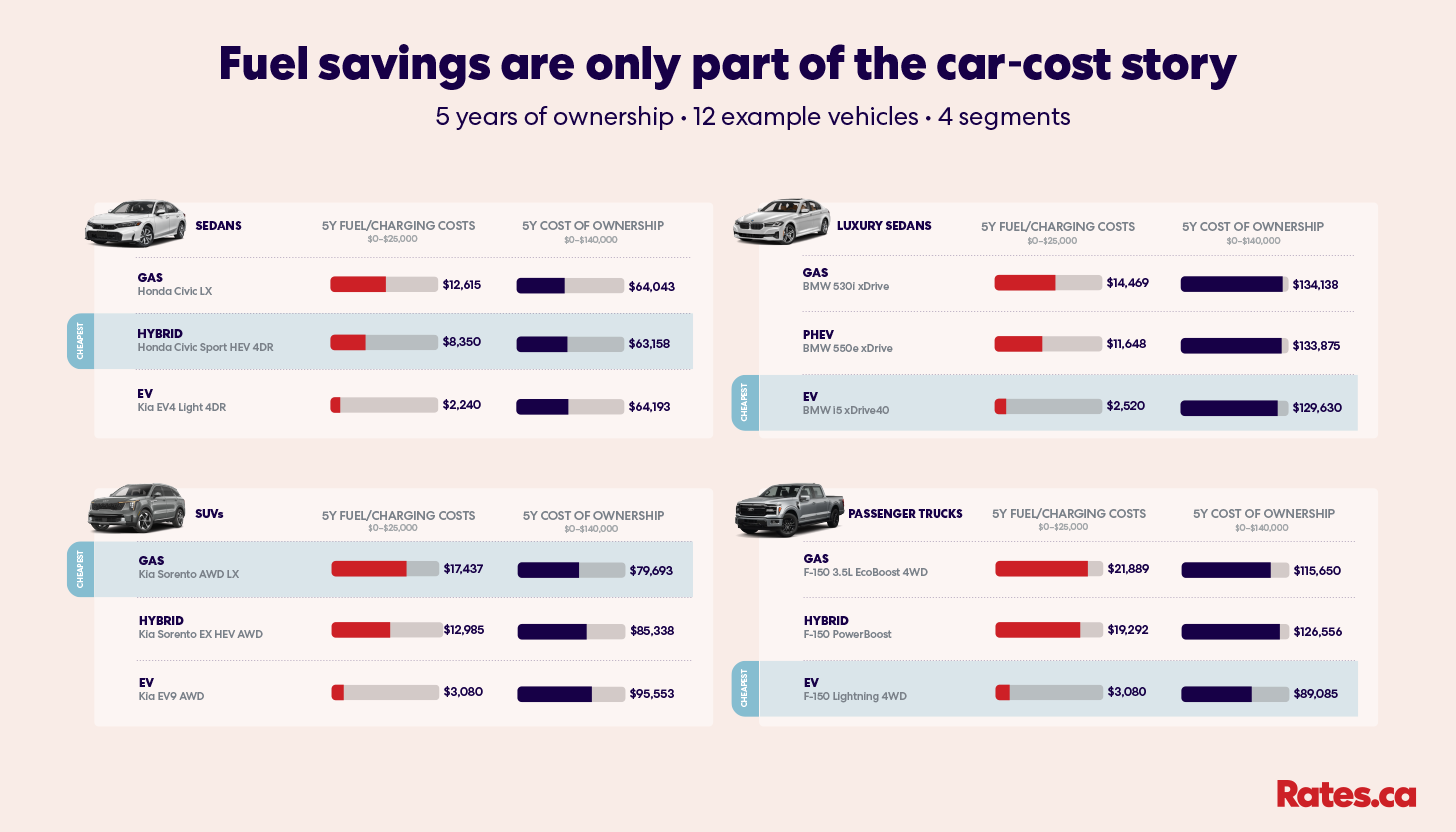
Source: Rates.ca analysis of total ownership costs. Refer to methodology for estimates on purchase price, taxes, rebates, insurance, licensing, maintenance, and fuel or charging costs, Natural Resources Canada; gas prices as of Sep. 8, 2026; Rates.ca calculations based on 20,000 km of annual driving; AI-generated infographic
By year five of lower charging costs that spread narrows to 20%. For sedans, a 21% difference in total ownership cost estimates of gas models versus EVs in year one shrinks to under 1% after five years. In the luxury sedan class, EVs flip from being 7% more expensive than comparable gasoline models to 3% cheaper after five years. In our truck group, the EV advantage over corresponding gas and hybrid options is evident across all years.
Pricing metrics depend heavily on vehicle category and upfront purchase price initially, while charging benefits tend to even out the playing field the longer you own your car.
Category | Type | Fuel/charging cost: 1Y | Fuel/charging cost: 5Y | Total cost of ownership: 1Y | Total cost of ownership: 3Y | Total cost of ownership: 4Y | Total cost of ownership: 5Y | Vehicle model |
|---|---|---|---|---|---|---|---|---|
Sedan | Gas | $2,523 | $12,615 | $38,023 | $51,033 | $57,538 | $64,043 | Honda Civic LX |
Hybrid | $1,670 | $8,350 | $42,782 | $52,970 | $58,064 | $63,158 | Honda Civic Sport HEV 4DR | |
EV | $448 | $2,240 | $46,021 | $57,607 | $60,900 | $64,193 | Kia EV4 Light 4DR | |
Luxury sedan | Gas | $2,894 | $14,469 | $94,834 | $114,486 | $124,312 | $134,138 | BMW 530i xDrive |
PHEV | $2,330 | $11,648 | $102,939 | $118,407 | $126,141 | $133,875 | BMW 550e xDrive | |
EV | $504 | $2,520 | $101,638 | $115,634 | $122,632 | $129,630 | BMW i5 xDrive40 | |
SUV | Gas | $3,487 | $17,437 | $51,237 | $65,465 | $72,579 | $79,693 | Kia Sorento AWD LX |
Hybrid | $2,597 | $12,985 | $55,878 | $71,858 | $78,598 | $85,338 | Kia Sorento EX HEV AWD | |
EV | $616 | $3,080 | $77,913 | $86,733 | $91,143 | $95,553 | Kia EV9 AWD | |
Truck | Gas | $4,378 | $21,889 | $83,090 | $99,370 | $107,510 | $115,650 | F-150 3.5L EcoBoost 4WD |
Hybrid | $3,858 | $19,292 | $92,788 | $109,672 | $118,114 | $126,556 | F-150 PowerBoost 4x4 | |
EV | $616 | $3,080 | $69,261 | $79,173 | $84,129 | $89,085 | F-150 Lightning 4WD |
Key insights from our data set:
- Compact sedan class: Honda Civic's hybrid claims lowest-cost ranking in year five after comparable gas models maintained lead for first four years. Kia’s EV4 nearly closes the gap through lower charging costs by year five, finishing within about $150 of the corresponding gas model.
- Luxury sedan class: Despite a higher upfront price, a BMW i5 EV becomes the cheapest option by year four compared to its gasoline counterpart, and is consistently priced below the brand’s comparable hybrid from year one onwards.
- SUV class: Purchase price outweighs charging savings across all five years; Kia’s EV9 and Sorrento hybrid are both unable to catch up with the cheaper gasoline-powered Sorento.
- Passenger truck class: Ford’s F150 Lightning EV starts out 17% and 25% cheaper than its gasoline and hybrid equivalents, which widens to 23% and 30% of a pricing advantage by year five.
Charging savings help narrow ownership costs, but they don't guarantee lower overall costs. In most cases, purchase price has a greater impact than fuel or charging expenses.
That gap is reflected in Canada's EV market, where affordable mainstream electric options remain limited and many buyers face a significant upfront premium before realizing any savings.
Two of 12 vehicles we analyzed qualified for government incentives: Kia’s EV4 ($5,000) and Sorento Hybrid ($2,500). Even with those rebates, most EV purchase prices remains a big hurdle for buyers. The Ford F-150 Lightning was the lone EV to post the lowest all-in costs despite not qualifying for a rebate, as its price exceeds the federal Electric Vehicle Affordability Program (EVAP) eligibility cap.
Related: Ask an Auto Expert: CarQuestions.ca’s Mark Whinton on the future of EVs
Can taxes and subsidies sway your car purchase decision?
Governments have traditionally used taxes and subsidies as part of nudge policy to encourage behavioural change without the more authoritative approach of mandates and bans. A classic carrot vs. sticks method offers subsidies to incentivize a shift toward certain fuels or class of vehicles. While punitive taxes tend to do the reverse, inducing a broad and gradual move away from certain products.
Gasoline and diesel fuels are subject to federal taxes in Canada and secondary taxes in some provinces.
Since 1995, Canadian drivers pay 10 cents/litre of gasoline and 4 cents/litre on diesel as part of federal excise taxes. Canada temporarily suspended these federal fuel duties in April as Strait of Hormuz blockages affected energy prices globally, sparking inflation concerns.
At the start of September, the government proposed extending tax relief until the end of January 2027. Ottawa’s proposal includes 50% duties reinstated from Feb. 1 to Mar. 31, 2027.
Provincial taxes on all fuel types are unaffected by federal exemptions and as follows:
Province | Gasoline tax | Diesel tax | Hybrid tax | EV tax | Notes |
|---|---|---|---|---|---|
Alberta | 13 cents/litre | 4 cents/litre | None | $200/year | Alberta Energy Rebate program provides tax relief on a graduated scale linked to oil prices. Hybrids exempt from EV tax. |
British Columbia | 7.75 cents/litre (varies by region) | 11.5 cents/litre coloured fuel | None | None | Metro Vancouver adds 18.5 cents/litre TransLink levy; |
Manitoba | 12.5 cents/litre | 12.5 cents/litre | None | None | |
New Brunswick | 15.5 cents/litre | 15.5 cents/litre | None | None | +15% HST applies |
Newfoundland & Labrador | 7.5 cents/litre | 7.5 cents/litre | None | None | Gasoline tax rate cut made permanent April 2026 |
Nova Scotia | 15.5 cents/litre | 15.5 cents/litre | $250 every 2 years | $500 every 2 years | Introduced in 2026–27 budget; both EVs and hybrids subject to biennial fee |
Ontario | 9 cents/litre | 9 cents/litre | None | None | Northern Ontario rate 2.7 cents/litre |
PEI | 8.47 cents/litre | 8.47 cents/litre | None | None | +15% HST applies |
Quebec | 19.2 cents/litre | 19.2 cents/litre | None currently | $125/year (from April 2027) | Montreal adds ~3 cents/litre transit levy; EV fee coming April 2027; hybrid treatment not yet confirmed |
Saskatchewan | 15 cents/litre | 15 cents/litre | None | $300/year | EV road-use charge doubled from $150 to $300 in June 2025; indexed to inflation from Jan. 2027; hybrids exempt from EV tax |
What subsidies and rebates exist in Canada for EVs and hybrid vehicles?
Canada’s carrot approach towards EVs involves a complete exemption of any federal excise fuel taxes. Some provinces as detailed in the table have instituted annual taxes on EVs typically at registration, to maintain provincial highways, given their batteries are heavier than ICE engines. Except for Nova Scotia, most provinces exempt hybrid vehicles from fuel taxes.
As of September 2026, current EV subsidies across Canada are as follows:
Program | EV rebate | Hybrid rebate | Notes |
|---|---|---|---|
Federal | $5,000 | $2,500 | EVAP applied at point of sale; drops to $4,000 Jan. 2027; no purchase price cap for Canadian-made vehicles; $50,000 final transaction value cap for all other vehicles. |
$4,000 | Up to $4,000 | Ends Mar. 31, 2027; rebate is $2,500 for eligible EVs. | |
PEI | $4,000 | Up to $2,000 | Applied at point of sale |
Quebec | $2,000 | $1,000–$2,000 | Roulez Vert program ends Dec. 31, 2026 |
British Columbia | Paused | Paused |
As subsidies begin to wind down across Canada, 2026 remains one of the best years to take advantage of government incentives. Combined federal and provincial rebates continue to encourage adoption of alternative vehicle powertrains.
Which fuels are cheapest for Canadian drivers?
EV fuelling is most economical for drivers across vehicle segments based on Ontario’s blended average electricity rates of 14 cents/kWh. Annual charging costs of EV models in our sample set range between 14% to 18% of comparative gasoline engines.
For example: Filling up a Kia EV4 is estimated to cost you under $450 for a full year, or under 18% of what a comparable Honda Civic owner would pay for regular gasoline priced at $1.855/litre (as of Sep. 8). That’s 27% of an equivalent Honda Civic Sport HEV plug-in hybrid option, making EV4s the cheapest car to fuel in our sample set. However, a steep Manufacturer's Suggested Retail Price (MSRP) price + HST erodes its EV fuel advantage in year one of ownership.
Our research shows hybrids tend to be cheaper to refuel than gasoline cars in every vehicle category. Hybrids use regenerative braking technology: a system that captures energy normally lost when the vehicle slows down and uses it to recharge the car's battery.
Drivers today can price several fuel options into a car purchase decision. Here’s what it costs annually to drive in Ontario across our sample set.
Category | Vehicle | Type | Consumption | At $1.855/litre | At $2.153/litre |
|---|---|---|---|---|---|
Sedan | Honda Civic LX | Gas | 6.8 litres/100 km | $2,523 | $2,927 |
Honda Civic Sport HEV 4DR | Hybrid | 4.5 litres/100 km | $1,670 | $1,938 | |
Kia EV4 Light 4DR | EV | 16 kWh/100 km | $448 | $448 | |
Luxury sedan | BMW 530i xDrive | Gas | 7.8 litres/100 km | $2,894 | $3,359 |
BMW 550e xDrive | PHEV (50/50) | 11.2 litres/100 km + 18 kWh/100 km | $2,330 | $2,663 | |
BMW i5 xDrive40 | EV | 18 kWh/100 km | $504 | $504 | |
SUV | Kia Sorento AWD LX | Gas | 9.4 litres/100 km | $3,487 | $4,048 |
Kia Sorento EX HEV AWD | Hybrid | 7.0 litres/100 km | $2,597 | $3,014 | |
Kia EV9 AWD | EV | 22 kWh/100 km | $616 | $616 | |
Truck | F-150 3.5L EcoBoost 4WD | Gas | 11.8 litres/100 km | $4,378 | $5,081 |
F-150 PowerBoost 4x4 | Hybrid | 10.4 litres/100 km | $3,858 | $4,478 | |
F-150 Lightning 4WD | EV | 22 kWh/100 km | $616 | $616 |
Annual fuel or charging costs are calculated using standard consumption rates for a yearly mileage of 20,000 km and Ontario's blended average electricity rate of 14 cents/kWh. Cheaper electricity rates in Ontario make EV running costs more favourable in the province, compared to Canada’s national average of 16.9 cents/kWh.
Ample hydroelectricity in Quebec lowers EV charging costs to about half of what Ontario drivers pay with 2026 avg. electricity rates about 7.3 cents/kWh. EV drivers in Nova Scotia and PEI pay much higher for charging given their electricity rates average 19 cents/kWh and 19.7 cents/kWh.
Can fuel price volatility change buying behaviour?
No, fuel price volatility alone doesn't change buying behaviour. Canadian pump prices climbed above $1.85 a litre this week. Renewed conflict in the Middle East pushed crude oil back above $100 US a barrel, the latest jolt in a year of fuel-price whiplash.
GasBuddy's head of petroleum analysis, Patrick De Haan, isn't expecting the usual labour day seasonal relief: "We may not see much of that tailwind this year."
De Haan says fuel prices alone rarely determine what consumers buy next. Drawing on past price spikes, he says it often takes six to 12 months of elevated fuel costs before purchasing habits begin to shift.
"It's not the outright price of fuel. It's how much of their income they're spending on filling their tank."
De Haan estimates that fuel efficiency becomes a major purchasing consideration when a family spend on refueling reaches roughly 2.5% to 3% of household income and drivers have endured 6–12 months of elevated gas prices. Below that threshold, higher prices tend to generate frustration more than changes in vehicle-buying behaviour.
The bigger challenge, De Haan says, is uncertainty. Once buyers choose a powertrain, they're exposed to future volatility in the cost of gasoline, diesel, or electricity, all of which can be affected by geopolitical shocks beyond their control.
Read more: Which vehicles are cheapest to insure by fuel type in Canada in 2026?
How your insurer prices risk, not the fuel type you use
According to David Mayer, director and insurance expert at Rates.ca, insurers price risk, not whether a vehicle runs on gasoline, electricity, or a hybrid system.
Vehicle value, repair costs, theft exposure, and claims history often have a greater impact on premiums than the powertrain itself. Gasoline-powered engines carry the highest premiums in sedan and luxury sedan categories, compared to their respective hybrid and EV counterparts. But in the SUV and passenger truck groups, gas engines such as the Kia Sorento and F-150 Ecoboost are cheapest to insure.
Theft can be particularly influential. Although auto theft claims fell last year, losses remain far above historic norms. The Insurance Bureau of Canada reports that theft-related claims costs were 169% higher than a decade ago, continuing to put pressure on premiums and insurer risk calculations.
Mayer says theft is often concentrated in the most popular gasoline-powered versions of a vehicle that are more desirable for export or parts. As a result, diesel, hybrid, and EV variants may not yet generate enough theft or claims data for insurers to price them the same way.
Learn more: What are the top five factors that influence your auto insurance rate?
Can Chinese brands target Canada's affordable EV gap?
Yes, Chinese automakers are positioning themselves to fill the lack of affordable, ‘non-luxury’ EVs—the biggest weakness in the Canadian car market exposed by this analysis. Under Canada's low-tariff import quota, companies such as BYD, Chery, and Geely are expected to bring EVs priced below $35,000, potentially undercutting every EV in our analysis.
For now, however, Chinese-built EVs remain a small part of the Canadian market. Fewer than 16,000 have entered Canada during the first eight months of 2026, less than one-third of the annual quota.
Rates.ca data shows EV quote activity was up at least 21% year over year in every month of 2026 through September, peaking at 69% growth in May.
According to J.D. Power, growing consumer interest in EVs is being supported in part by arrival of more affordable models and expectations that additional lower-cost options are on the horizon. However, Chinese EVs are not eligible for the federal EV rebate program. To succeed, they'll need to compete on price alone.
Read more: Survey: 30% of Canadians interested in EVs, but cost remains a barrier in 2026
Do EVs save you money on maintenance and repairs?
In theory, yes. EVs have far fewer moving parts than combustion vehicles, eliminating routine services such as oil changes while reducing wear on components like brakes through regenerative braking.
Vincentric's 2024 Canadian EV Cost of Ownership analysis found 41 of 50 EVs (82%) had lower five-year maintenance costs than comparable gasoline vehicles, largely because of their simpler mechanical design.
In our analysis, Kia’s EV sedan and SUV posted higher maintenance and repair costs than their gas counterparts. According to Mayer, niche vehicles can face higher repair bills because parts are less readily available, leading to longer repair times and higher labour costs.
What about a car's battery? Costs vary widely by vehicle, replacing an EV battery pack in Canada can run anywhere from roughly $8,000 to $25,000 or more, with larger batteries and premium models typically falling at the upper end of that range.
Available evidence suggests, however, that most owners are unlikely to face a steep EV battery expense during a typical ownership period. Nino Di Cara, founder and president of Electric Autonomy Canada, says most research shows EV batteries "outlast the life of the vehicle" in a vast majority of cases, making a full battery replacement uncommon for most owners.
Related: Are car models made in Canada cheaper and better to insure?
How much does it cost to licence and register your vehicle?
If you’re in Ontario, vehicle registration fees don't vary by powertrain. EVs, hybrids, and gasoline vehicles all pay the same licensing and registration costs, including a $59 licence plate and permit fee when registering a vehicle.
The only notable EV-specific benefit is Ontario's green licence plate program, which grants qualifying battery-electric and plug-in hybrid vehicles access to HOV lanes and provincially operated HOT lanes regardless of occupancy.
Read more: How much does it cost to own a car in Canada?
Which cars depreciate faster?
Depreciation adds another layer of complexity because a vehicle's value ultimately depends on market demand when it's time to sell or trade it in.
According to insurance expert Mayer, EVs are currently depreciating faster than any other powertrain in this comparison, as falling new-EV prices and uncertainty in the used market continue to weigh on resale values. Hybrids tend to land somewhere in the middle, while gasoline vehicles remain the most predictable. Diesel models can hold their value well, Mayer says, but often depreciate sharply once a model is discontinued, and its buyer pool shrinks.
There is no clear depreciation winner. The same forces that make a vehicle attractive today can work against it tomorrow, leaving buyers to base vehicle purchasing decisions on sticker prices, insurance premiums, fuel costs, potential future repairs, and uncertain resale values.
Read next: Is 0% financing a good deal when buying a car?
Methodology
This analysis examines one year of ownership assuming a cash purchase. Total ownership estimates include MSRP plus HST, insurance premiums, licensing and registration fees, estimated costs for maintenance and repair, and annual refueling. Throughout this report, ’fuel costs’ refers to estimates of powering a vehicle, whether through gasoline, diesel, electricity—a vehicle’s powertrain, or a combination of gasoline and electricity in a hybrid.
Annual fuel or charging costs are calculated using standard consumption rates for a yearly mileage of 20,000 km and Ontario's blended average electricity rate of 14 cents/kWh. Auto insurance premiums were calculated using the Rates.ca quoter and reflect a recommended personal-use policy including collision and comprehensive coverage for a 35-year-old male driver with a clean driving record, living in Toronto, who drives approximately 10,000 kilometres annually.
Not every comparison is a perfect nameplate match. In two of the four segments (sedan and SUV), we paired a mainstream gas or hybrid model with the closest available EV in the same class because a direct electric equivalent does not currently exist.
Repair and maintenance costs are calculated using the CAA Driving Costs Calculator. Vehicle licensing and registration costs are one-time fees in Ontario.
Caveats: Financing or leasing charges, depreciation, resale value, fuel-price volatility (long-term), changing insurance record, availability or pricing of replacement parts, and other ownership factors were not included in our analysis as they vary significantly by vehicle, location, driving habits, interest rates, geopolitical inputs, and individual circumstances.
For media inquiries, please contact:
Laura Fitch
Director of Editorial and PR
Rates.ca
Latest home insurance articles:
Shopping for cheaper home insurance isn't tied to a calendar but aligns best with your changing needs and a market that's constantly shifting.

When subletting your rental property remember to inform your insurer. Your subtenant should carry their own insurance policy.

A heavily discounted home with prior flooding seems attractive, but unexpected repair costs can erase savings.

As the real estate market fluctuates, doing minor, strategic renovations may help improve your home equity and offset falling home values.

A comprehensive home insurance policy can help you cover significant repair costs from a water-damaged basement.

How to reduce risk of your car getting caught in an underground parking garage flood and details on your insurance coverage options.