Choose an Insurance Quote
Nearly half of Canadians renewing mortgages spend over 50% of their budget on housing



KEY FINDINGS
- Nearly half of recent mortgage renewals are budget-strained: 45% of Canadians who renewed their mortgage since January 2025 say housing costs now consume half or more of their monthly household budget.
- Borrowing costs rose for the vast majority: interest rates increased for 82% of Canadians whose mortgage rate changed at renewal since January 2025; the most common hike was between 2% and 4.99%.
- Younger homeowners face the heaviest burden. 90% of homeowners aged 18–34 years renewed at a higher rate, and 56% say their mortgage takes up 50–70% of their monthly budget.
- Foreign-born homeowners are disproportionately affected. 56% of foreign-born homeowners say their mortgage accounts for 50–70% of their household budget, compared with 35% of Canadian-born borrowers.
- Renewals expected to shift housing market gradually. Experts say Canada’s mortgage renewal wave could have a gradual impact on the housing market over the next couple of years rather than cause a sudden shift.
Higher mortgage renewal rates at today’s borrowing costs are a strain on Canadian family budgets.
A survey commissioned by Rates.ca and conducted by Leger from July 24 to 26, 2026, finds that borrowing costs increased for 82% of Canadians whose mortgage rate changed at renewal since January 2025. Following renewal, 45% of homeowners say their mortgage now consumes half or more of their household budget. As part of an expected wave of renewals, younger homeowners, lower-income households, and newcomers to Canada are under significant financial pressure.
What mortgage renewal terms are homeowners opting for?
Among homeowners who renewed with a higher or lower fixed-rate mortgage, 40% chose 5-year terms, compared with 35% who opted for 3-year terms. Only 7% locked in for more than five years.
Jenny Tate, an Ontario mortgage agent with Tango, says current pricing helps explain why many borrowers are avoiding longer commitments.
"Three-year fixed rates are currently sitting slightly below 5-year rates, roughly 3.84% versus 4.04% at the competitive end, which tells you the market itself leans toward rates drifting down," she says. "And there's scar tissue. Everyone remembers someone who locked in five years at the peak and regretted it."
Still, she cautions against trying to predict where rates are headed.
"Nobody knows, and anyone who tells you they know where rates will be in 2029 is guessing with confidence. The right term is about your buffer, not your forecast. If a one-point increase at your next renewal would break you, you shouldn't be making rate bets at all."
Rob Gill of Rob Gill Realty Group views the preference for shorter terms as a sign of caution.
"Instead of locking in a high rate for a long time, they [borrowers] may be hoping for lower rates later," he says. Mortgage renewal choices are evidence that homeowners are being cautious and uncertain about where the housing market is heading.
"Many call us for advice before deciding to get our professional input," he notes.
Preference for mortgage terms varied depending on the profile of borrowers:
| Canadian homeowner group* | Fixed-rate Mortgage term choice |
|---|---|
| Aged 18 to 34 years | 13% chose mortgage terms >5 years |
| Aged 35 to 54 years | 1% chose mortgage terms >5 years |
| Born outside Canada | 15% chose mortgage terms <3 years |
| Born in Canada | 7% chose mortgage terms <3 years |
Source: 2026 Rates.ca–Leger Survey. *whose fixed rate changed at renewal since Jan. 2025
The 2026 Rates.ca–Leger survey results suggest that while most Canadians are sticking with traditional 3- and 5-year terms, some younger borrowers and newcomers are taking different approaches as they navigate a more uncertain rate environment.
Homeowners who have renewed since January 2025 include:
| Canadian homeowner group* | Share who renewed since Jan. 2025* |
|---|---|
| Under 55 years | 29% |
| 55 years and older | 9% |
| Born outside Canada | 28% |
| Born in Canada | 19% |
| Households earning <$100,000 | 17% |
| Households earning >$100,000 | 32% |
Source: 2026 Rates.ca–Leger Survey. *whose rate changed at renewal since Jan. 2025
Not every borrower faced a higher rate. From those surveyed, who renewed mortgages since January 2025 with a different rate, 13% negotiated lower rates. These borrowers were likely locked in at 6% or higher during the 2023–24 rate-cycle peak.
"It's not luck versus bad luck. It's almost entirely about which year you signed," Tate says.
Read more: What's the difference between a deposit and a down payment on a house?
Have monthly payments increased for Canadian families after mortgage renewals?
Borrowing costs have increased for eight in 10 Canadians renewing their mortgage at a different variable or fixed rate since January 2025. Many homeowners who locked in rates below 2% in 2020 to 2021 are now renewing loans above 4%. Based on CMHC data, the implied effective annual rate is 4.33% for Q4 2025, the latest quarterly information available, given 25-year amortization and bi-annual compounding.
For example: A homeowner with a $500,000 mortgage at a 1.99% loan rate would have paid about $2,115/month. Five years later, their mortgage balance would be roughly $418,000. Renewing at 4.29% would push their monthly payments to about $2,594, which equates to an increase of $479/month, or roughly $5,748/year.
Victor Tran, Rates.ca mortgage and real estate expert says a mortgage payment increase after renewal is tangible for most borrowers. "On average, I've been seeing payments increase by roughly $200 to $600 per month depending on the balance and remaining amortization," he says. "Of course, the larger the mortgage, the higher the increase."
"My rough rule of thumb: every percentage point costs you around $50 a month for every $100,000 you still owe," says Tango mortgage agent Tate.
The 2026 Rates.ca–Leger survey finds that 24% of Canadians renewed their mortgage since January 2025. Of the 21% who renewed, at a different rate, 82% say their borrowing costs have risen.
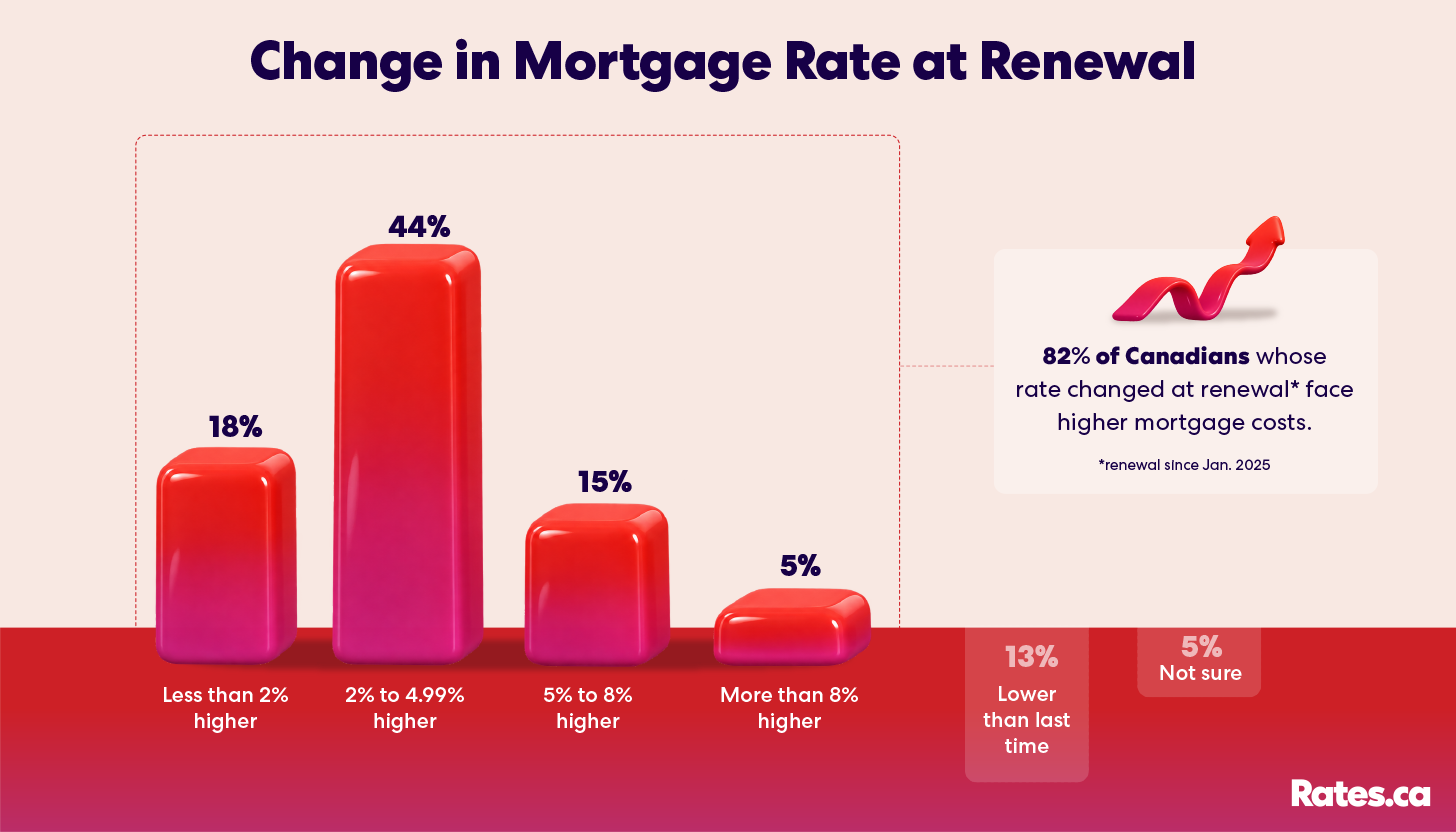
Source: 2026 Rates.ca–Leger survey. AI-generated infographic
A Bank of Canada (BoC) staff analytical note published July 2025 projected payments would rise by an average of about 20% for borrowers with 5-year fixed-rate mortgages renewing in 2026. These renewals account for roughly 40% of all mortgages in Canada.
BoC's May 2026 Financial Stability Report (FSR) showed that most 5-year fixed-term borrowers who renewed over the last year experienced projected increases. Over the next 12 months, the Bank expects 12% of all outstanding mortgage renewals to face average payment increases of about 15%.
"Can households absorb it? Most can, technically everyone who got these mortgages was stress-tested at roughly two points above their contract rate, and mortgage arrears in Canada remain low," Tate says.
"But 'absorb' is doing a lot of work in that sentence. It's not missed payments. It's the vacation that doesn't happen, the RESP contribution that gets skipped, the emergency fund that quietly stops growing. The damage shows up in savings rates, not default rates."
Gill says higher mortgage costs are affecting housing decisions of many Canadians. Delaying a move because a new mortgage would cost much more each month, staying in their current homes longer than planned, or choosing to downsize are strategies families are using to lower their housing costs.
For some borrowers, financial pressure has prompted unexpected family support. "I have heard of homeowners receiving early inheritance from parents to help with finances," Tran says.
Read next: How much mortgage can the median household income afford in these cities?
How much of family budgets go towards mortgage payments after renewal?
The 2026 Rates.ca–Leger survey shows that after renewal, 40% of Canadians say their mortgage now takes up between 50% and 70% of their monthly family budget. For another 5%, home loan payments consume more than 70% of household monthly outgoings. After renewal, 47% of homeowners say their mortgage payments account for less than half of monthly household expenses.
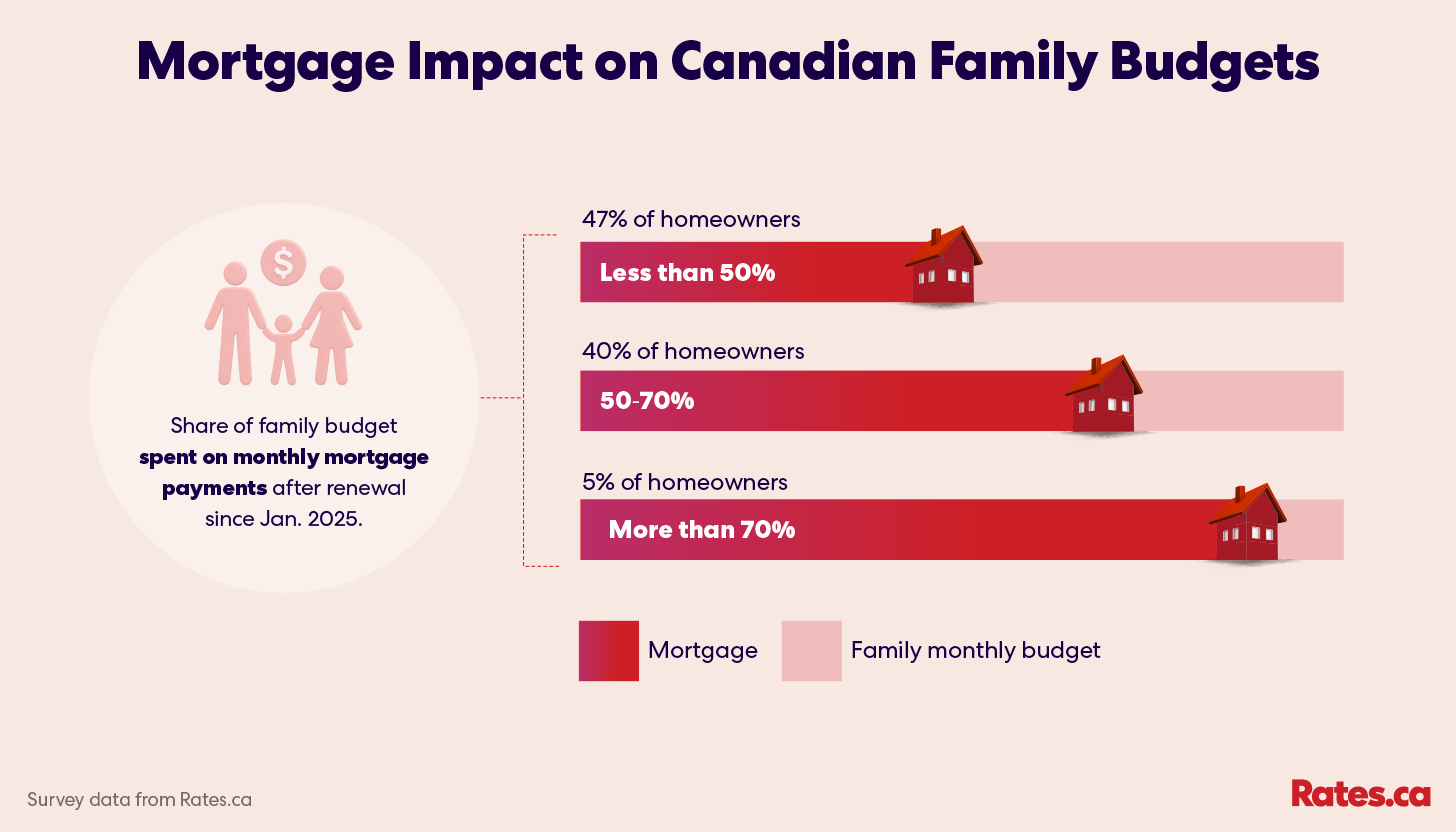
Source: 2026 Rates.ca–Leger survey. AI-generated infographic
Tate says lenders generally require borrowers to qualify with housing costs below 39% of gross annual income.
"Everything else has to fit in what's left: food, transit or a car, insurance, retirement savings, and any kind of emergency cushion," she says.
"In practice, the first thing to disappear is savings, then the buffer, then flexibility—one transmission repair or one vet bill lands on a credit card. There's a career cost too that nobody measures: at that ratio you can't take risks, can't leave a bad job, can't survive a two-month gap between roles."
In the housing market, Gill is noticing, more recently, a growing number of clients downsizing if payments become too difficult to manage.
Which group of homeowners renewing mortgages face the heaviest financial burden?
Younger homeowners were more likely than older borrowers to face higher rates after renewal and devote a larger share of their budget to mortgage payments.
| Canadian homeowner group | Renewed at higher rate | Mortgage payment takes 50–70% of monthly budget | Renewed at a lower rate |
|---|---|---|---|
| 18–34 years | 90% | 56% | 5% |
| 35+ years* | 77% | 29% for 35–54 years 32% for 55+ years | 18% |
| Born outside Canada | 85% | 56% | 12% |
| Born in Canada | 81% | 35% | 13% |
Source: 2026 Rates.ca–Leger Survey, 2026. *Source data does not break down the 35+ years bracket in each dataset.
Six per cent of young Canadians say their mortgage consumes more than 70% of their budget, compared with 4% of borrowers between 35–54 years, and 2% of those above 55 years or above.
"It's timing, not approval. Lenders don't price your renewal based on your age, and renewing with your existing lender typically doesn't even require requalifying," Tate says.
"What age actually tells you is when someone bought and how much they still owe. Younger owners disproportionately bought in 2020–21 at record-low rates with big balances—so they're renewing up, and on a large amount of principal, which makes every point hurt."
Older owners either bought long ago at comparatively higher rates or renewed mid-cycle at 5 or 6%, and are now renewing at lower rates with smaller balances. As a result, their renewal rate matters less, Tate says.
"A rate jump on $150,000 remaining is annoying. The same jump on $450,000 is a budget event. That's the entire generational divide in one sentence."
Gill says older homeowners are often in a different financial position than recent buyers.
"Older homeowners often bought their homes years ago at lower prices and have built up more equity or paid off more of their mortgage," he says.
Read more: The hidden costs of home buying
How varied is mortgage affordability by income after renewal?
Income makes a significant difference in families managing housing costs, especially after recent mortgage renewal.
Among households earning $100,000 or more, who renewed their mortgage since January 2025, 61% say their mortgage takes up less than half of their monthly budget after renewal. By comparison, 54% of households earning between $60,000 and $100,000 say their mortgage consumes between 50% and 70% of their budget.
Low-income households face the greatest strain. Eight per cent of homeowners earning less than $60,000, who renewed their mortgage since January 2025, say more than 70% of their budget goes toward mortgage payments.
Gill says higher borrowing costs are also changing what many middle-income households can afford. "We are noticing more middle-income households are looking for more affordable options, such as smaller homes, condos, or properties farther from major cities," he says.
"Higher mortgage payments are causing some buyers to adjust their plans and focus on homes that better fit their budgets."
For homeowners struggling to make higher payments work within their existing budget, there may be ways to reduce the impact of renewal.
"Don't just sign the renewal letter your lender mails you. Shop the renewal, ask about extending amortization to lower payments, and start that conversation 120 days out," Tango’s Tate says.
"The difference between the letter and a negotiated rate is often the difference between 70% of your budget and something you can actually live with."
BoC’s 2026 FSR shows about 10% of borrowers who held a mortgage in 2022 have refinanced, and roughly 70% of those borrowers extended their amortization by an average of six years.
The Bank also estimates that about half of borrowers facing higher payments could offset those increases entirely by extending their amortization by five years.
Gill believes that homeowners who have built up equity or had incomes rise will be able to absorb higher mortgage payments.
The FSR also notes that average household disposable income grew by about 16% between 2021 and 2025, which should help many borrowers manage higher payments.
However, the Bank cautions that income gains have not been evenly distributed. Some highly indebted households have little savings or financial flexibility to deal with unexpected expenses.
What to expect with mortgage renewals over the next year
The Bank of Canada estimated that roughly 60% of all outstanding mortgages are up for renewal across 2025 and 2026, and a big chunk of that is back-loaded, Tate says, expecting an ongoing wave. “The people who bought at the absolute bottom of rates in 2021 are the ones renewing right now and into next year."
Gill likewise believes the industry remains in early stages of the renewal cycle because many homeowners who locked in ultra-low rates in 2020 and 2021 have yet to refinance, expecting higher payments.
In the 2026 Rates.ca–Leger survey, 69% of respondents either don't have a mortgage or haven't renewed since January 2025.
"That number looks dramatic, but most of it is just the calendar," she says. "Mortgages renew on a schedule, not on vibes. If you signed a 5-year term in 2021 or 2022, your renewal date is late 2026 or 2027 whether you like it or not."
But some prospective first-time buyers may also be delaying their home purchase.
"Asking rents have fallen for over 20 straight months nationally, down about 4.3% year-over-year (YoY), while home prices have mostly flattened rather than dropped," she says.
"For a lot of would-be first-time buyers, renting and waiting is not an unreasonable math decision right now."
Learn more: Bank of Canada holds at 2.25% amid oil-price uncertainty and weak growth
Will households face higher mortgage payments in 2027?
Not every homeowner renewing mortgages through to the end of 2027 is expected to face higher payments.
Projections based on CMHC Ontario mortgage data, assuming the BoC overnight rate remains unchanged from fourth-quarter 2025 levels, suggest the impact of renewal will depend heavily on when a borrower originally took out their mortgage.
Homeowners with renewals in Q4 2026 coming off of 5-year variable rates of 1.89% annualized at the end of 2021 are expected to experience an 8.8% increase in monthly payments.
Conversely, new mortgage monthly payments after renewal in Q4 2026 are anticipated to drop 20.8% for the 3-year fixed rate cohort who had locked in 6.17% annualized implied effective borrowing rates in Q4 2023.
In Q2 2027, those homeowners renewing 5-year variable rates of 2.59% annualized secured in Q2 2022 could face a much smaller increase in monthly mortgage outgoings of 2.1%.
Meanwhile, monthly payments are likely to fall 17.3% for the 3-year term group of borrowers paying 5.66% annualized interest since Q2 2024.
By the end of 2027, both 3-year and 5-year borrowers from the last quarter of 2024 and 2022 could pay 12.7% and 17.3% less in monthly mortgage costs, provided all else stays equal.
These projections suggest renewal outcomes will vary based on when borrowers locked in their original mortgage rate.
Read more: Does renewing your mortgage early save you money?
Are Canadians actually falling behind on their mortgages?
Mortgage delinquencies are rising in Canada, but they remain low by historical standards.
According to the Canadian Bankers Association, 14,061 bank mortgages were at least 90 days past due in May 2026, the highest number in more than a decade.
Even so, the national arrears rate remains below 0.3%, meaning more than 99% of mortgage holders are still in good standing.
According to TransUnion, the national mortgage delinquency rate for mortgages that were 90 or more days past due reached 0.19% in the first quarter of 2026, up from 0.16% a year earlier.
Equifax note a similar trend. The credit bureau reported that the national 90-plus-day mortgage delinquency rate was 0.22% in the first quarter of 2026, while noting that financial pressure remains concentrated in certain parts of the country.
According to Equifax, mortgage delinquencies rose 52% YoY in Ontario and 36% in British Columbia. TransUnion also reported that mortgage delinquency rates were rising in Ontario and Prince Edward Island, while several Prairie and Atlantic provinces show declines.
Overall, more Canadians are falling behind on their mortgages than they were a year ago, but delinquency rates remain relatively low. The greatest pressure is concentrated in specific regions rather than across the mortgage market as a whole.
How are higher mortgage rates impacting Canada's housing market?
Higher mortgage costs are changing how Canadians make housing decisions. Gill says some homeowners are delaying moves because a new mortgage would significantly increase their monthly payments. Others are staying in their current homes longer than planned or downsizing to reduce costs.
"Higher housing costs are also pushing some buyers to look farther from major cities, where homes are more affordable. This is helping drive demand in suburban and more distant communities as people search for lower-cost options," he adds.
When payments become harder to manage, homeowners are taking a range of approaches. Gill says many are refinancing, drawing on home equity, postponing renovations, staying in their homes longer, downsizing, selling or finding ways to earn additional income from their property.
Despite the pressure, Gill does not foresee a sudden correction. "The mortgage renewal wave is more likely to have a gradual impact on the housing market over the next couple of years than cause a sudden shift," he says.
Many homeowners have built enough equity or seen income growth to absorb higher payments without being forced to sell—a buffer that has so far held the market together.
CMHC's Spring 2026 Residential Mortgage Industry Report supports that view. Residential mortgage debt crossed the $2.4 trillion mark in December 2025, up 4.8% YoY. National 90-plus-day delinquency rates reached 0.24% in Q4 2025, up from 0.21% the prior year, with increases concentrated heavily in Ontario and most acutely in the Toronto Census Metropolitan Area, where delinquencies climbed roughly 45% YoY.
BoC’s FSR expects the Covid-era mortgage renewal wave to be largely complete by the second half of 2027, when nearly all borrowers facing significant payment increases will have renewed.
But BoC's Deputy Governor Toni Gravelle was direct about what the aggregate conceals: "Some households face far greater strain than others, and those with the highest debt burden have very little financial flexibility to cope with a job loss or an unexpected expense."
That is what this survey captures on the ground—a country in which the mortgage renewal wave has not broken the system but has quietly redrawn the financial lives of hundreds of thousands of households. Disproportionately young. Disproportionately new to Canada. And disproportionately squeezed.
Learn more: Why Canadian housing seems unaffordable in 2026: A 35-year real estate disconnect
Methodology
Leger is the largest Canadian-owned full-service market research firm. An online survey of 1,516 Canadians aged 18+ was completed between July 24–26, 2026, using Leger's online panel. Leger's online panel has approximately 500,000 members nationally and has a retention rate of 90%. A probability sample of the same size would yield a margin of error of +/- 2.5 per cent, 19 times out of 20.
Compare Mortgage Rates
Engaging a mortgage broker before renewing can help you make a better decision. Mortgage brokers are an excellent source of information for deals specific to your area, contract terms, and their services require no out-of-pocket fees if you are well qualified.
Here at Rates.ca, we compare rates from the best Canadian mortgage brokers, major banks and dozens of smaller competitors.

Aya AlHakim
Aya AlHakim, Data reporter
Aya Al-Hakim is a data reporter with Rates.ca. Previously, she worked as an online journalist, reporting on a wide range of topics including business, politics, and health. Her work has been featured in Global News, CBC, Yahoo Lifestyle Canada and Canadian Business.
Featured Topics
Mortgage insurance is mandatory in Canada if your down payment is under 20%. Here's what it costs, who qualifies, and how to lower your premium.

An analysis of U.S and Canada central bank hiking cycles over 30 years to help you plan and navigate a long-term mortgage strategy.
Personal debt shrinks the mortgage you may qualify for—every extra $100 in monthly payments can reduce total loan amount by $15,000–$20,000.

An overview of important considerations when applying for a mortgage as a single parent.

BoC overnight lending rates remain unchanged, but higher gas prices, new U.S. tariffs, and a slowing economy could shape what's next for Canadians.

Reverse mortgages can unlock home equity for older Canadians but be aware of risks and high borrowing costs.

Home sellers in Canada must disclose latent defects, hidden property issues, and potential legal risks.

Risk tolerance is a lens by which you assess financial trade-off between possible stability with lower returns vs. potential upside involving higher risk.

Buying a home in Canada? Learn the difference between a deposit and down payment, plus minimum payout rules when deal closes.