Choose an Insurance Quote
Survey: 30% of Canadians interested in EVs, but cost remains a barrier in 2026

KEY FINDINGS
- 30% of Canadians are open to buying an EV — but only 17% plan to buy within five years. Interest is rising, but near-term adoption remains limited.
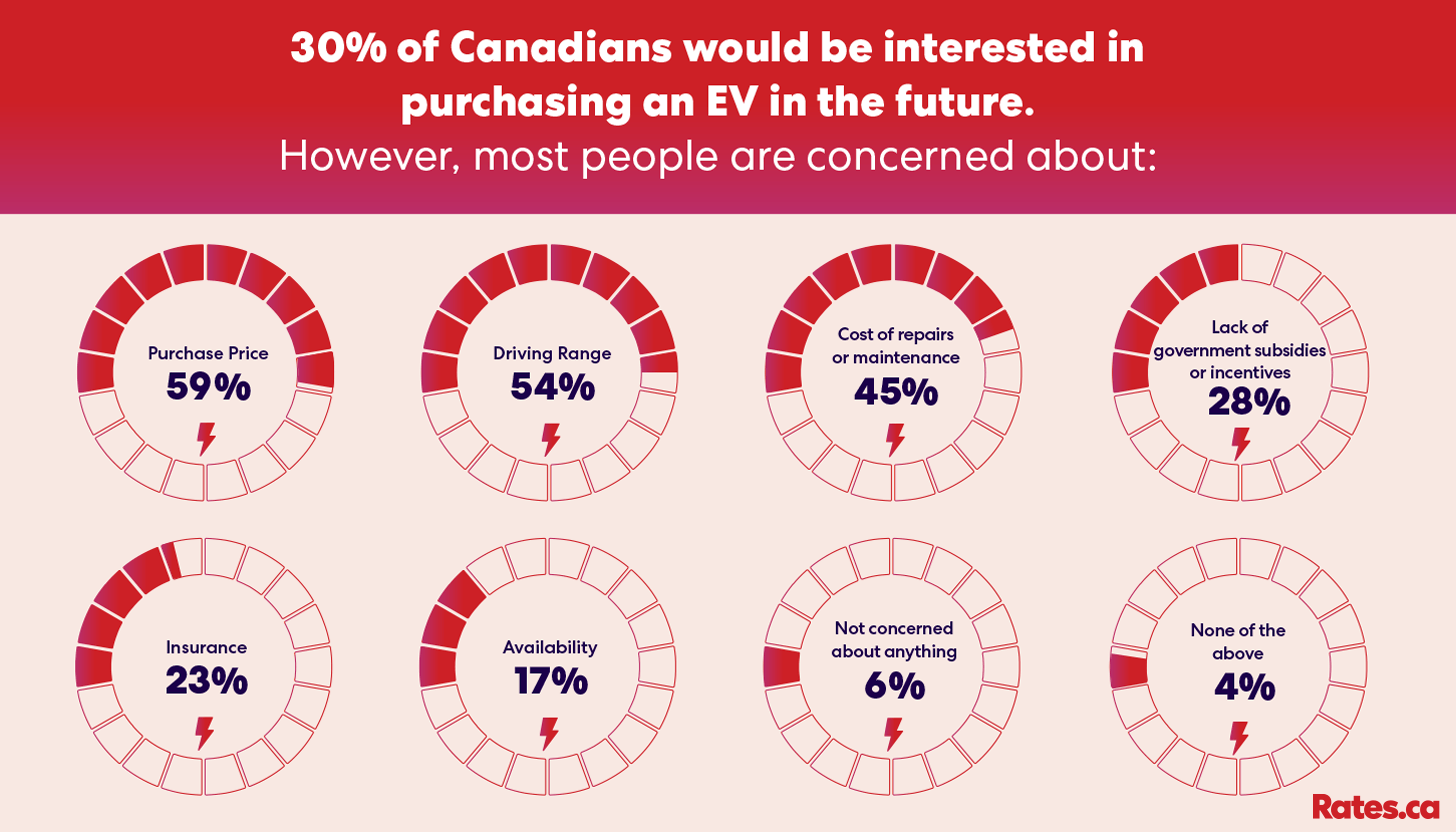
- Sticker price is the biggest barrier. 59% of EV-interested or unsure Canadians cite purchase cost as their top concern.
- Charging anxiety remains widespread. 54% worry about driving range or charging access, reflecting uneven infrastructure access.
- Long-term ownership costs still give buyers pause. 45% worry about repair and maintenance costs, while 23% cite insurance concerns.
- Lower-priced EVs could unlock demand. 56% of EV-interested or unsure Canadians would consider a Chinese-built EV if it’s more affordable.
After a long slump, Canadian interest in electric vehicles is showing signs of life.
Searches for electric vehicle models on the Rates.ca insurance quoter have climbed, with EV interest rising by 40% in March compared to the same time last year.
Similarly, a new Leger survey commissioned by Rates.ca finds that nearly a third (30%) of Canadians have an interest in buying an EV at some point.
There are a few reasons why.
After the expiration of provincial and federal EV rebates in 2025, Prime Minister Mark Carney has introduced a new $2.3‑billion Electric Vehicle Affordability Program (EVAP) to help with the high cost of vehicles.
Meanwhile, Chinese automakers, once blocked by steep tariffs, are now eyeing Canada as a new market, adding fresh competition to the mix.
But it’s not all smooth driving. While excitement grows around competitive pricing and new options, Canadians remain concerned about charging infrastructure, data privacy, and more.
17% are interested in purchasing an EV in the next 5 years
According to the survey conducted by Leger, 30% of surveyed Canadians show some level of interest in buying an EV.
Within that group, 17% say they would consider a purchase within the next five years, while the other 13% are open to the idea but not in the near term.
The remaining 51% say they’re not interested, 11% are unsure, and for 8%, purchasing or owning a car doesn’t apply.
The Canadians more likely to consider an EV are those with higher incomes or easier charging access:
- Younger adults (18–34)
- Men
- Urban and suburban residents
- Higher‑income households (earning over $60,000)
Meanwhile, rural and lower‑income Canadians are far less likely to consider an EV purchase — indicating that cost and infrastructure gaps still shape EV adoption.
Signals of renewed interest — and what’s driving it
Meanwhile, Canadians are shopping again. Rates.ca auto insurance quoter data shows EV interest ticking higher: up 33% year‑over‑year in February and climbing another seven percentage points to 40% in March.
Nino Di Cara, founder and president of Electric Autonomy, a publication focused on EV and autonomous transportation, points to three forces behind the increasing interest:
- Fuel‑price volatility
- New federal rebates
- Cheaper Chinese EVs on the way
Together, these pressures are pulling EV interest out of its 2025 slump. But as the rest of the report shows, sticker price, charging access, and long‑term costs still drive the final decision.
High sticker price is a major barrier for EV adoption
Even with 30% of Canadians interested in purchasing an EV, 89% of Canadians who are either interested or unsure report at least one concern.
Cost is the biggest: 59% cite the purchase price as their top concern.
According to Erik Johnson, vice president and senior economist at BMO Capital Markets, buyers are laser‑focused on the financial bottom line. In his words, “the arithmetic of a monthly payment needs to check out” before consumers commit to an EV.
When rebates were reduced or paused in 2025, the already high sticker price of an electric vehicle becomes a much bigger obstacle for buyers. According to Johnson, EV sales in Canada dropped significantly — over 90,000 expected sales were lost for the year.
Adding to the challenge, Canada remains the only North American vehicle producer still below its pre‑pandemic baseline — producing 1.2 million vehicles in 2025, down 7.8% from 2024 and 33% below 2019.
When vehicles are less available and prices remain high, both automakers and consumers face an uphill climb.
“It's the sticker price that matters most for whether or not someone's going to make that [purchase] choice,” says Johnson.
Read more: Most Ontario households have spent over $15k on insurance in the past four years
Will rising fuel prices boost Canadian EV sales?
Fuel shocks may boost curiosity — but affordability will ultimately determine whether Canadians switch to EVs.
As of late March 2026, the Strait of Hormuz has been effectively shut down after U.S.–Israeli strikes on Iran on February 28 triggered Iranian missile and drone retaliation. This halted most tanker traffic and sent global oil prices soaring.
Oil‑price shocks have historically nudged consumers toward more efficient vehicles, Johnson says — and the current Strait of Hormuz conflict could have a similar effect.
A prolonged disruption could reshape how households and governments think about long‑term energy security, encouraging a shift toward renewables and electrification to “insulate themselves more from these really big fossil‑fuel shocks,” Johnson says.
Di Cara points to historical precedent: “The oil crisis in the ‘70s created a whole slew of small vehicles — the Volkswagen Beetle really blew up in North America directly as a result. So yes, we know it drives consumer action.”
Electricity stability is a selling point in volatile times. Charging costs are regulated, locally produced, and far less prone to sudden spikes — offering a more predictable fuel source.
But both experts emphasize that operating savings can only go so far. Even with rising gas prices, Johnson says a few hundred dollars in annual fuel savings can’t offset EVs that are still $6,000–$8,000 more expensive upfront.
Rebates and more are back on the table
In February 2026, Ottawa scrapped the national sales mandate and replaced it with a new incentive‑driven approach.
The updated EV program includes rebates of:
- Up to $5,000 for battery‑electric and fuel‑cell vehicles
- Up to $2,500 for plug‑in hybrids
- Eligibility capped at $50,000, unless the vehicle is Canadian‑built
- Rebates will gradually decrease each year until 2030 — meaning the incentives are temporary and will sunset over time.
This will lift some of the price concerns highlighted in the Leger survey. But lowering the actual sticker price is another issue entirely.
Related: Ask an Auto Expert: CarQuestions.ca’s Mark Whinton on the future of EVs
Will a new supply of Chinese EVs finally fill Canada’s low‑cost EV gap?
New imports of Chinese-built EVs are poised to fill Canada’s low‑cost gap, and early consumer sentiment suggests Canadians are ready for them. Among Canadians who are interested or unsure about buying an EV, 17% say they’re concerned about availability.
That worry is well‑founded. “There's this huge missing low-cost segment right now in the North American space,” Johnson says. Without genuinely affordable models, math simply doesn’t work for most buyers.
To expand supply, the federal government is rolling out a new quota‑and‑permit system allowing up to 49,000 Chinese-built EVs annually at a reduced 6.1% tariff, with a requirement that 50% of the imported cars will cost $35,000 or less.
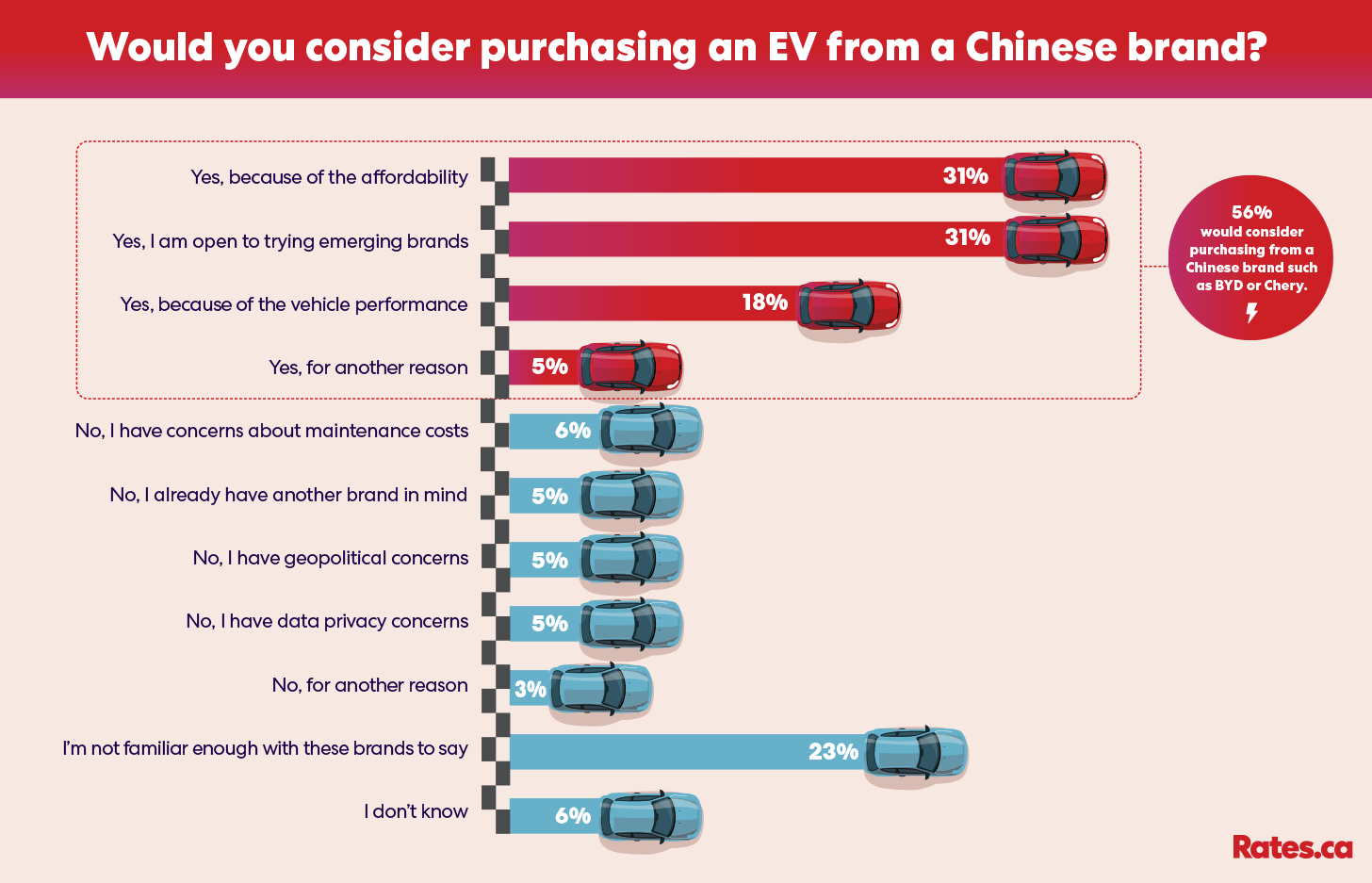
Per the survey, 56% of respondents who are either unsure or interested in purchasing an EV would consider a Chinese-built EV such as BYD or Chery.
Their top motivators are:
- Affordability (31%)
- Openness to emerging brands (31%)
- Performance (18%)
Interest is higher among younger adults (18–34) and men, with both groups reporting that about two‑thirds would consider a Chinese EV.
If EVs start entering Canada at $35,000 or below, as per the quota, Johnson says, it “really is going to move the needle,” given that the market “struggles to have many units under the $50,000 threshold” today.
Learn more: How much does it cost to own a car in Canada?
Filling the price gap left by legacy brands
Chinese automakers are poised to enter the market with models already proven in Europe and Australia, potential models include BYD’s Atto 3, Seal, Dolphin, and Seagull. BYD plans to open twenty dealerships in Canada within the year.
And they’re arriving at a moment when existing options — particularly Tesla’s Model 3, one of the most popular EVs in Canada — have become more expensive. Tariffs over the past two years pushed Model 3 prices near $80,000 CAD.
Related: When is the right time to upgrade your car?
Hesitations remain — but they’re modest
Despite broad openness, 23% of potential EV buyers say they aren't familiar enough with these Chinese brands to consider a purchase.
Other concerns — repair costs, data privacy, or geopolitics — are each cited by 5-6% of prospective EV purchasers. Still, geopolitical tension shapes sentiment: a Leger survey released in February surveying Canadians on their views of Chinese EVs found that 63% expressed concern that stronger China–Canada auto ties could prompt retaliatory U.S. tariffs.
Read more: Toronto pays far more for auto insurance than other Ontario cities
More than half of EV shoppers are concerned about driving range
“Price is the number one factor,” Di Cara says — “another is the ability to charge.” More than half (54%) of those who are interested or unsure about purchasing an EV worry about driving range, largely because charging access remains uneven across the country.
Di Cara estimates that 60–65% of Canadians can charge at home, which he calls “an incredible luxury,” while renters and residents of multi‑unit buildings still face steep installation barriers.
Without national “right‑to‑charge” rules, access often depends on property managers or strata boards.
Public charging is similarly inconsistent: Quebec hosts over a third of Canada’s public chargers, while rural and remote regions still face patchy coverage.
Johnson says the long‑term goal is straightforward: “charging infrastructure needs to get to a place where people don’t have to think about it as much.”
EVAP aims to address key gaps, including a $1.5‑billion Canada Infrastructure Bank commitment to expand fast‑charging access nationwide.
But Johnson’s point remains: until chargers are as common, convenient, and reliable as gas stations, range uncertainty will continue to hold many Canadians back.
The real cost of owning an EV
Even as lower‑priced EVs arrive, Canadians remain wary of long‑term costs. Forty-five percent of unsure or interested respondents worry about the cost of repairs and maintenance, while 23% cite insurance as a concern.
In early 2025, battery‑electric vehicles averaged $7,026 per repair, compared to $5,345 for gas vehicles. Heavier platforms, complex sensors, and calibration‑dependent systems all push costs higher — trends Johnson says are affecting the entire market.
Some out-of-pocket EV repairs and costs
| EV component / repair | Typical cost (CAD) |
|---|---|
| Main battery replacement | $10,000–$30,000+ |
| Charging module / onboard charger repair | $2,000–$5,000 |
| Inverter / power electronics repair | $3,000–$7,000 |
| Drive motor / drive unit repair | $5,000–$12,000 |
| Cooling system (battery / powertrain cooling) | $1,200–$2,000 |
| Parking sensor repair (per sensor) | $150–$600 |
| Autopilot sensor / radar / lidar repairs | $200–$1,500 |
| Camera replacement (rear/side/ADAS) | $300–$800 |
| Sensor‑related bumper replacement | ~$1,900 |
| Battery management sensor replacement | $500–$1,200 |
| Tesla MCU (media control unit) replacement | ~$2,700 |
| Home charging installation maintenance (Level 2) | ~$400 per year |
Source: Motor.ca; Tesla Motors Club (Canada); Everyday Tesla; Canada EV battery replacement and repair cost reports
Typically, the higher the vehicle costs — no matter what their engines run on — the higher the insurance premiums on them. But the fact is, EVs do tend to cost more than their gas-powered counterparts.
“Insurance costs are going up for everyone… and EVs are higher than conventional vehicles,” Johnson says.
Not only that, EV-specific factors add to the premiums. Because EVs are heavier, they wear out tires much faster. Replacing those tires could soon cost even more, as ongoing conflicts in the Middle East continue to disrupt global shipping routes and impact supply chains.
“The Strait of Hormuz is a key transit point for some rubber production,” says Johnson.
Another cost factor consumers rarely see but insurers track closely: resale volatility.
“Resale value has been more challenged for EVs in the past couple of years,” he says.
Johnson explains that EVs are more frequently written off after accidents because repairing their batteries or specialized components is often costly or not practical. This limits what insurers can recover through resale or parts, increasing their risk. To offset these potential losses, insurers raise premiums for EVs.
Taken together, these dynamics contribute to the insurance gap more Canadians are noticing.
Canada may be emerging from its EV pause, but whether new incentives, cheaper models, and a stronger charging network can finally convert curiosity into adoption remains the central question for the transition ahead.
Read next: Here are the changes coming to Ontario auto insurance in 2026
Frequently asked questions (FAQ)
How much does an electric vehicle cost in Canada?
The average new electric vehicle (EV) in Canada costs between CAD $50,000 and $70,000, depending on model and range. Entry‑level EVs start around $40,000, while premium EVs exceed $80,000. Prices remain higher than gas vehicles but are gradually declining as more models enter the market.
What rebates are available for electric vehicles in Canada?
As of March 2026, Canada offers a federal EV rebate through the Electric Vehicle Affordability Program (EVAP). It applies to EVs purchased or leased on or after February 16, 2026, with dealer submissions opening March 31, 2026.
EVAP provides up to $5,000 for battery‑electric vehicles and up to $2,500 for plug‑in hybrids, based on a final transaction price of $50,000 or less (not MSRP). Canadian‑made EVs have no price cap. The program runs until March 2031 or until funds are exhausted. Provincial EV rebates remain available and may be combined with EVAP.
Are electric vehicles cheaper than gas cars in Canada?
Yes. Canadian studies consistently show that electric vehicles are cheaper to operate than gas vehicles. 2 Degrees Institute found that EVs have 66–77% lower fuel and maintenance costs, depending on province.
Actual annual savings vary based on electricity rates and driving distance, but fuel and maintenance costs for EVs are consistently lower than for gasoline vehicles.
Is charging infrastructure for electric vehicles a problem in Canada?
Yes. Canada’s EV charging infrastructure is uneven and remains a barrier outside Quebec and British Columbia. Quebec hosts the largest and most reliable public charging network, followed by B.C., while most other provinces lag significantly in charger density and fast‑charging access.
Canada will need hundreds of thousands of additional public chargers to meet EV targets, confirming current infrastructure growth is insufficient nationwide.
Are EV repair costs higher than gas cars?
Usually no for routine upkeep, but yes for major repairs. EVs generally cost less to maintain than gas cars because they have fewer moving parts and no oil changes, resulting in significantly lower routine service costs.
However, major EV repairs — especially batteries or high‑voltage components — can be more expensive if needed outside warranty. Most EV batteries are covered for up to ten years or 160,000 km, which limits risk for new owners.
Methodology
Leger is the largest Canadian-owned full-service market research firm. An online survey of 1,659 Canadians aged 18+ was completed between February 27th – March 2nd, 2026, using Leger’s online panel. Leger's online panel has approximately 500,000 members nationally and has a retention rate of 90 per cent. A probability sample of the same size would yield a margin of error of +/- 2.4 per cent, 19 times out of 20.
Quoter data was derived from searches for electric vehicle models through the Rates.ca insurance quoter.
Don't waste time calling around for auto insurance
Use Rates.ca to shop around, and compare multiple quotes at the same time.

Arshi Hossain
Arshi Hossain, Associate editor
Arshi Hossain is the associate editor at Rates.ca. She has 4+ years of experience in delivering strategy-backed digital content through various mediums. Her expertise lies in breaking down complex information, meeting people where they are, and in the moments that matter.
Prior to joining Rates.ca, she worked in the editorial and digital content space at Wealthsimple, supported digital strategies, and UX writing for payment products and solutions at Bank of Montreal. She has also worked with startups to support editorial, content writing, communications, copywriting, and marketing needs.
Featured Topics
While dealers clear inventory in the fall, best car deals depend on vehicle demand, supply stock, and when the next model year arrives at dealerships.

Eastern Ontario dominates Ontario's cheapest car insurance markets, with annual premiums starting at $1,824 in 2026.

Colour of your car won't change your auto insurance rate but could impact vehicle repair costs and resale value.

How 'Dieselgate', stricter emissions rules, and changing economics reshaped Canada's passenger vehicle market away from diesel.
Premium gas costs nearly 30¢ more per litre than regular, meaning drivers whose vehicles don't require it could save $400 to $700 a year at the pump.
CEO of Rates.ca, Igal Mayer explains how Covid-era price increases reshaped the auto market and what could bring costs down for consumers.
Accident forgiveness is an extra layer of protection for drivers at fault in their first collision; and helps prevent an increase in premiums.

Adaptive driving equipment won't always raise your car insurance premium, but disclosure of changes that could impact a car's value is mandatory.

Buying Canadian cars may be top of mind in ongoing tit-for-tat tariff spat with U.S., but price advantages aren’t connected to assembly location.