Choose an Insurance Quote
Severe weather adaptations boost home value by up to 5.6% in Canada


KEY FINDINGS
- Homes protected against extreme weather are selling for more. Price premiums range from 2.8–5.6%. In Toronto, Calgary, and Edmonton, this adds roughly $19,500 to more than $50,000 to resale value.
- Resilience features only add value when they’re clearly named. Listings that mention improvements like backwater valves, sump pumps, or hail‑proof shingles sell for higher prices than ones that don’t.
- Adaptation worth it say 56% of Canadians. Survey results showed three-in-five Canadian homeowners would be willing to pay more for mitigation measures.
- Most renovations cost far less than the value they add. A recent research study estimates common adaptation home upgrades typically cost $3,000–10,000.
- Government rebates and subsidies can reduce upfront costs. Several Canadian cities offset flood‑protection costs through homeowner rebate programs.
As Canada faces more frequent floods, fires, and severe storms, homeowners are increasingly looking for ways to protect their properties. But climate‑resilient home upgrades aren’t just about protection, they’re starting to influence real estate values.
A recent study by the Institute for Catastrophic Loss Reduction (ICLR) shows that features like hail‑proof shingles or a hail‑roof, backwater valves, and other resilience measures are becoming selling points in cities across the country.
In places like Calgary, Edmonton, and Toronto, these upgrades are adding 2.8–5.6% to home prices—roughly $20,000–51,500 in additional value. These benefits often far exceed the cost of installation.
Most homeowners don’t realize these features add value and many listings fail to mention them at all.
Here’s what happens when home improvements against extreme weather are clearly named in real estate listings:
Up to $50,000 premium when resilience mentioned in property listings
A recent analysis of listings in Toronto, Calgary, and Edmonton by ICLR found five‑figure price lifts when adaptation features were clearly mentioned—consistent with what buyers say they’ll pay once they understand the value.
Here’s a breakdown of how much resiliency measures can increase a home’s value:
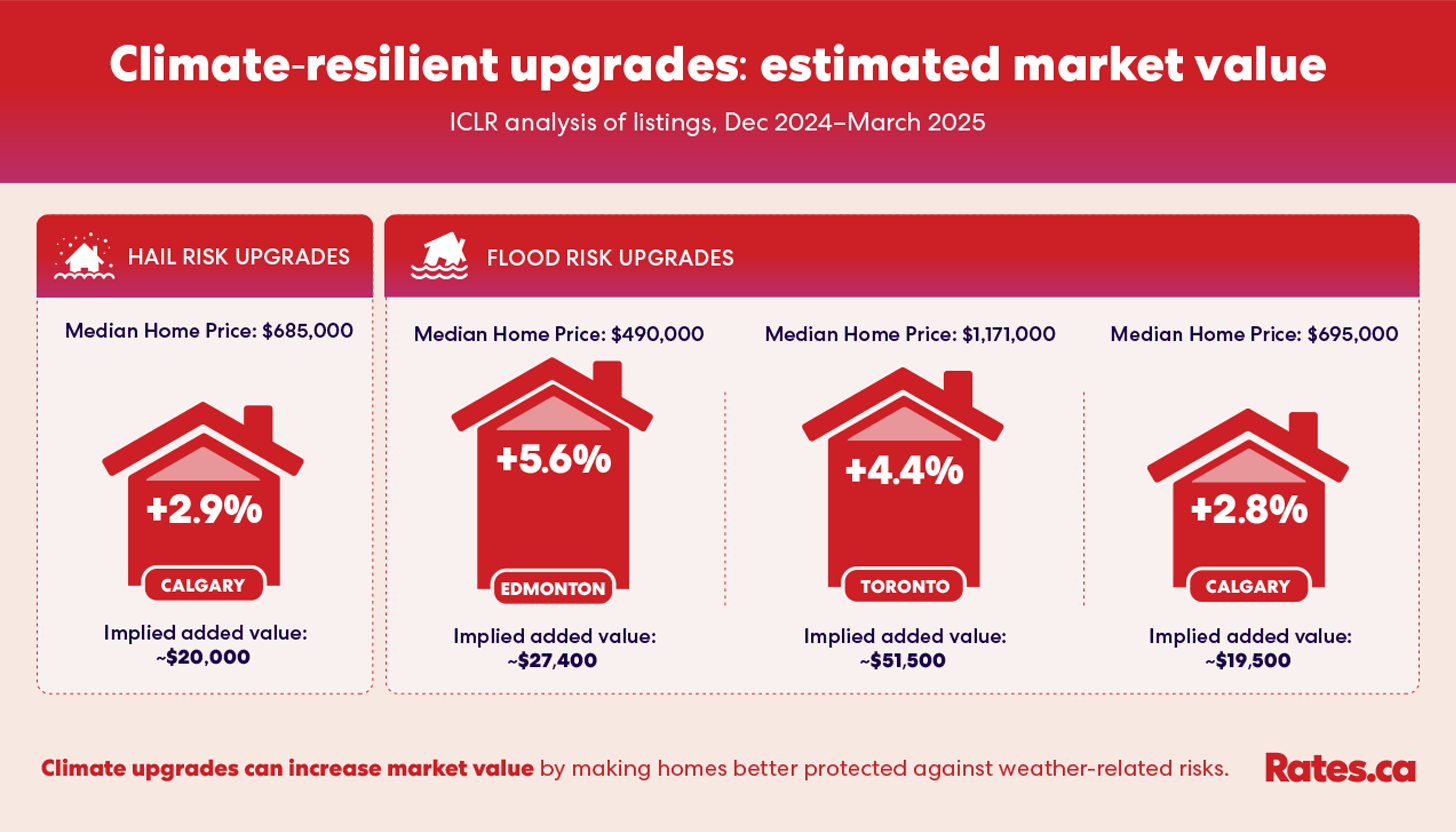
- Calgary: Listings that highlighted hail‑resistant roofing showed 2.9% higher asking prices, with the true effect likely between 0–6%. On a median price of $685,000, that’s about $20,000.
- Edmonton: Listings that mentioned flood‑resistant features were priced about 5.6% higher, adding an estimated $27,400 on a median detached home.
- Toronto: Homes that mentioned flood‑resilience features added 4.4% to the median home closing price of approximately $1.2 million, implying a best-estimate market value for flood protection over $50,000.
- Calgary: Flood‑protection features were linked to a 2.8% increase in closing price, or about $19,500.
Most of these additions, such as sump pumps, backwater valves, or hail‑resistant shingles, typically cost between $3,000–10,000, according to the ICLR study. Homeowners could receive a return on investment for these installations prior to selling.
“I was surprised that there was evidence that resilience did affect property resale prices,” says Dan Sandink, senior director of resilience programs at ICLR in Toronto and co‑author of the study.
“And I was also surprised that there was even mention of resilience measures in real estate ads to begin with. But it’s a sign, a positive sign,” he adds.
The researchers note that study findings are considered to be early signals rather than precise market-wide estimates. Some cities had only a handful of listings highlighting weather related installations, and in a few cases, only asking prices were available.
More than half Canadian homeowners would pay for upgrades if explained
Many homeowners say they face severe weather risks, but far fewer act on them. However, when people understand what resilience additions are, and what problems they prevent, interest rises quickly.
A Leger survey conducted for Rates.ca found that 56% of Canadian homeowners would be willing to pay more for a home with sump pumps with battery backup, stronger roof shingles, or better drainage. Another 20% said they hadn’t made up their minds, leaving room for demand to grow with clearer information.
Among those willing to pay more, spending thresholds were substantial:
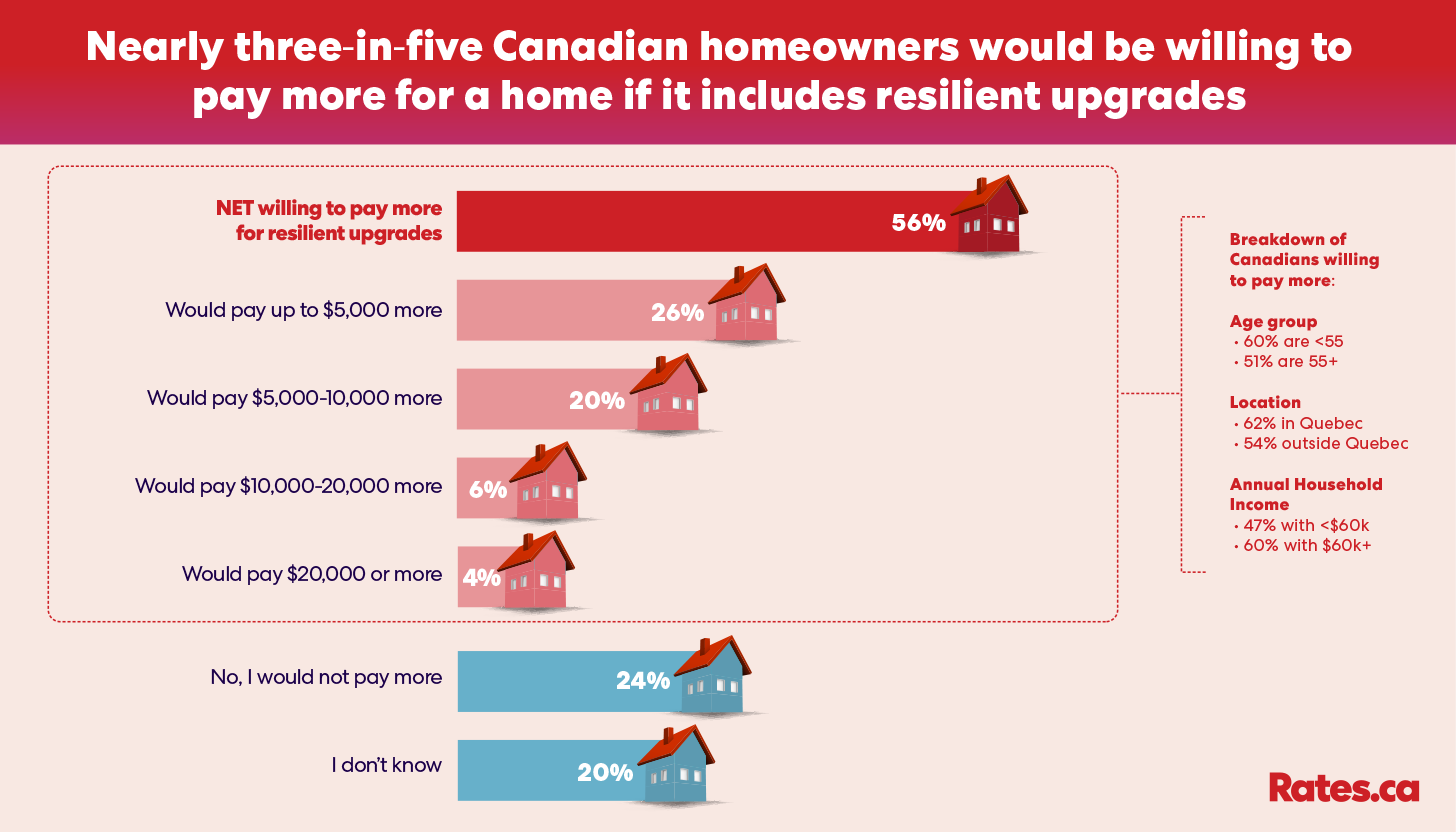
- 26% would pay up to $5,000 more
- 20% would pay $5,000–10,000 more
- 6% would pay $10,000 or more, including 4% willing to spend $20,000+
The survey was conducted March 6–9, 2026, and polled 1,073 homeowners across Canada.
The findings point to a clear gap. While 86% of homeowners believe homes face extreme weather risks, three in five (59%) say they have not installed, and do not plan to add, any protective measures. The issue isn’t indifference, it’s clarity. Buyers often don’t know what protective measures and rebates are available, what they do, or why it matters.
Flooding tops the list of perceived threats nationwide, followed by high winds, wildfire, heavy rain, and hail. When homeowners can connect a familiar risk to a specific fix, they’re more open to paying for it. Hence price premiums show up once those features are built into homes and clearly explained.
Learn more: How to protect your home from severe weather
Why awareness flips to action
Willingness to invest in upgrades is shaped by how people perceive their own risk exposure—and most underestimate it. As Sandink notes, “Most homeowners have no idea what the technical components of their building are. They usually assume flood protection is already covered through government requirements.”
Public awareness often lags reality. “Even in high‑risk flood‑prone areas, we know that 90% of people don’t know they’re exposed to flooding, if they’re in a floodplain,” Sandink says.
This gap explains why resilient homes command a premium in some markets. In other areas, buyers overlook renovations because they don’t recognize risks those features address.
After a disaster, public attention to risks grows. Coverage issues are discussed more openly and agents report buyers scrutinizing protective features. The ICLR researcher points to Calgary listings that highlight Class‑4 hail‑resistant roofs after major storms.
When risks are local and immediate, protective home measures are perceived as worth the costs.
Read more: Rebates for climate-friendly changes to your home
Homeowner rebates and subsidies make improvements more affordable
For homeowners weighing weather-resistant renovations, there’s financial help on the table. Municipalities across Canada offer a growing patchwork of rebates and subsidies designed to reduce upfront costs of flood‑prevention upgrades, while also boosting property value and long‑term resilience.
Here’s a snapshot of what’s available in several major cities and regions, organized alphabetically by location, according to ICLR’s analyses:
- Edmonton: Residents can receive up to $800 for backwater valve installations, along with a free home flood‑prevention inspection.
- Halton Region: Residents can receive up to $19,500 for a range of flood‑mitigation measures, including sump pumps, backwater valves, and storm drain disconnections.
- London: The city covers 90% of eligible costs for protective upgrades such as sump pumps, backwater valves, and sewage ejectors, with grants capped at $7,200.
- Mississauga: Homeowners may qualify for rebates of up to $7,500 for adding sump pumps, foundation drain capping, and downspout disconnections.
- Toronto: The Basement Flooding Protection Subsidy Program provides up to $1,250 for backwater valve additions and $1,750 for sump pumps.
Read next: How is climate change affecting home insurance premiums?
What home improvements do buyers recognize in high‑risk markets?
Here are features that appeared most often in listings tied to price premiums or prioritized by buyers once risks were explained, according to the ICLR study:
Hail (Calgary and the Prairies):
Homes with Class 4 shingles stood out. These are impact‑resistant roofing materials designed to take a beating from large hail without cracking or tearing. Paired with hail‑resistant siding, they reduce the chance of costly roof repairs after major storms.
Flood (Toronto, Edmonton, Halifax):
Features that make a flood‑resistant house were a major draw. Buyers responded strongly to backwater valves, which stop sewage from backing up into basements during heavy rain, and sump pumps with battery backups that keep water moving out even if the power goes out. Listings that also flagged drainage improvements or basement waterproofing tended to perform better, especially in areas with a history of basement flooding.
High wind (GTA and Atlantic Canada):
In wind‑exposed regions, attention shifted to how firmly a house is held together. Features like reinforced roof‑to‑wall connections, upgraded nailing patterns, and shingles rated for high winds helped signal that a home was less likely to lose shingles, or its roof, during major wind events.
Wildfire (B.C. Interior and Alberta):
In wildfire zones, buyers prioritized homes built to resist fire spreading. Fire‑resistant roofing and siding, vents designed to keep embers out, and cleared space around the house all reduced the risk of ignition. These improvements increasingly factored into buyer decisions as wildfire seasons grow longer and more intense.
Listings rarely name these improvements—leaving value on the table
The study shows that adaptation features can boost a home’s value, but you wouldn’t always know it from the way listings are written.
Mortgage broker and Rates.ca expert Victor Tran says real estate agents tend to spotlight whatever photographs best, new kitchens, updated bathrooms, while the most important improvements often sit behind the walls.
“Agents highlight what’s visible,” he says. “Mechanical upgrades or resilience features are just as important, but buyers don’t usually see them. They’re the backbone of a house.”
Still, in neighbourhoods with a history of basement flooding, Tran says buyers appreciate when agents mention backwater valves, sump pumps, better drainage, or newer mechanicals in property listings.
“Knowing a homeowner has taken preventative measures is reassuring,” he says. “It’s something buyers feel they won’t have to worry about.”
ICLR’s research shows that when resilience features are clearly mentioned in a listing, homes tend to sell for more. Even small cues in the listing description can signal to buyers that the home is better protected over the long run.
So why aren’t these features highlighted more often? Tran says it mostly comes down to awareness. “There’s definitely a lack of understanding, not just among buyers, but even among real estate agents and mortgage brokers,” he says. “We’re not experts in these things.”
That gap mirrors what researchers are seeing nationally: most homeowners underestimate their risk unless they’ve lived through an unfortunate situation. But interest in these preventative measures jumps with improved awareness of strategies to mitigate such risks. Listing agents who don’t mention these additional features may be leaving money on the table.
Learn more: Is severe flooding making your home uninsurable?
How to turn invisible home improvements into documented value
If you’re planning to invest in severe weather mitigation or getting ready to sell, here’s how to translate installation dollars into real value, according to the ICLR study and the experts:
1) Package your proof
Create a simple file with invoices (showing install dates and models), any permits, and a short explanation about each new protection measure. Add relevant pages from a pre‑listing inspection. This turns “invisible” work into something buyers can verify quickly.
2) Add reasons for installations in listings
Ask your agent to name the home improvement and anchor it to local conditions in one clear line, e.g., “Class 4 roof (2022), upgraded after recent hail events,” or “Backwater valve + sump (2021) due to neighbourhood flooding”. Put it in the bullets, not buried in paragraph three.
3) Use photos and captions
Include a close‑up of the installed mitigation with a short caption (label the roof shingle bundle, valve location, sump with battery backup). A single photo can do more than a paragraph of copy.
4) Time your messaging
If your area recently had a major event, lead with resilience details in the first sentence of the home description and in your social posts. Attention to these features is highest right after local headlines.
5) Talk to your insurer before you list
Ask how your preventative measures are recognized (not just on premium, also deductibles, sub‑limits, eligibility). Get the exact wording insurers use and keep it in your proof file. If appropriate, add “eligible for insurer incentives (buyer to verify)” in remarks.
ICLR’s research points to a market that’s already shifting. Severe weather protection, once treated as invisible, technical add‑ons, are increasingly showing up in what buyers value and what homes sell for.
The surprising part isn’t that these upgrades protect properties; it’s that they’re now beginning to influence price in measurable ways. The gap, for now, is awareness: most homeowners don’t realize these features boost value, and many listings leave them out entirely.
Read more: How to lower home insurance rates by keeping your home in good shape
Frequently asked questions (FAQ)
How much do climate‑resilient home improvements increase property value in Canada?
A study by the Institute for Catastrophic Loss Reduction (ICLR) found that Canadian homes with climate‑resilient features can sell for 2.8% to 5.6% more. In major markets like Toronto, Calgary, and Edmonton, this can add roughly $19,500 to more than $50,000 to a home’s resale price.
How much do flood‑ and hail‑protection measures cost in Canada?
According to ICLR, common climate‑resilience upgrades—such as backwater valves, sump pumps with battery backup, and hail‑proof shingles or a hail‑proof roof—typically cost between $3,000 and $10,000. In many cases, the resale value added exceeds the upfront installation cost.
Are Canadian homebuyers willing to pay more for weather‑resilient homes?
Yes. A 2026 Leger survey conducted for Rates.ca found that 56% of Canadian homeowners would pay more for a home with protection against extreme weather risks like flooding, hail, or power outages once those features are clearly explained.
Are there government rebates for home resiliency measures in Canada?
Yes. Many Canadian cities offer homeowner rebates and subsidies to support climate‑resilient home upgrades that reduce flood risk. Programs in cities like Toronto, Mississauga, Edmonton, Halton Region, and London, Ontario help cover the cost of measures such as backwater valves, sump pumps, drainage improvements, and foundation disconnections. Eligibility, rebate amounts, and application rules vary by municipality, and most programs require proof of installation by licensed contractors.
Methodology
Leger is the largest Canadian-owned full-service market research firm. An online survey of 1,073 Canadians aged 18+ was completed between March 6th – 9th, 2026, using Leger’s online panel. Leger's online panel has approximately 500,000 members nationally and has a retention rate of 90 per cent. A probability sample of the same size would yield a margin of error of +/- 3.0%, 19 times out of 20.
Don't waste time calling around for home insurance
Use Rates.ca to shop around and compare multiple quotes at the same time.
Finding the best home insurance coverage has never been so easy!

Aya AlHakim
Aya AlHakim, Data reporter
Aya Al-Hakim is a data reporter with Rates.ca. Previously, she worked as an online journalist, reporting on a wide range of topics including business, politics, and health. Her work has been featured in Global News, CBC, Yahoo Lifestyle Canada and Canadian Business.
Featured Topics
Shopping for cheaper home insurance isn't tied to a calendar but aligns best with your changing needs and a market that's constantly shifting.

When subletting your rental property remember to inform your insurer. Your subtenant should carry their own insurance policy.

A heavily discounted home with prior flooding seems attractive, but unexpected repair costs can erase savings.
As the real estate market fluctuates, doing minor, strategic renovations may help improve your home equity and offset falling home values.

A comprehensive home insurance policy can help you cover significant repair costs from a water-damaged basement.

How to reduce risk of your car getting caught in an underground parking garage flood and details on your insurance coverage options.
Consider short-term home insurance additional options before you rent out your home to FIFA World Cup 2026 soccer fans.

Spring landscaping can affect your insurance. Minor grading changes can send water toward foundations, raising flood risk.

A backwater valve is a gate mechanism added to your wastewater outflow pipe that prevents city sewage from flowing back into your home.