Choose an Insurance Quote
Try before you buy: Canadians to choose autonomous vehicles as a service before ownership


KEY FINDINGS
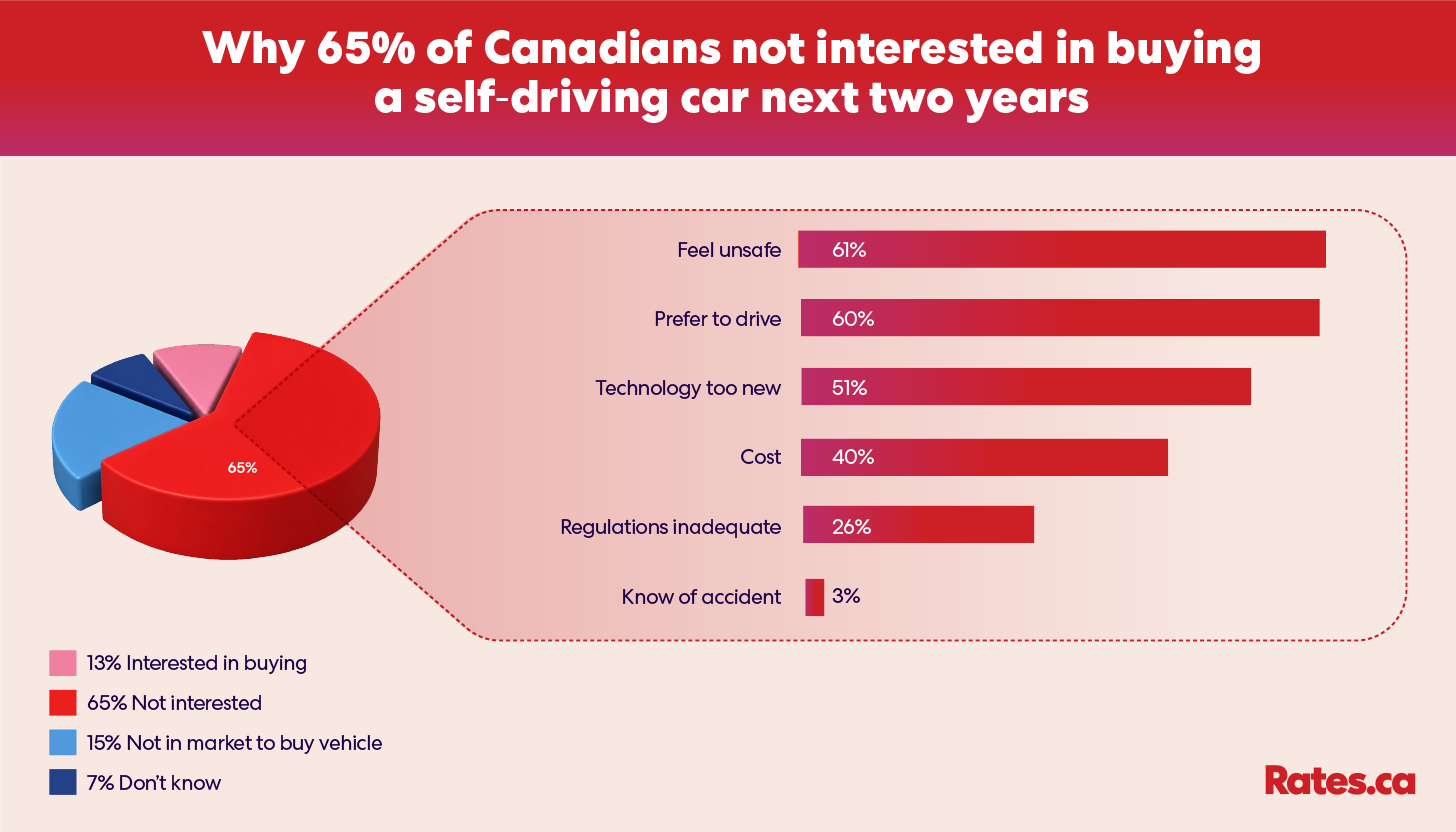
- Demand for ownership remains low. Only 13% of Canadians surveyed would consider purchasing an autonomous vehicle in the next two years, while 65% are not interested.
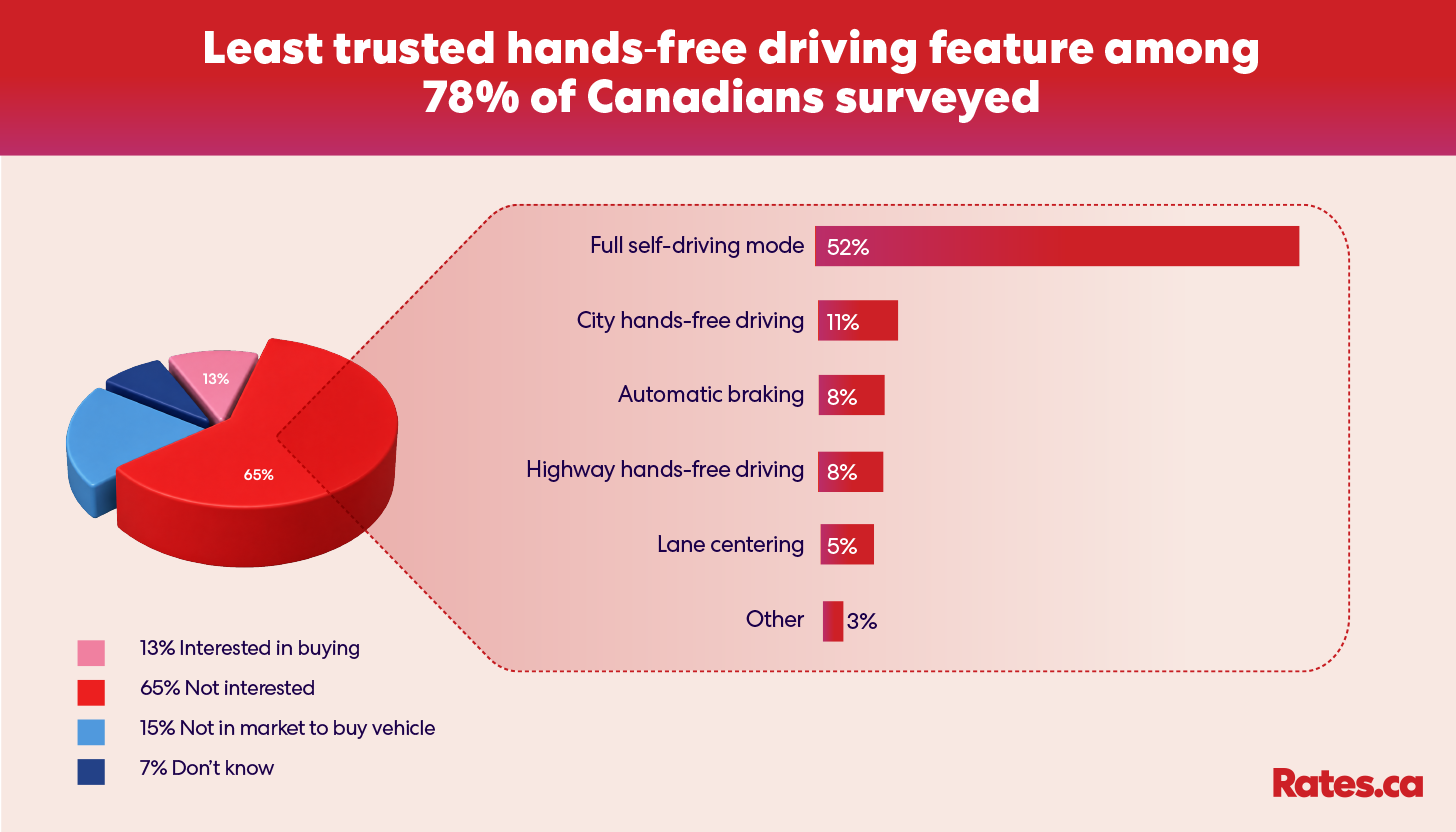
- Safety concerns and mistrust are key barriers. 61% of those not interested in buying a driverless car wouldn’t feel safe; 52% of Canadians mistrust full self-driving mode.
- Safety data improving. Data shows lower crash rates and fewer serious accidents with autonomous vehicles than cars with human drivers.
- Preference for driving remains strong. 60% of Canadians uninterested in buying hands-free cars would rather drive themselves.
- Cost is a structural barrier. 40% of Canadians not interested in autonomous vehicles cite price as a reason. Higher levels of automation can add significant costs.
- Evolving technology yet to resolve unpredictable, complex situations. Autonomous systems can still struggle in poor lighting, intersections, or unusual road conditions.
Autonomous vehicles may soon begin appearing on Canadian streets, but survey results indicate consumer demand in Canada for buying driverless cars remains low.
A survey of 1,521 Canadian adults conducted in April 2026 by Leger for Rates.ca, showed 13% would consider purchasing a vehicle with autonomous or hands-free driving (HFD) features in the next two years. Five times that number, or 65% of those surveyed, show no interest in ownership.
Low demand for driverless cars is rooted in safety concerns, a preference to drive, and high costs of innovation. Many survey respondents consider autonomous driving technology to be relatively new.
What counts as ‘autonomous’ is not always clear. Autonomous can refer to a range of technologies based on levels of complexity. Basic driver-assistance features such as cruise control, steering, and braking assistance that allow drivers to retain control of their vehicle are already built into some models in the market. The complete self-driving mode refers to a fully functional car without any human input, yet to become mainstream in Canada.
Taken together, safety concerns, a lack of trust, and cost are shaping how companies plan to introduce the technology into Canada, especially the full self-driving mode. In the near future, market observers expect Canadians to welcome driverless cars as a service before considering ownership.
Are autonomous vehicles safe? What safety data shows
Safety remains the biggest barrier to adoption of autonomous vehicles in Canada according to Leger’s survey. Among those not interested in ownership, 61% say they wouldn’t feel safe, and 51% say the technology still feels too new.
An overwhelming share of survey respondents, or 52% of those both interested (13%) and not eager to purchase a driverless car (65%), mistrust the full self-driving mode.
But real-world performance data suggests a different reality. Waymo, which operates robotaxi fleets in several U.S. cities, reported significantly lower crash rates than human drivers as of December 2025, especially in more severe incidents:
- Serious crashes are about 10 times less common
- Injury-causing crashes occur 5 to 6 times less frequent
- Fewer collisions involve pedestrians, cyclists, and motorcyclists
“Perception can differ, but we should all look at the data,” says Sahil Shah, founder and CEO of Flowstate, who previously worked as a software engineer on Waymo's autonomous vehicle systems. “If these systems were not safe enough, there was no chance they would be given a permit in the first place.”
Understanding levels of automation
Autonomous vehicles are classified into six levels based on the SAE International framework, outlined in 2021. Each level represents a step up in capability from basic driver assistance to full automation. Higher levels typically require more advanced technology.
Levels of automation are defined as follows:
| Level | What it does | Human role |
|---|---|---|
| Level 0 | No driving automation; system may issue warnings but does not control vehicle | Driver performs all aspects of dynamic driving task |
| Level 1 | Driver assistance (e.g., either steering or acceleration/deceleration support) | Driver performs most driving tasks and monitors environment |
| Level 2 | Partial automation (system controls both steering and acceleration/deceleration in certain conditions) | Driver must continuously supervise system and monitor environment |
| Level 3 | Conditional automation (system performs full driving task in limited conditions) | Driver not required to monitor continuously but must be ready to take over when requested |
| Level 4 | High automation (system performs all driving tasks within a defined operational design domain (ODD)) | No driver intervention required within ODD; system handles fallback |
| Level 5 | Full automation (system performs all driving tasks under all conditions) | No human driver required at any time |
Low level HFD systems rely mainly on cameras and radar. High level systems require more advanced components, such as LiDAR, which uses laser pulses to map a vehicle’s surroundings.
“To achieve Level 4 automation, you need a lot more sensing and perception technology built into the vehicle,” says Bilal Farooq, a professor at Toronto Metropolitan University and a Canada Research Chair in disruptive transportation technologies and services.
As a result, “the vehicle is going to be expensive,” which makes personal ownership difficult to justify, he adds.
Added complexity comes with a cost. A 2025 World Economic Forum white paper estimates that Level 2 systems can cost under $700, making them widely accessible, while more advanced Level 2+ systems can reach up to $3,000.
Level 3 systems are significantly more expensive, typically ranging from $7,000 to $10,000, reflecting the need for more advanced sensors, software, and computing power. These figures reflect cost estimates of underlying technology, typically incorporated into vehicle pricing.
How much are Canadians willing to pay for driverless cars?
In the survey, 40% of Canadians who say they are not interested in buying an autonomous vehicle cited price as a reason.
Even among 13% of Canadians interested in buying autonomous cars in the near future, 74% expect to pay more for the technology, but within reason.
| Additional costs | Share of respondents willing to pay more |
|---|---|
| Up to $5,000 | 29% |
| Up to $10,000 | 30% |
| Up to $20,000 | 15% |
| Would not pay extra | 24% |
For higher levels of autonomy, those amounts may fall short of the added cost.
Shah says costs remain elevated in part because global production is still limited.
“We have not hit economies of scale. Once we get into hundreds of thousands or millions of units, sensors will keep getting cheaper. The overall cost of the vehicle—the bill of materials—will come down as well,” Shah says.
Until production volumes increase and costs fall, Shah says ownership is likely to remain out of reach for many consumers.
Read more: Survey: 30% of Canadians interested in EVs, but cost remains a barrier in 2026
Where autonomous vehicle technology stands in Canada today
Fully driverless cars are not yet available for purchase nor serve as taxis in Canada. But early versions of the technology are already being used and tested.
Transport Canada has had a safety framework in place since 2019, updated in 2021, allowing companies to test these systems on public roads under specific conditions.
Pilot projects, including low-speed automated shuttles, have already taken place in cities like Ottawa, Montreal, Calgary, Edmonton, and Vancouver. These vehicles operate in limited environments, such as fixed routes and low speeds, and are introduced gradually before any wider rollout.
Prior to wider adoption, terminology for this novel technology needs to be aligned within policymakers and broader public perception. Transport Canada’s framework doesn’t reference commonly used terms such as ‘driverless’, ‘hands-free driving’, or ‘self-driving’.
At the same time, many Canadians already use basic forms of automation in their own cars, including systems that can assist with steering, speed, and braking. However, these features fall short of true autonomy.
“There are no 'true self-driving’ cars in Canada available as of yet,” says David Mayer, director of insurance at Rates.ca. “Systems like Autopilot or Super Cruise are Level 2—they assist with driving, but the driver is still fully responsible.”
Who is responsible when something goes wrong?
This distinction is especially important when it comes to insurance. Today, even if a crash involves a vehicle using these systems, responsibility does not change.
“If you are in a crash with one of these vehicles, you are still liable as the owner of the vehicle, whether it was caused by driver error or the system,” Mayer says.
That creates a gap as the technology becomes more advanced. According to the Insurance Bureau of Canada (IBC), the current system is built on the assumption that human error causes most collisions. As vehicles take on more of the driving, that model becomes harder to apply.
The IBC says crashes may increasingly be linked to software or system failures, which complicates how insurers assign fault.
“Because fully driverless cars don’t exist yet, the insurance industry and regulators haven’t determined how this will look,” Mayer says. “Will it be product liability, or the individual who owns it? That’s still to be decided.”
To prepare for that shift, the IBC recommends a model where a single insurance policy covers both the driver and the automated system. This format allows victims to be compensated first while responsibility is sorted out afterward using vehicle data.
For now, Canada remains in a transition phase: partly automated vehicles are already in use, more advanced systems are still being tested, and the rules around responsibility are still evolving.
What are limitations of autonomous vehicle technology?
Autonomous systems are not without limitations even as overall safety data improves.
A 2024 study published in Nature Communications analyzed more than 2,100 autonomous vehicle crashes and over 35,000 involving human drivers in the U.S. Researchers found that vehicles with automated systems are generally less likely to be involved in accidents in comparable situations.
Hands-free cars were also:
- Less likely to be involved in rear-end and side-impact crashes
- Linked to fewer fatal outcomes
- Much less likely to be involved in crashes tied to inattention or poor behaviour (1.8% vs. 19.8%)
However, the technology still struggles in certain conditions. At dawn and dusk, autonomous vehicles were more than five times as likely to be involved in crashes. The report also shows that while turning, driverless cars were nearly twice as likely to be involved in collisions.
These risks are often tied to how systems handle changing light or complex environments, such as intersections and unpredictable pedestrian or vehicle movements.
Recent incidents highlight those limitations. For example, in April 2026, Waymo recalled thousands of robotaxis after one drove through a flooded road due to a software issue.
Other viral moments have also raised questions about how these systems behave in complex, real-world settings. In one widely shared video also from April 2026, multiple Waymo vehicles were seen circling and blocking residential streets in Atlanta. This influx of unusual traffic created confusion for residents as the cars struggled with routing in a neighbourhood environment, according to a report by The Street.
Large-scale infrastructure failures can also create problems. In December 2025, a major power outage in San Francisco caused multiple Waymo robotaxis to stall at intersections after traffic signals went dark.
Some vehicles stopped in the middle of the road. Others blocked intersections and forced drivers to move around them. The blackout was caused by a fire at a power substation and affected about one-third of the city. Waymo temporarily paused its service during the power outage.
The incident shows how these systems can struggle during large-scale unexpected disruptions. Vehicles are designed to treat dark traffic lights as four-way stops. But the scale of the outage created unusual conditions that slowed their response and caused congestion.
Shah says these types of unpredictable, real-world scenarios, often referred to as 'edge cases', remain among the hardest problems to solve.
“The hardest things for the technology to handle still are completely uncertain corner case situations where a lot of human judgement or even human interaction is required,” he says.
He points to situations such as a construction worker directing traffic by hand, where vehicles may need human input to proceed. Other examples include a police officer unexpectedly redirecting traffic, or construction zones with unclear or inconsistent signage.
“The technology is still evolving. It’s not an end product yet,” says Farooq. “But you also have to appreciate that these systems have driven millions of kilometres without any serious accidents.”
Why some Canadians still prefer driving over autonomous vehicles
Even beyond concerns about safety and cost, many Canadians are simply not ready to give up the experience of driving.
Sixty percent of Canadians who are not interested in buying a fully self-driving vehicle say they prefer to drive themselves. The survey found this preference stronger among older Canadians: 55% of those aged 35 years and up cited it, compared to 45% of those aged 18 to 34 years.
“If your driving is not just going to your office, stuck in congestion, you might be driving on a highway to visit someone. Those kinds of trips can be enjoyable, they also give you a sense of control,” Farooq says.
Both experts view public hesitation to be largely a matter of unfamiliarity rather than outright rejection of the technology.
Shah points to aviation as an example of how attitudes toward automation can shift over time.
“Autopilot is now the standard for most long-haul flights. Most of the flight is flown on autopilot and pilots only take over in extreme situations,” he says. “We are so used to it now because we just take it for granted.” Shah expects a similar progression towards mainstream acceptance for hands-free driving.
Wider deployment, he says, is likely to be the turning point.
“If you deploy it at scale, you will see the decline in pedestrian deaths, cyclist deaths, in accidents that happen on the road. Once those numbers start showing up, people will start accepting it more,” Shah says.
What is the future of autonomous vehicles in Canada?
Waymo is working to bring its robotaxis to Toronto and has been navigating the regulatory process required to operate in Ontario, CBC News reported in April.
Ontario's Ministry of Transportation has had regulations in place for autonomous vehicle testing for several years, and has used them to permit limited pilots, including a test of an autonomous delivery vehicle by auto supplier Magna on Toronto streets in the summer of 2025. But full commercial deployment of Level 4 robotaxis in Canada has not yet occurred.
The regulatory environment is still evolving. While testing is allowed, broader rules around commercial deployment, liability, and safety oversight are still being worked out, which can slow how quickly companies scale up operations.
Farooq says part of the challenge is that Canadians have had limited exposure to the technology so far. It’s something that could change as deployment expands.
Once driverless cars enter a market and have a presence, people would be able to see them operate. This familiarity would improve public perception and openness to try out the technology, he said.
The service model is first step forward for Canada
For now, both experts say the more realistic path for autonomous vehicles in Canada is through rideshare services rather than personal ownership.
Farooq describes a model where fully self-driving vehicles operate as shared, on-demand transportation in cities.
"They have a huge role to play in shared mobility—a shared autonomous mobility, like these Waymo shared vehicles running around as an on-demand public transit system, as an Uber sort of system," he says.
Shah says the service model makes sense for the near term but may not be the final state of the industry.
Waymo’s fleet of all-electric Jaguar I‑PACE vehicles is already operating across 10 major U.S. metropolitan areas, CBC News reported. The system works like a ride-hailing service. Users request a trip through an app and are picked up by a fully driverless vehicle.
"Initially, for maybe a decade or so, it will look very much like a service,” Shah expects, considering the robotaxi service model only in dense areas with a lot of demand.”
Shah says that timeline will depend heavily on how quickly companies can navigate regulation and adapt the innovative technology to Canadian conditions.
“I think it really depends on regulation and how quickly Waymo and others solve for snow,” he says. “I would expect maybe two to three years.”
Handling winter weather remains a key challenge. Autonomous systems rely heavily on sensors like cameras, radar, and LiDAR, which can be affected by snow, ice, and low visibility. These conditions are common across much of Canada.
He added that personal ownership could become viable eventually, if costs come down enough. Owners might even put their cars on a shared network when not in use to offset the expense.
For now, the combination of low consumer demand, high vehicle costs, and limited real-world exposure in Canada points toward a service-first rollout.
"Lawmakers and leadership in Canada and every country should be forward-thinking...about introducing these vehicles and reducing roadblocks for them because that way they can get a safer road system and transportation grid, faster," says Shah.
Frequently asked questions (FAQ)
Are self-driving cars legal in Canada?
Self-driving cars are not yet approved for public use in Canada. Autonomous vehicle testing is allowed under federal and provincial rules, but fully driverless cars and robotaxis are not currently available.
What level of autonomous driving is available in Canada?
Most cars in Canada offer Level 2 automation, which includes features like adaptive cruise control and lane-keeping assistance. These systems still require a driver to remain fully engaged and responsible at all times.
How much do self-driving features cost?
Basic driver-assistance features can cost under $1,000. More advanced systems can add several thousand dollars to the price of a vehicle, depending on the level of automation.
When will driverless cars be available in Canada?
There is no confirmed timeline for full deployment. Wider adoption will depend on regulation, safety performance, and how well the technology handles Canadian winter driving conditions.
Methodology
Leger is the largest Canadian-owned full-service market research firm. An online survey using Leger’s LEO panel was conducted among 1,521 Canadian residents aged 18 and older between April 17 and April 20, 2026 (inclusive).
For comparison purposes, a probability sample of n=1,521 yields a margin of error no greater than ±2.5%, 19 times out of 20.
Results were weighted according to age, gender, mother tongue, region, education and presence of children in the household in order to ensure a representative sample of the Canadian population.

Aya AlHakim
Aya AlHakim, Data reporter
Aya Al-Hakim is a data reporter with Rates.ca. Previously, she worked as an online journalist, reporting on a wide range of topics including business, politics, and health. Her work has been featured in Global News, CBC, Yahoo Lifestyle Canada and Canadian Business.
Featured Topics
While dealers clear inventory in the fall, best car deals depend on vehicle demand, supply stock, and when the next model year arrives at dealerships.
Eastern Ontario dominates Ontario's cheapest car insurance markets, with annual premiums starting at $1,824 in 2026.

Colour of your car won't change your auto insurance rate but could impact vehicle repair costs and resale value.

How 'Dieselgate', stricter emissions rules, and changing economics reshaped Canada's passenger vehicle market away from diesel.
Premium gas costs nearly 30¢ more per litre than regular, meaning drivers whose vehicles don't require it could save $400 to $700 a year at the pump.
CEO of Rates.ca, Igal Mayer explains how Covid-era price increases reshaped the auto market and what could bring costs down for consumers.
Accident forgiveness is an extra layer of protection for drivers at fault in their first collision; and helps prevent an increase in premiums.
Adaptive driving equipment won't always raise your car insurance premium, but disclosure of changes that could impact a car's value is mandatory.

Buying Canadian cars may be top of mind in ongoing tit-for-tat tariff spat with U.S., but price advantages aren’t connected to assembly location.