Choose an Insurance Quote
Key benefits and risks of a Mortgage vs. HELOC



KEY FINDINGS
- Mortgages and Home Equity Lines of Credit (HELOCs) are both loans tied to value of your home.
- Mortgages are capped at 80% of your home's value; require fixed monthly repayment of interest and principal.
- HELOC is a revolving line of credit capped at 65% of your home's value, or 80% when combined with a mortgage; requires monthly repayment only of interest.
- Mortgages help with purchase of a home; HELOCs are preferable with a clear repayment plan such as financing renovations with an expected return of a higher sale price.
- HELOCs are riskier than mortgages because they offer access to an open loan as needed, with only interest payments required every month.
A mortgage and Home Equity Line of Credit (HELOC) are two types of loans linked to the value of your home. There are major differences between the two borrowing instruments for homeowners, such as qualifying requirements, repayment conditions, and associated risks. Here's a guide to when you might consider using either a mortgage or HELOC.
What are mortgages and HELOCs?
Both mortgages and HELOCs are tied to the value of your house, but they differ in terms of use and mechanics. A mortgage is a loan from a bank used to buy your home. It has set terms and conditions, including the number of years it will take to repay it, and a payment schedule. Payments are made every month on both the principal and interest. Your borrowing rate of interest can either be fixed for a set term, such as five years, or variable, linked to the prime set by banks.
HELOCs, on the other hand, function like a rolling line of credit secured by your home. Essentially, you are borrowing against the value of your home and its equity. HELOCs typically are one of the cheaper loans you can get, usually with only a half percentage point more than the prime. People often use HELOCs when there’s a good chance of a return on investment.
“(HELOC) is a collateral. You’re basically saying, ‘If something happens, I’m giving up on my home,’” Tango Ontario Mortgage Agent Jenny Tate told Rates.ca. “Think of a HELOC as borrowing money from yourself.”
What are key differences between mortgages and HELOCs?
Mortgage | HELOC | |
|---|---|---|
Borrowing limits | Up to 80% of the value of an uninsured home. | Up to 65% of home value standalone, or 80% combined with a mortgage. Example: on a $1 mln home with no mortgage, you can borrow up to $650K. With a $300K mortgage, you can borrow up to $500K. |
Gross Debt Service (GDS*) ratio no more than 39% of gross household income. Total Debt Service (TDS**) ratio no more than 44% of gross income. | 35%+ home equity for standalone HELOC; 20%+ combined with mortgage. Must pass stress test. Credit score above 680. GDS up to 39%; TDS up to 44%. | |
Monthly payment schedules | Fixed payment schedule covering both interest and principal. | Required to pay monthly interest on loan amount only; no mandatory principal repayment. |
Impact of interest rates | No impact if fixed rate. Variable rate changes with prime. | Prime + 0.5%; rate fluctuates with prime. |
Default penalties if payment missed | Interest on overdue amount. Home repossession after months of missed payments. | Interest accrues on balance. Home repossession after months of missed payments. |
* GDS includes monthly housing costs of mortgage payments, property taxes, and heating charges. ** TDS refers to monthly housing costs, student loans, credit card balances, and car loans.
Read more: Does your credit score affect your mortgage rate?
When to use HELOCs and mortgages
The beautiful thing about HELOCs, Tate says, is their liquidity. These instruments provide fast, reusable access to cash without having to reapply for a loan each time. You get a credit limit and can keep withdrawing until it is reached. You also only have to pay the interest and not the principal, which makes payments more affordable than mortgage payments.
You should consider using a HELOC if you have a plan for repayment, such as investing in renovations for a return on investment when you sell your home. Mortgages are typically used to buy a home as most people do not have the full purchase amount upfront and need a loan.
Are there risks linked to HELOCs and mortgages?
HELOCs come with some risk. Tate says some people end up financing their lives through HELOCs when the economy isn’t doing well. Without a plan to recover HELOC capital spent, they risk becoming poorer in the long run. By kicking the can on repayment, homeowners may lose out in the end if income earned on sale of their home is required to afford another place to live.
In Tate’s view, HELOCs are riskier than mortgages because they offer access to an open loan as needed, with only interest payments required every month. Conversely, mortgages require a more disciplined monthly payment on the principal until the loan is fully paid back. Access to a “bucket of money” via a HELOC can be too much of a temptation for some, according to Tate.
“With mortgages, basically in the end you’re getting a home out of it,” she says. “With a HELOC, if it’s just a lifestyle expense, yes, you have your lifestyle, but financially you are worse.”
Mortgages can be at risk from higher interest rates that impact your bank’s prime rate. If your mortgage was secured with a variable interest rate, an inflationary environment can send monthly repayment costs up.
Neither HELOCs nor mortgages have an impact on home insurance or its rates, according to Tate.
Frequently asked questions***
Why would you borrow against your home equity?
Borrowing against equity of your home is the cheapest loan you can get. HELOCs are also very flexible, with only regular interest repayments necessary, rather than paying back the principal. People often use HELOCs to finance home improvements that will reap a higher sale price for their home.
What are financial risks of having both a HELOC and mortgage payment?
Financial risks are similar for either loan, which can include repossession of your home if payments are not made regularly.
However, having both loans can be a heavier financial burden of regular repayment costs. If you don’t have a plan for how to recoup costs incurred from home upgrades, then both loans could leave you in worse financial shape down the line.
Do interest rates impact HELOC and mortgage loans?
Yes. A HELOC’s interest rate is typically the prime plus 0.5%. Interest on a mortgage loan can be determined by the prime if on a variable loan.
What happens if you miss a HELOC or mortgage payment?
Interest will accumulate and there is risk of your home being repossessed if months go by and no payment is made.
Are there any discounts if your HELOC and mortgage are with the same lender?
No, but you will likely get a prime plus 0.5% rate for your HELOC if with the same lender. Alternative lenders can charge up to twice the interest rate.
*** All answers as per Tango Ontario Mortgage Agent Jenny Tate.
Compare Mortgage Rates
Engaging a mortgage broker before renewing can help you make a better decision. Mortgage brokers are an excellent source of information for deals specific to your area, contract terms, and their services require no out-of-pocket fees if you are well qualified.
Here at Rates.ca, we compare rates from the best Canadian mortgage brokers, major banks and dozens of smaller competitors.

Eric Stober
Eric Stober,
Eric Stober is a Toronto-based freelance writer with over 10 years experience at publications big and small, including Global News, Toronto Life, Yahoo Canada and Real Estate Magazine.
Featured Topics
Homebuyers often assume “bigger is better” for a down payment. But buyers should balance between having savings left vs. high monthly payments.

Mortgage insurance is mandatory in Canada if your down payment is under 20%. Here's what it costs, who qualifies, and how to lower your premium.

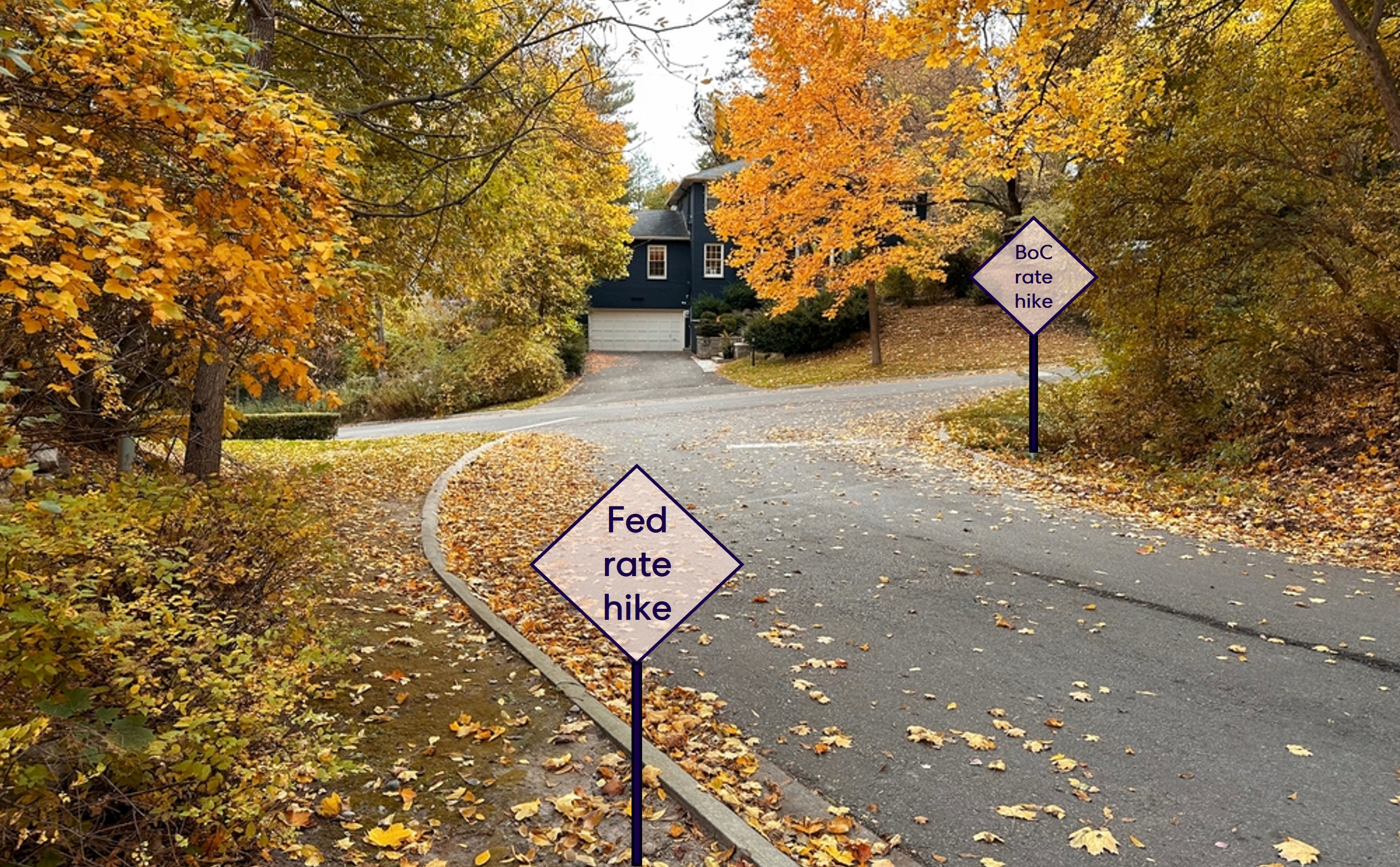
An analysis of U.S and Canada central bank hiking cycles over 30 years to help you plan and navigate a long-term mortgage strategy.
Personal debt shrinks the mortgage you may qualify for—every extra $100 in monthly payments can reduce total loan amount by $15,000–$20,000.

An overview of important considerations when applying for a mortgage as a single parent.

BoC overnight lending rates remain unchanged, but higher gas prices, new U.S. tariffs, and a slowing economy could shape what's next for Canadians.
Canada's mortgage renewal wave has nearly half of homeowners spending 50%+ of monthly outgoings on housing; younger Canadians and newcomers most strained.

Reverse mortgages can unlock home equity for older Canadians but be aware of risks and high borrowing costs.

Home sellers in Canada must disclose latent defects, hidden property issues, and potential legal risks.