Choose an Insurance Quote
Is a self-directed RRSP mortgage niche product for you?



Updated on November 24, 2026 by Arshi Hossain | Originally written: July 2, 2023 by Jessica Wei
KEY FINDINGS
- A self-directed RRSP mortgage lets your RRSP act as your lender. Your mortgage payments and interest go into your own retirement account rather than to a bank lender.
- These products are financially viable in specific cases. A large RRSP, high home equity, and a willingness to lock most of your retirement savings into one asset for 25–30 years.
- Canada Revenue Agency (CRA) mandates mortgage insurance. CMHC, Sagen, or Canada Guaranty must insure this mortgage at any equity level, at a bank-equivalent rate, or the RRSP faces penalty taxes of 50% to 100%. Some provinces charge taxes on premiums.
- Approved trust companies administer your home loan. You can’t hold and administer your own mortgage.
- Cost of fees adds up. Trustee, mortgage insurance providers, lawyers, and appraisers all charge upfront fees.
A self-directed RRSP mortgage is not a very common investment option. It is a niche product for certain mortgage-holders who have sufficient retirement savings and are looking to take advantage of a high-interest rate environment.
Essentially, it allows you to borrow from your RRSP and make regular mortgage payments to yourself rather than paying back your principal home loan and interest to a bank or other lender.
What is a self-directed RRSP mortgage?
A self-directed RRSP is when your RRSP becomes your bank lender of your mortgage loan.
According to Victor Tran, mortgage and real estate expert at Rates.ca, self-directed RRSP mortgages are very niche.
“The idea is that instead of paying interest to a bank, the borrower pays interest into their own RRSP,” says Tran. But he cautions that the strategy only is viable in a narrow set of circumstances: the RRSP money would otherwise be sitting in lower-return investments, and the borrower is comfortable locking those funds up for several years.
“There’s no simple break-even point,” Tran says. “It depends on the RRSP rate, the mortgage rate they would otherwise get, insurer premiums, trustee fees, and legal costs.”
Consider this example of using your RRSP towards your mortgage loan:
- Before: You have $300,000 of GICs in your RRSP that earns 3% annually, and a $300,000 mortgage with your lender costing you 4.6% interest. Two separate things.
- After: Your RRSP cashes out your GICs and lends you $300,000 to buy your home. You still owe $300,000 back to your RRSP and pay a 4.6% interest rate on your home loan. But this 4.6% is paid back to your RRSP, where it can grow tax-deferred. Your RRSP earns 4.6% instead of 3% from GICs, and no bank is involved.
However, your monthly payments don't shrink. You still pay the same amount of interest on your home loan as a traditional mortgage. What changes is who collects the interest: You, in your retirement account.
What are CRA rules of a self-directed RRSP mortgage?
CRA allows you to make a mortgage loan to yourself from your RRSP, but only on specific terms. The rules of a self-directed RRSP mortgage are outlined in Income Tax Folio S3-F10-C1 (paragraph 1.36) as follows:
- A trust company usually administers the loan: You can’t hold or administer the mortgage yourself. A National Housing Act (NHA)-approved lender/trust company administers your mortgage loan.
- You pay current interest rates: Your borrowing rate and terms must match what a bank would charge.
- Mortgage insurance is mandatory: CMHC, Sagen, or Canada Guaranty must insure your RRSP mortgage at any equity level, even if you have a 20%, 50% or 80% downpayment.
- CRA’s rules are strict: CRA taxes your loan at 50% of its value if any conditions are not met.
“In the event of default, the trustee is supposed to treat it like any other mortgage,” says Tran. “That could mean a power of sale, with the RRSP as the mortgagee and sale proceeds going back into the plan.”
He notes he has never seen it happen—these files tend to be structured conservatively—but the risk is real: “Clients need to understand that if they miss payments, they could be dealing with enforcement against their own home.”
What does a RRSP mortgage cost to set up?
Setting up this niche product is not free. Here is what a self-directed RRSP mortgage costs:
| Cost | What it is | Details |
|---|---|---|
| Mortgage default insurance | Similar to CMHC (or Sagen / Canada Guaranty) insurance that buyers with less than 20% down payments pay | Required on any mortgage to yourself, even if you own most of your home outright. CMHC’s current rates run from 0.60% of the mortgage at low loan-to-value up to 4.00% at 95%. Not available on homes over $1.5 million. |
| Trust company fees | A setup fee and an annual fee for holding your RRSP and administering your mortgage | Only a few trust companies approved; each publishes its own fee schedule. Ask for fee details before you commit. Expect a set-up fee of about $200–$300 and an annual mortgage administration fee of roughly $175–$225, charged on top of the account’s regular annual fee. Renewal and discharge fees of $85–$100 also apply. |
| Legal and appraisal fees | A lawyer to register your mortgage and an appraiser to value the home | Same as with any mortgage. |
| Provincial sales tax on insurance premium | Ontario, Quebec, and Saskatchewan tax mortgage insurance premiums | Must be paid in cash at closing; can’t be added to mortgage. |
Sources: CMHC, Mortgage loan insurance premiums; CRA, Income Tax Folio S3-F10-C1, para. 1.36; CMHC, National Housing Act approved lenders; Department of Finance Canada; TD Wealth, Statement of Disclosure of Rates and Fees; CIBC Investor Services, Fees and Commissions.
How much does mortgage insurance cost? It depends almost entirely on your equity. On a $300,000 mortgage:
- With 35% or more equity: Insurance premium is 0.60% or $1,800 one-time payment
- With 10% down payment: it is 3.10% or $9,300
CMHC charges a one-time mortgage insurance as a percentage of your loan, which can be added to your mortgage principal or paid as a lump sum at closing. High costs of mandatory mortgage insurance tend to make opting for this strategy more suitable if you’re borrowing smaller amounts from your RRSP and already own a large share of your home.
Viability of this strategy depends on the mortgage rate you qualify for, your equity, all your fees, and what interest your RRSP could otherwise earn. Consult a planner or accountant using your own figures rather than anyone’s rule of thumb.
Related: What is mortgage insurance in Canada?
How to set up a self-directed RRSP mortgage in six steps
- Check your balance and ask your advisor if your RRSP assets justify fixed costs associated with a self-directed RRSP mortgage
- Move your RRSP to a trust company that handles self-directed mortgages
- Sell to cash inside your RRSP plan
- Qualify like any borrower—income, credit, stress test—and get an appraisal
- Engage a lawyer and trustee. A lawyer registers your self-directed RRSP mortgage; a trustee arranges mortgage insurance
- Start paying. Monthly mortgage payments go from your bank account into your RRSP
What happens at mortgage renewal or if you move?
A mortgage to yourself runs on the same cycle as any other typical product. At the end of each term, Tran says, your mortgage resets to a market rate, and the trust company processes your renewal, charging its admin fee and possibly a renewal fee on top.
You can refinance or pay the mortgage off early, but with one caveat: payouts must go back into your RRSP, not to you directly. Porting the mortgage to a new home is “possible in theory”, Tran says, “but more complicated because the mortgage is held inside the registered plan and still has to meet trustee and insurer requirements.”
What to consider before opening a self-directed RRSP mortgage
It may be easy to see current interest rates and picture all that interest flowing back to you instead of your bank. Before you opt for an RRSP mortgage, here are five things to consider:
- Very few traditional financial institutions offer this niche product: Most banks and online brokerages won’t administer a mortgage to yourself. You’ll need a trust company that does, and it must be on CMHC’s list of approved lenders. Expect to shop around.
- You need a large RRSP and the stomach to cash it out: Your registered savings have to fund your whole mortgage. You would need to sell your current investments and commit a big share of your retirement savings into a single asset. If your mortgage balance is small or nearly paid off, associated fees of an RRSP mortgage and effort involved are unlikely to be worth it.
- Be prepared to pay some hefty fees to open this RRSP account: In addition to paying the normal fee to open a self-directed RRSP, you will likely also have to pay legal fees, appraisal fees to value your home, administration fees, and more. Each trust company publishes its own fee schedule.
- Mortgage insurance is mandatory, no matter your downpayment: With a regular mortgage, insurance is only required when you put down less than 20%. With a mortgage to yourself, the CRA requires it in every case.
- You’re locked in for the long haul: Rates could move in either direction over a 25- or 30-year amortization. The Bank of Canada raised its policy rate to 2.50% on Oct. 28, but no one can predict where borrowing rates could sit in a few years. Meanwhile, the investments you sold could have grown, making the strategy less worthwhile.
Discuss the risks and potential financial drawbacks with an expert. There may be better investment opportunities and more lucrative returns to be gained with your registered savings rather than allocating a very large sum towards a mortgage.
Read more: How to understand and assess your risk tolerance
What are alternative ways to use registered savings toward buying a home?
Here are traditional routes to use registered savings in paying towards your home loan:
| Option | Suitable for | Program details |
|---|---|---|
| Home Buyers’ Plan | First-time buyers | Withdraw up to $60,000 per person tax-free from your RRSP (raised from $35,000 in April 2024); repay over 15 years |
| First Home Savings Account | First-time buyers | Contribute up to $8,000 a year, $40,000 lifetime; pay a deductible, tax-free withdrawal |
| Mortgage prepayments | Anyone with a mortgage | Most lenders allow lump-sum prepayments each year without penalty; check your mortgage terms |
| Keep investing in your RRSP | Everyone | 2026 RRSP dollar limit $33,810; 2027 limit $35,390 |
A couple who both qualify can combine two Home Buyers’ Plan withdrawals and two FHSAs—up to $200,000 of combined registered savings toward a first home—avoiding extra fees and costs through a self-directed RRSP mortgage.
Paying yourself mortgage interest instead of a bank is an appealing idea. But a self-directed RRSP mortgage is a niche tool, not a shortcut. Be prepared for extra costs, strict rules, and hefty penalties for non-compliance.
Read next: How to transfer your RRSP
Compare Mortgage Rates
Engaging a mortgage broker before renewing can help you make a better decision. Mortgage brokers are an excellent source of information for deals specific to your area, contract terms, and their services require no out-of-pocket fees if you are well qualified.
Here at Rates.ca, we compare rates from the best Canadian mortgage brokers, major banks and dozens of smaller competitors.

Arshi Hossain
Arshi Hossain, Associate editor
Arshi Hossain is the associate editor at Rates.ca. She has 4+ years of experience in delivering strategy-backed digital content through various mediums. Her expertise lies in breaking down complex information, meeting people where they are, and in the moments that matter.
Prior to joining Rates.ca, she worked in the editorial and digital content space at Wealthsimple, supported digital strategies, and UX writing for payment products and solutions at Bank of Montreal. She has also worked with startups to support editorial, content writing, communications, copywriting, and marketing needs.
Featured Topics
As construction costs skyrocket, here are actionable strategies that can ensure new homebuyers aren't leaving money on the table.
Variable-rate mortgages align with Bank of Canada’s policy rate. Interest rate changes have far-reaching implications for mortgage loan borrowers.
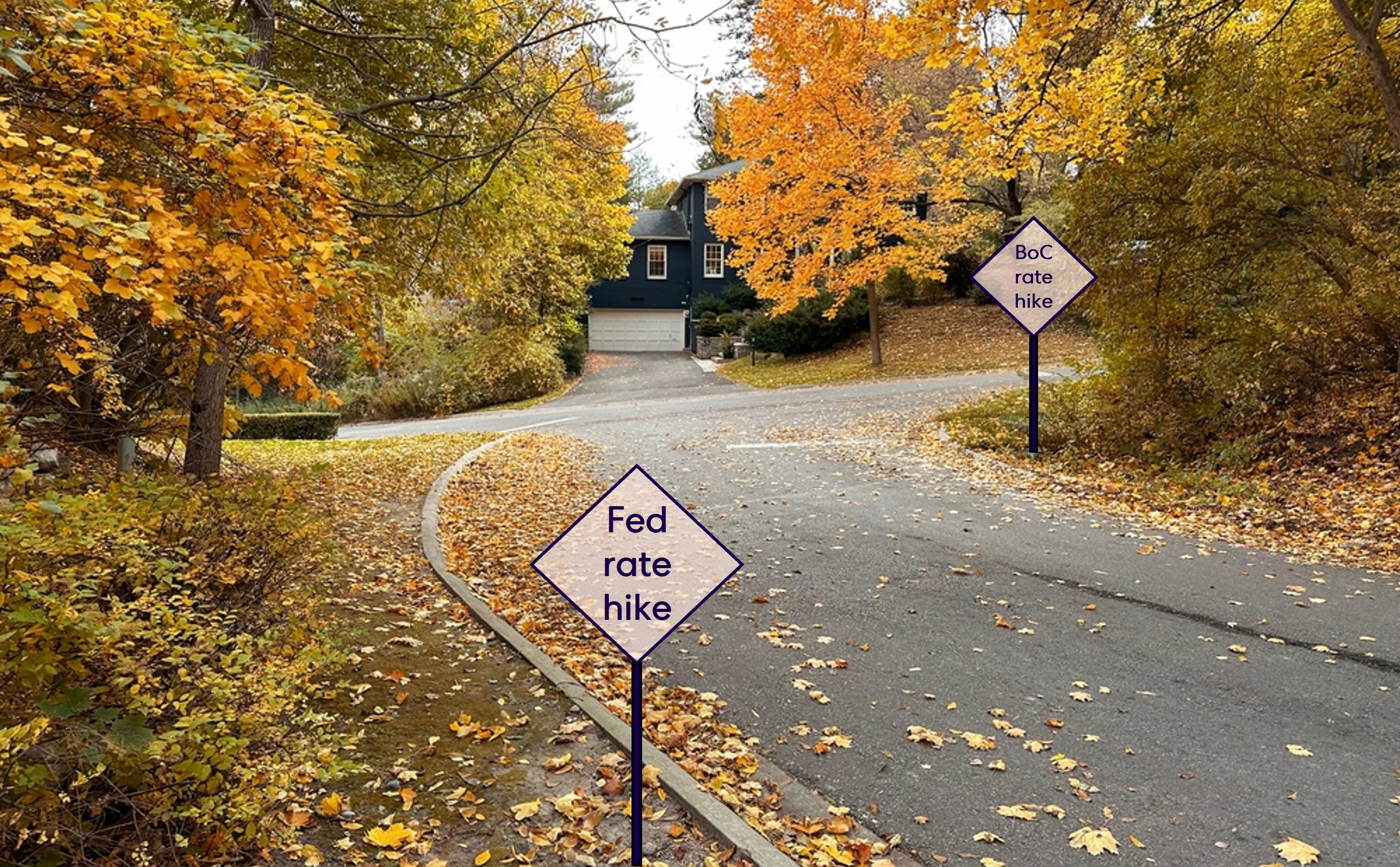
Borrowing privately to buy a home should be a temporary option as interest rates can be as high as 20% in a market largely unregulated and opaque.

The Bank of Canada raises key rate 25 bps to 2.50% on Oct. 28, ending seven straight holds as energy inflation persists and bond yields climb.

Homebuyers often assume “bigger is better” for a down payment. But buyers should balance between having savings left vs. high monthly payments.

Mortgage insurance is mandatory in Canada if your down payment is under 20%. Here's what it costs, who qualifies, and how to lower your premium.

An analysis of U.S and Canada central bank hiking cycles over 30 years to help you plan and navigate a long-term mortgage strategy.
Personal debt shrinks the mortgage you may qualify for—every extra $100 in monthly payments can reduce total loan amount by $15,000–$20,000.

An overview of important considerations when applying for a mortgage as a single parent.