Choose an Insurance Quote
How to secure a mortgage as a single parent



KEY FINDINGS
- Lenders consider federal child benefit payments as part of your monthly income, allowing you to typically qualify for a larger mortgage when you have kids.
- Spousal support payments can factor into debt service ratios, but lenders have different criteria for measuring eligible amounts.
- Age of your child can impact your eligibility for a mortgage, especially as children approach within few years of an adult threshold.
- Spousal support payments you make can impact your mortgage application, especially your total debt obligations.
- Unclear end or review date language in child support agreements can be a liability when mortgage lenders review your application.
- Joint assets of a couple, during and after their relationship, factor into mortgage eligibility calculations.
- A higher interest rate environment can affect your ability to pass a mortgage stress test.
Besides standard requirements including a ‘stress test’ by which lenders assess every mortgage application, additional factors of being a single parent could ramp up pressure.
What are standard requirements when applying for a mortgage?
When you apply for a mortgage, there are certain basic criteria lenders require from everyone:
- Employer letter or at least two years of tax returns if you’re self-employed.
- Your credit report and credit score in great shape. The higher the number, which goes up to 900, the better the terms of your mortgage, including getting a favourable interest rate.
- A lower total debt-to-income (DTI) ratio, ideally under 44%, the better for your application. DTI is the percentage of your monthly income that goes towards paying off all outstanding debt.
- Passing the mortgage stress test. The minimum qualifying rate is either 5.25% or your rate plus 2%, whichever one is higher. Your potential lender uses the stress test to verify that you can still pay your mortgage if interest rates go up, which they have in the last five years.
- Ideally, a downpayment less than 20% of overall cost of your home to avoid paying CMHC mortgage loan insurance.
- Your ability to cover other incidental costs of being a homeowner including property taxes, home insurance, maintenance fees if you buy a condo, hydro and water, and renovation and repairs.
But what if you’re a single parent or one who is either separated or divorced? Does that affect your mortgage application and process?
“The ironic part about it is that you can actually typically qualify for a bigger mortgage when you have kids versus not having kids,” says Sean Cooper, Toronto-based mortgage broker and author of Burn Your Mortgage. “The reason for that is if you're receiving the Canada Child Benefit, we can include that income for qualification purposes. So, you can actually qualify for a larger mortgage, which is … kind of ironic because it ignores the fact that with kids come expenses.”
Read more: How much does your credit score affect your mortgage rate?
What income can single parents use to qualify for a mortgage?
Lenders consider various government benefits and spousal support payments towards monthly income calculations for single parents applying for a mortgage.
- Child care payments
The Canada Child Benefit (CCB) is a monthly, non-taxable amount that helps eligible families with the cost of raising children under 18 years of age. There is a formula for how much a parent can receive but generally, if the adjusted family net income (family net income minus any universal child care benefits (UCCB) and registered disability savings plans (RDSP) plus any UCCB and RDSP amounts that have been repaid) is under $38,237, parents can get $8,157 per year for each eligible child under the age of six years and $6,883 for individual eligible children from age six to 17 years of age.
But there are limits around CCB calculations as an income stream for mortgage eligibility. Cooper says some lenders will consider CCB as income and factor it into your total income as part of your mortgage application or renewal. But one important factor that could change mortgage amount eligibility is your child’s age.
“A lot of these lenders, when the child turns 16 years old, will say they can't include the income anymore,” he says. “These income sources are going to be pending during the next mortgage term and that's definitely a concern of the lenders.”
- Spousal support
If you’re the parent receiving support, the spousal support amount can be considered as another source of income when applying for a mortgage, says Terry Wright, chartered investment manager and portfolio with Raymond James in Vancouver.
“It [spousal support received] does factor into the debt servicing ratio that the bank typically has in place,” he says, pointing out that every lender has different criteria for accepting spousal support as part of your income for your mortgage application.
Similar to the CCB, there are limits to including spousal support in your mortgage application, such as:
- Income caps. Lenders cap spousal support as part of income at 30-35% of the total income to qualify for a mortgage loan.
- An enforceable legal agreement. You have to show a signed, legally binding agreement or a court order that clearly states: requirement for support, as well as frequency, duration, and amount of monthly spousal support payments.
- The 6/36 continuance rule. Your spousal support agreement shows that you have at least a six-month consecutive history of receiving payments, and that this amount will continue for at least 36 months or three years after your mortgage closing date.
- Support payment irregularity. If the former partner providing spousal support has a history of late, irregular, or missed payments, lenders will not consider spousal support as income. Ineligibility can affect how much you can borrow.
Does paying spousal support impact your mortgage application?
If you are the former spouse paying support, it can affect your mortgage application. Lenders check the following debt ratios when calculating your mortgage eligibility:
- Total Debt Service (TDS): Share of gross income used for housing costs plus other debt obligations
- Gross Debt Service (GDS): Share of gross income used for housing costs
You can have a higher TDS or percentage of income that goes towards all your debt obligations. Your spousal and child payments count as monthly outgoings. If your TDS is high, 44% of your income or more, many lenders will refuse to give you a mortgage.
GDS calculates percentage of your gross household income that goes towards total housing costs—your mortgage payment + property tax + heating [utilities] + 50% of condo or similar fees. Lenders cap your GDS ratio at 39% of your gross monthly income before taxes.
With a high GDS some lenders could also disqualify you for a mortgage. You might have to use a private lender which often comes with a higher interest rate.
“Private first mortgage rates typically range from 7% to 10%, which is higher than standard bank rates,” Cooper cautions. “In addition, there is usually a lender fee of 1% to 3% and a broker fee of 1% to 3% (fees that standard mortgages typically do not include).”
Does a child support agreement affect mortgage approval?
For both adults who have a spousal or child support agreement, an end or review date clause of spousal monthly payouts is important when applying for a mortgage. Phrases like “until further notice” or “agreed upon by both parties” makes lenders uneasy. Mortgage providers can consider ambiguous end date language in child support agreements as a liability when reviewing your application.
That’s because they can’t properly assess your long-term financial capacity whether you’re applying for a mortgage or renewing one. If you don’t have end dates specified, consider getting your legal documents amended to include them.
Read more: How to better qualify for a mortgage in Canada
How do lenders measure assets and liabilities of a single parent?
As part of your application process, mortgage lenders assess a couple’s joint assets during and after their relationship. Lenders can look at a separation agreement, which would include: debt responsibility, or who is paying any joint credit cards, loans, or previous mortgages. They can also check details around any division of property, what it is and who owns it. A couple’s joint property can include homes, second homes like a cottage, and vehicles.
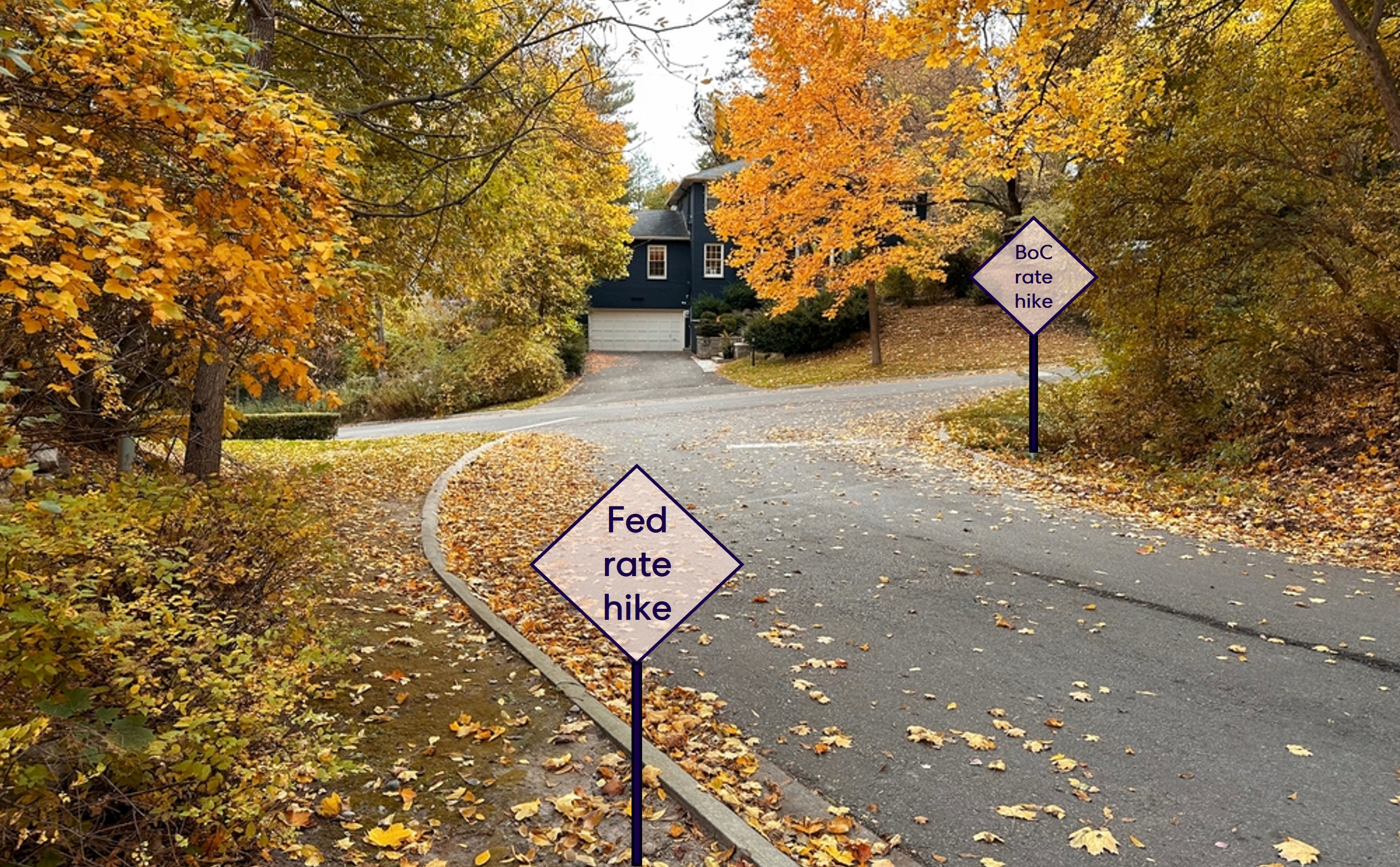
A potential higher rate environment would factor into lenders’ assessments of a couple’s joint liabilities before and after separation. After the US Federal Reserve raised interest rates, expectation is building towards the Bank of Canada (BoC) beginning a similar hiking cycle at their next end-October announcement. The BoC has a recent history in the last five years of raising overnight interest rates to curtail inflation. A higher interest rate environment can affect your ability to pass a mortgage stress test.
No matter your situation, Cooper says to sit down and draw up a budget to make sure you can afford the property you’d like to purchase without being house poor. Also, keep an eye on your credit report, especially if you share a credit card with your former partner.
“Just keeping an extra close eye is important because you don't want something that happened a few years ago to stop you from getting a mortgage today,” he says. “That's definitely been problematic for some clients that I've helped in recent years.”
Learn more: Does renewing your mortgage early save you money?
Compare Mortgage Rates
Engaging a mortgage broker before renewing can help you make a better decision. Mortgage brokers are an excellent source of information for deals specific to your area, contract terms, and their services require no out-of-pocket fees if you are well qualified.
Here at Rates.ca, we compare rates from the best Canadian mortgage brokers, major banks and dozens of smaller competitors.

Renee Sylvestre-Williams
Renee Sylvestre-Williams, Freelance writer
ReneeSylvestre-Williams is a finance and business reporter. In her more than 10 years of journalism, her work has been published in the Globe and Mail, Flare, Canadian Living, Canadian Business, the Toronto Star and Forbes. She also publishes a biweekly newsletter,The Budgette,where she providesfinancial educationfor single earners.
Featured Topics
Mortgage insurance is mandatory in Canada if your down payment is under 20%. Here's what it costs, who qualifies, and how to lower your premium.

An analysis of U.S and Canada central bank hiking cycles over 30 years to help you plan and navigate a long-term mortgage strategy.
Personal debt shrinks the mortgage you may qualify for—every extra $100 in monthly payments can reduce total loan amount by $15,000–$20,000.

BoC overnight lending rates remain unchanged, but higher gas prices, new U.S. tariffs, and a slowing economy could shape what's next for Canadians.

Canada's mortgage renewal wave has nearly half of homeowners spending 50%+ of monthly outgoings on housing; younger Canadians and newcomers most strained.

Reverse mortgages can unlock home equity for older Canadians but be aware of risks and high borrowing costs.

Home sellers in Canada must disclose latent defects, hidden property issues, and potential legal risks.

Risk tolerance is a lens by which you assess financial trade-off between possible stability with lower returns vs. potential upside involving higher risk.

Buying a home in Canada? Learn the difference between a deposit and down payment, plus minimum payout rules when deal closes.