Choose an Insurance Quote
Ask the mortgage expert: What a U.S. Fed rate hike could imply for Canadian mortgage rates
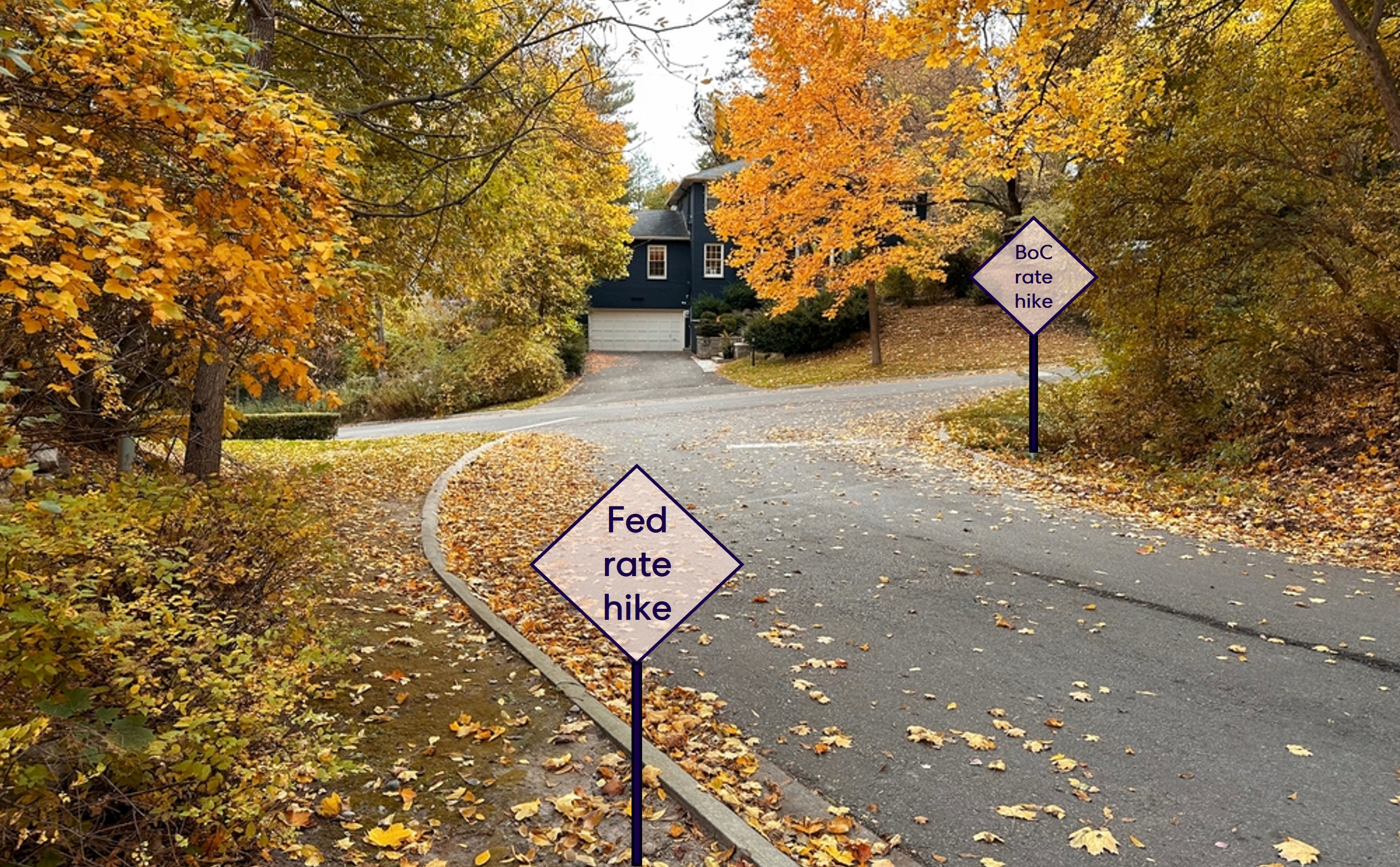


Updated October 7, 2026 with chart of Bank of Canada hiking cycles over 30 years 1996–2026.
Ask the Expert is a monthly column where Steve Garganis, lead mortgage planner at Mortgage Architects and founder of CanadaMortgageNews.ca dives into what’s going on with mortgage rates and the Canadian housing market. Have a question for Steve on home buying and your mortgage? Reach out to us at media@rates.ca.
When the U.S. Federal Reserve (Fed) raised rates on September 16, 2026, media headlines went into overdrive speculating whether the Bank of Canada (BoC) would follow suit. If you want to know what to expect for your monthly housing budget over the next 6 months to 5 years, look past dramatic breaking news, examine how Canada’s bond market reacted to the Fed hike, analyze domestic inflation metrics, and review multi-decade historical data.
Here is a breakdown for Canadian borrowers on how central bank hiking cycles work, what the data implies, and ways to help you navigate your mortgage strategy today.
Why Canadian fixed mortgage rates didn't spike right after the Fed hike
As soon as the Fed announced its quarter-point rate hike on September 16, standard consumer expectation held that Canadian fixed mortgage rates would immediately surge. Fixed mortgage products in Canada are priced off of Government of Canada (GoC) 5-year bond yields, which historically track U.S. Treasuries due to our tightly integrated capital markets.
But instead of spiking overnight, Canadian fixed rates didn't react as consumers expected. Following the initial Fed announcement, 5Y GoC bond yields edged slightly downward before eventually adjusting higher as broader monetary policy filtered through the financial system.
Why did yields drop initially before climbing? Newly appointed Fed Chair Kevin Warsh signaled a disciplined, proactive stance on price stability. Institutional bond investors likely interpreted the Fed’s stance as a credible commitment to keeping long-term inflation in check, temporarily lowering inflation risk premiums across North America.
However, after the immediate response as market mechanics settled, fixed mortgage rates moved higher to reflect expectations for sustained policy tightening. While rates have drifted higher and are expected to stay elevated near current levels, the recent move appears to be a controlled, modest upward adjustment, rather than a runaway spike that could derail housing budgets.
Historical analysis of Fed hikes vs. BoC & mortgage rates: 1996–2026
To understand what to expect in the months ahead, let’s look at prior rate hikes. Over the past 30 years (1996–2026), whenever the Fed initiated a policy tightening cycle, the BoC and Canadian mortgage rates followed distinct, predictable patterns.
Key financial correlations:
- Fixed mortgage rates vs. 5Y GoC bond yields: Fixed mortgage rates move directly with 5Y GoC bond yields. Lenders maintain an operational margin (typically 100 to 200 basis points) above bond yields.
- Variable mortgage rates vs. BoC overnight rate: Variable mortgage rates directly track BoC’s overnight policy rate (Prime Lending Rate = BoC target + 200 basis points). Variable contracts are structured as Prime minus or plus a fixed discount/premium.
- U.S. Fed influence on BoC: While the BoC operates independently, a wide gap between the U.S. Fed Funds Rate and the BoC Overnight Rate creates CAD exchange rate volatility. A weakening Canadian dollar drives up import prices, creating indirect pressure on the BoC to follow Fed hikes.
Comparing Fed/BoC hiking cycles over 30 years: 1996–2026
The table below simplifies key data from every major U.S. Fed rate hiking cycle over the past 30 years, showing how long the BoC lagged, total basis points raised, and how retail mortgage rates moved:
Hiking cycle: Fed start date | # Fed hikes / total bps / duration | BoC lag / # hikes / total bps / duration | 5Y GoC bond yield movement | Fixed mortgage rate impact | Variable mortgage rate impact | Economic & proximity event context |
|---|---|---|---|---|---|---|
1999–2000 Cycle: | 6 hikes / | 0 months (concurrent)/ 6 hikes / +175 bps / 11 months | +120 bps (5.30% to 6.50%) | +140 bps (7.10% to 8.50%) | +175 bps (6.25% to 8.00%) | Dot-com boom expansion and preemptive inflation containment |
2004–2006 Cycle: | 17 hikes / | 3 months lag / | +65 bps (3.85% to 4.50%) | +85 bps (5.80% to 6.65%) | +225 bps (3.75% to 6.00%) | Global housing expansion; BoC lagged due to strong CAD exchange rate |
2015–2018 Cycle: | 9 hikes / | 19 months lag / | +140 bps (1.05% to 2.45%) | +115 bps (2.54% to 3.69%) | +125 bps (2.70% to 3.95%) | BoC delayed initial hiking due to 2014–2015 oil price crash impact |
2022–2023 Cycle: March 2022 | 11 hikes / | 0 months (concurrent)/ 10 hikes / +475 bps / 16 months | +270 bps (1.50% to 4.20%) | +320 bps (2.95% to 6.15%) | +475 bps (2.45% to 7.20%) | Post-Covid19 multi-decade inflation surge and energy supply shocks |
Source: U.S. Federal Reserve, Bank of Canada, Bank of Canada bond yields
The chart below tracks how retail mortgage rates changed as BoC hiked overnight lending rates through each of the Fed's hiking cycles in the last 30 years from 1996–2026.
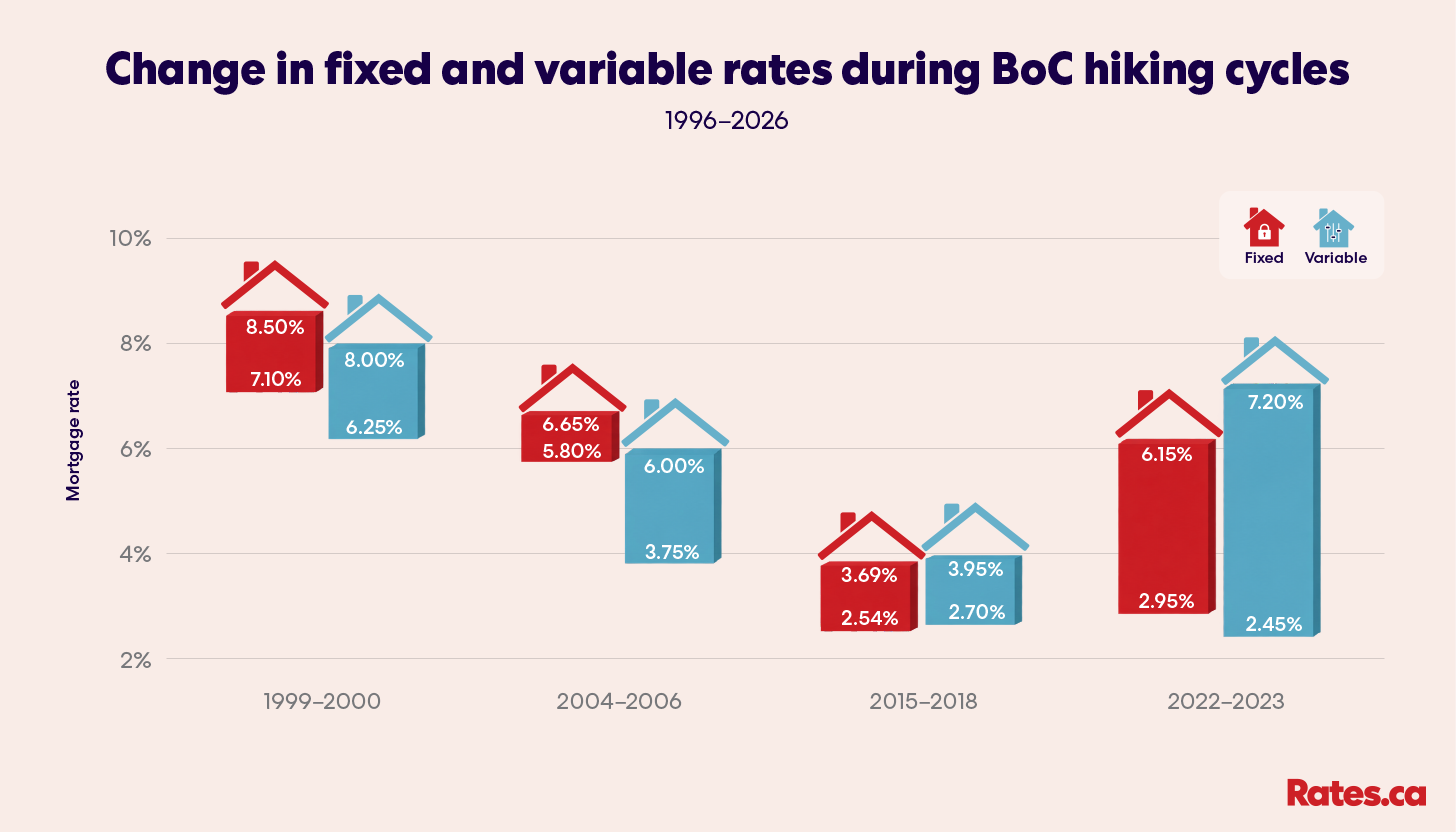
Source: U.S. Federal Reserve, Bank of Canada, Bank of Canada bond yields; image created with AI assistance.
Expectations for inflation in Canada
Heading into the BoC's October 28 rate decision, Governor Tiff Macklem would be weighing U.S. policy against domestic inflation. Headline CPI stood at 3.0% year-over-year in August—at the upper edge of the BoC's 1.0% to 3.0% target band.
Data from Statistics Canada's August 2026 CPI release reveals where price pressures are coming from:
- Gasoline: +22.8% YoY
- Travel Tours: +26.1% YoY
- Transportation overall: +7.5% YoY
- Rent: +2.8% YoY
- Groceries: +2.8% YoY
While headline inflation is elevated due to supply-side energy costs, core trimmed inflation sits at 2.0% and core median sits at 1.9%. Because core inflation is right at the 2.0% midpoint target, chief economists across Canada's major financial institutions widely expect the Bank of Canada to hold the overnight rate steady at 2.25% on October 28.
Near-term institutional forecast overview
- RBC Economics: Expects an extended pause through late 2026, with a potential 50-basis-point increase in early 2027 if headline inflation remains sticky.
- TD Economics, Scotiabank: Project moderate rate adjustments totaling 50 to 100 basis points by mid-to-late 2027 to rebuild policy buffers.
- CIBC Capital Markets: Expects the BoC to hold rates steady, pointing out that core inflation is grounded and high household debt service costs present a natural brake on consumer overspending.
Canada’s personal debt load creates ceiling to higher borrowing costs
One critical reason central banks cannot raise rates excessively is Canadian consumer debt. Canadian household debt-to-disposable-income sits near 175%. Raising policy rates sharply higher from today's levels could risk widespread default and severe economic drag. This debt load creates a practical ceiling on how high rates can go during this cycle.
Forecast: What Canadian borrowers could expect over 6-months to 5-years
Based on historical cycles and current economic indicators, here is what Canadian borrowers should plan for across different timeframes:
- Next 6 months: Fixed mortgage rates are expected to remain elevated but relatively steady near current levels, experiencing only minor fluctuations as bond markets calibrate economic data. Variable rates will remain pegged directly to the BoC Overnight Rate (currently expected to hold at 2.25% on October 28). Borrowers renewing during this window have a stable environment to lock in fixed rates or secure competitive variable discounts off Prime.
- 1Y horizon: As policy adjustments continue filtering through capital markets, borrowing costs could remain elevated. However, increases would be modest (projected at 0.25% to 0.50%), avoiding dramatic spikes as central bank policy plateaus. Homeowners should build a modest rate buffer into their renewal calculations.
- 3Y horizon: Expect Central bank policy rates and bond yields to reach cyclical plateaus before normalizing. Major federal election cycles approaching in both Canada and the U.S. over the next three years historically coincide with more supportive monetary environments as governments prioritize economic stability. Homeowners facing mid-term renewals should prepare for slightly higher payment obligations than ultra-low policy eras, but well below peak crisis levels.
- 5Y horizon: Over a full 5Y term, inflation control and general economic balance bring borrowing costs back toward historical midpoints. Long-term planning allows mortgage holders to ride out short-term fluctuations with total confidence.
Central Bank policy trends and outlook matrix
Institution / Forecast Horizon | U.S. Federal Reserve | Bank of Canada |
|---|---|---|
Short-term outlook: 0–12 months | Proactive policy stance under Chair Kevin Warsh; potential 25–50 bps additional hikes to anchor long-term inflation expectations and stabilize bond yields. | Policy hold expected October 28 at 2.25% overnight target; balancing headline CPI volatility against controlled core inflation (1.9–2.0%) and elevated debt service loads. |
Long-term outlook: 1–3 years | Policy rate stabilization followed by gradual normalization toward terminal neutral rate (3.00–3.25%) as labour market and price pressures settle. | Modest potential upward adjustment of 50–100 bps by 2027 if headline energy inflation lingers, settling into a sustainable neutral equilibrium near 2.75–3.25%. |
Key policy drivers | U.S. Treasury yield dynamics, global fixed-income demand, domestic wage metrics, and institutional monetary credibility. | Canadian household debt service ratios, housing renewal walls, core inflation metrics, and foreign exchange CAD volatility. |
Expert opinion: Steve Garganis on variable rates
In today’s market, variable rates present a compelling option for qualified borrowers. Variable rate discounts are available around Prime -0.75% to -0.90% compared to 5Y fixed rates in the mid-4.00% range.
Choosing a variable rate mortgage keeps your options open: you retain the contractual right to convert into a fixed rate at any point during your term without penalty if market conditions shift or your risk tolerance changes. Working with an experienced mortgage broker ensures your product selection fits your overall financial roadmap.
Compare Mortgage Rates
Engaging a mortgage broker before renewing can help you make a better decision. Mortgage brokers are an excellent source of information for deals specific to your area, contract terms, and their services require no out-of-pocket fees if you are well qualified.
Here at Rates.ca, we compare rates from the best Canadian mortgage brokers, major banks and dozens of smaller competitors.

Steve Garganis
Steve Garganis, Lead mortgage planner at Mortgage Architects
Steve Garganis is a licensed mortgage broker, leader mortgage planner at Mortgage Architects and founder and editor of CanadaMortgageNews.ca.
In 1992, Steve was one of the first Mobile Mortgage Specialists at TD Bank and has since held senior management positions in two major banks.
In 2004, he decided to focus on his passion for mortgages became a mortgage broker.
In 2009, after noticing a lack of accurate, fact-checked and helpful mortgage content available online at the time, he founded CanadaMortgageNews.ca, where he has written over 600 articles and shares useful facts, opinions and recommendations for the owners, buyers, and sellers.
Featured Topics
Mortgage insurance is mandatory in Canada if your down payment is under 20%. Here's what it costs, who qualifies, and how to lower your premium.

Personal debt shrinks the mortgage you may qualify for—every extra $100 in monthly payments can reduce total loan amount by $15,000–$20,000.

An overview of important considerations when applying for a mortgage as a single parent.

BoC overnight lending rates remain unchanged, but higher gas prices, new U.S. tariffs, and a slowing economy could shape what's next for Canadians.
Canada's mortgage renewal wave has nearly half of homeowners spending 50%+ of monthly outgoings on housing; younger Canadians and newcomers most strained.

Reverse mortgages can unlock home equity for older Canadians but be aware of risks and high borrowing costs.

Home sellers in Canada must disclose latent defects, hidden property issues, and potential legal risks.

Risk tolerance is a lens by which you assess financial trade-off between possible stability with lower returns vs. potential upside involving higher risk.

Buying a home in Canada? Learn the difference between a deposit and down payment, plus minimum payout rules when deal closes.