Choose an Insurance Quote
Licence plates: A primer and what they reveal about your driving

KEY FINDINGS
- Licence plates uniquely identify your vehicle. Passenger vehicles in Ontario must display a government‑issued alphanumeric plate on the front and rear.
- Plates help authorities track vehicles and drivers. Information linked to your plate is used in accidents, traffic violations, toll enforcement, and criminal investigations.
- Costs for plates vary by type. New or replacement regular plates cost $59, while personalized plates are $310. Customization with a graphic costs $336.40.
- Eligible licence plates are renewed automatically each year, provided you have valid insurance and no outstanding fines or unpaid tolls.
- Driving with an expired plate carries a fine. The penalty for an expired plate is $110, including fees and surcharges.
- Valid insurance is required to get or renew plates. You must show proof of insurance to obtain new plates or keep existing ones active.
Ontario drivers tend to pay little attention to their licence plates since the provincial government introduced automatic plate renewal in 2024. But licence plates can speak volumes about your driving and are an integral part of auto ownership.
A valid licence plate is legally required to drive and park your car on the road. You could receive a $110 fine for driving with a licence plate that’s illegible, even if that distortion occurred from a manufacturing defect. A police cruiser behind you could have on-board technology that can automatically check if your licence plate is one of the millions on a national hotlist.
Here’s a helpful primer on licence plates in Ontario.
What is the purpose of a licence plate?
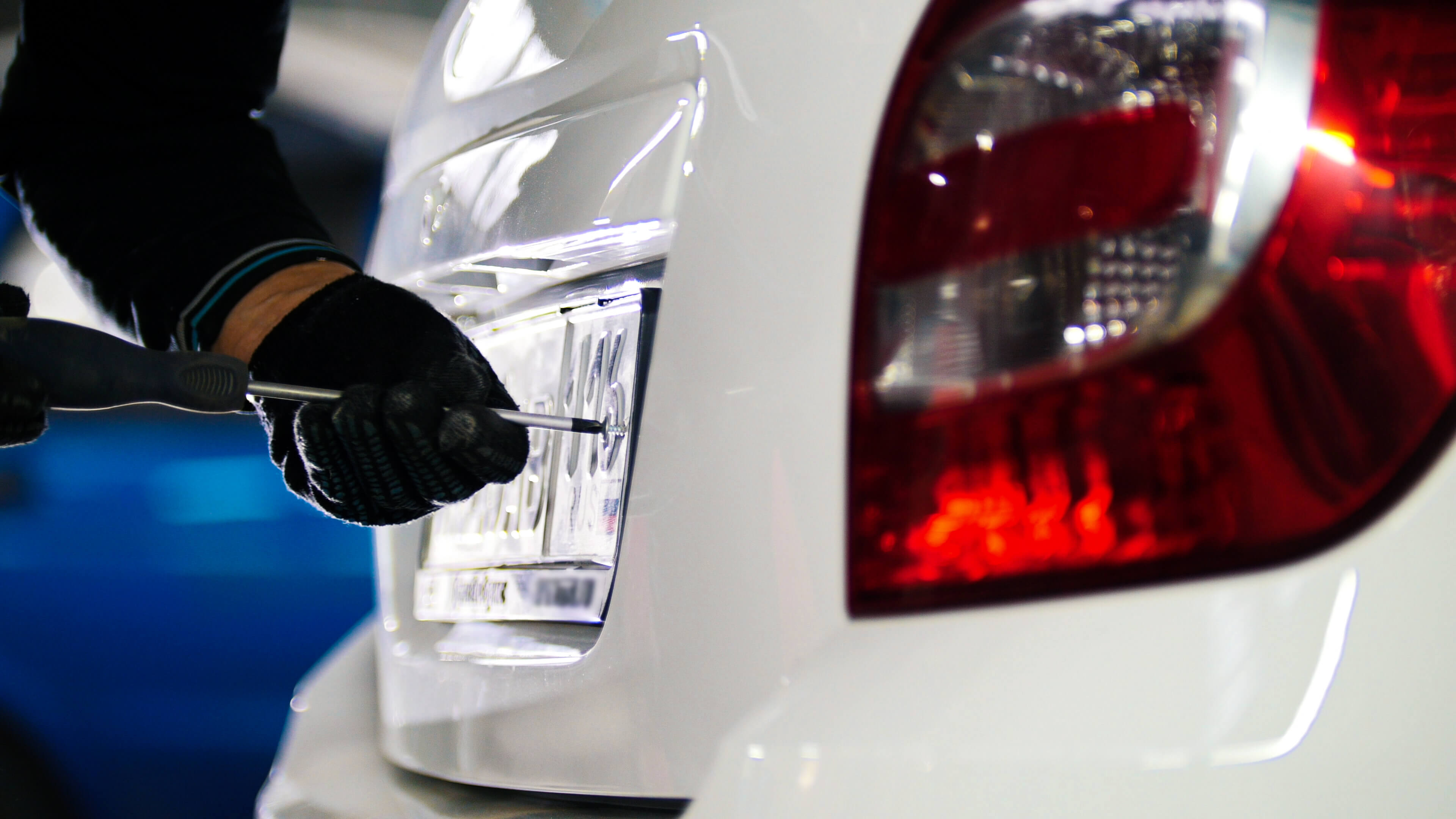
A licence plate is a government-issued tag that must be displayed on the front and rear of most passenger vehicles on public roads in Ontario. Each pair of licence plates bears a unique identifier: a combination of letters and numbers associated with a particular vehicle and its owner. Licence plates have many purposes, but they’re used primarily by government authorities to identify vehicles involved in accidents, traffic violations, or crimes.
What information can authorities access through your licence plate?
Your licence plate number is tied to an array of information about you and your vehicle, including:
- Your name and address
- Your auto's make, model, year, and vehicle identification number (VIN)
- Tolls and fines you haven’t paid
- Your licence plate’s status, such as whether the plate is suspended or expired
Police also scan through a list of millions of licence plates deemed to be in poor standing as part of the Automated Licence Plate Recognition Program in Ontario. Plates can be put on that list for many reasons such as:
- Expired, terminated, or stolen
- Connected directly to criminal activity in an active police investigation
- Registered to a person under criminal investigation
- Associated with a suspended driver, missing person, or Amber Alert
For how long can you retain your licence plate number?
Once you purchase a pair of regular, new plates for $59, they remain tied to you until they’re cancelled, replaced, or transferred to an eligible family member. You can keep your plate number for as long as you want, even after the corresponding vehicle is sold or scrapped. Many people keep their plates as souvenirs. But you can also transfer your plates to another vehicle you own—a used car you’ve just purchased—for a fee of $32 and completed forms.
Can you change your plate number?
You can obtain a new plate number for a vehicle whenever and as often as you want, if you’re willing to file the paperwork and pay the fee for new plates. But changing your plate number won’t help you avoid penalties for past infractions, because the government keeps a time-stamped ownership record of every plate number.
How much does a custom licence plate cost in Ontario?
'Custom' or 'vanity' licence plates, officially called personalized licence plates, are available in two varieties. A regular pair of personalized plates with your choice of 2–8 letters and/or numbers costs $310. Personalized graphic plates are $336.40, limited to 2–6 characters but you can choose one of more than 60 available graphics, such as the Toronto Blue Jays logo or Canadian flag.
What are the restrictions on custom licence plates in Ontario?
Unsurprisingly, there are restrictions on the alphanumeric combinations you can use in a personalized plate number. For instance, offensive language or slang (even if spelled in SMS code) is prohibited, as are trademarks, religious messages, and anything associated with violence, criminal activity, or discrimination. Personalized plate numbers must also be clear and legible to law enforcement, so some combinations of letters and numbers are banned. These include plate numbers that could easily be mistaken for an existing plate number, such as GEORGE versus 6EOR6E.
Do you need new plates when you change your car?
No. When you take ownership of a new or used car, you have a few options:
- Get shiny new plates and a new plate number
- Transfer plates from a car you already own to your new vehicle
- Use plates that are assigned to you but no longer associated with another vehicle
- Use plates transferred to you by an eligible family member, particularly when that family member gifts the car to you
Car dealerships will usually register a brand-new vehicle on your behalf and provide newly issued plates. If you buy a used car, you can obtain new plates or use old ones. In both cases, you’ll have to complete paperwork and pay associated fees.
Personalized plates that are lost, damaged, or stolen can be reissued with the same plate number. All other plates are replaced with a new plate number.
How much does it cost to replace lost, damaged, or stolen plates?
Replacement plates cost the same as new plates: $59 for regular plates, $310 for personalized plates, and $336.40 for personalized plates with a graphic.
All plates, however, are covered by a five-year manufacturer’s warranty against defects. So, if your plates fall apart under normal use before they’re five years old, you can replace them at no charge. A common problem with Ontario plates is bubbling and peeling of their protective laminate coating, which eventually makes the plates unreadable. If your plates are like this, replace them as soon as possible: driving with unreadable plates makes you subject to a fine, fees, and surcharges totalling $110.
Everything you need to know about renewing your licence plates
How often is a licence plate renewed?
Until July 2024, car owners had to renew their plates every one or two years and affix a dated sticker indicating the plate’s expiry date on their rear plate. Depending on the renewal term chosen, a driver would pay $60 or $120 to renew their plates.
Now, eligible plates are renewed automatically each year, 90 days before the expiry date—which, on passenger vehicles, is the owner’s birthday. Automatic renewal, however, doesn't apply to certain vehicle classes (e.g., commercial) or vehicles manufactured before 1983.
What prevents a plate from being renewed?
Generally, plates will be renewed automatically if the vehicle has valid insurance and is not associated with outstanding tolls or fines. If your plates aren’t eligible for renewal, you’ll receive notice by mail 90 days before the expiry date.
You can also sign up for renewal reminders via email, text, or phone for alerts 90, 45, and 10 days before the expiry date.
What are the implications of driving with expired licence plates?
The fine for driving with an expired plate is $110, including fees and surcharges.
Can you insure a vehicle without a valid licence plate?
You don’t need a valid licence plate or permit to obtain insurance for your car. But you do need valid insurance to renew or obtain new plates for your car. Ontario’s Ministry of Transportation checks an insurance industry database for every vehicle’s insurance status before issuing or renewing plates.
Will driving with an expired plate impact your insurance coverage?
One common misconception is that driving with an expired licence plate can void your auto insurance policy or cause a claim to be denied. Driving with an expired driver’s licence is what gets you in trouble with insurers. The status of your plate shouldn’t impact your insurance coverage or any claims you make.
How does licence plate information help in a collision?
If you’re involved in a collision with another vehicle, try to record all of the information that will help you file a police report and insurance claim. This includes the licence plate number, driver’s name and contact information, driver’s licence number, insurance policy number, and more.
If the other driver is uncooperative or flees the scene, their plate number alone will help police and your insurer identify the vehicle and its owner, but not necessarily the driver. If the driver can’t be identified, the owner’s insurance will handle the claim. If the owner doesn’t have insurance, your insurance policy’s mandatory Uninsured Motorist Coverage will cover up to $25,000, with a $300 deductible. But if the vehicle was stolen, you’ll probably have to file a claim under your own collision or all perils coverage, and pay your deductible.
Licence plates are a vital component of auto ownership in Ontario. With an incident-free driving record you can enjoy the convenience of automatic free renewal of your plates in Ontario. But keep your driving record clear, or you might encounter some surprises at renewal.
Frequently Asked Questions
What is the purpose of licence plates?
Licence plates are primarily required by government authorities to quickly identify vehicles involved in accidents, traffic violations, or crimes.
How much do licence plates cost in Ontario?
A set of new regular plates cost $59. Personalized or vanity plates are $310. Plates cost $336.40 for an additional graphic. Since 2024, annual plate renewal is free of cost.
How can you renew your licence plates?
In Ontario, plates are renewed automatically if the vehicle has valid insurance and is not associated with outstanding tolls or fines.
Can expired licence plates affect your car insurance?
The status of your plate shouldn’t impact your insurance coverage or any claims you make. However, the fine for driving with an expired plate is $110, including fees and surcharges.
Why are some Ontario licence plates blue?
In 2020, Ontario’s classic white plates with light blue lettering were replaced by blue licence plates with reflective white lettering. Since the blue plates were unreadable in some lighting conditions, the government quickly reverted to white plates.
Don't waste time calling around for auto insurance
Use Rates.ca to shop around, and compare multiple quotes at the same time.

Ian Portsmouth
Ian Portsmouth, Freelance writer
Ian Portsmouth is an award-winning writer, editor and media executive. He is a former editor-in-chief of PROFIT and Engineering.com, and past publisher of Canadian Business, MoneySense and Canadian Underwriter. His editorial work has been recognized for excellence by the National Magazine Awards Foundation, Canadian Society of Magazine Editors, Canadian Business Press and American Society of Business Publication Editors.
Featured Topics
Here's what Ontario drivers need to know about consequences of driving uninsured or getting injured in a collision without insurance.
While dealers clear inventory in the fall, best car deals depend on vehicle demand, supply stock, and when the next model year arrives at dealerships.

Eastern Ontario dominates Ontario's cheapest car insurance markets, with annual premiums starting at $1,824 in 2026.

Colour of your car won't change your auto insurance rate but could impact vehicle repair costs and resale value.

How 'Dieselgate', stricter emissions rules, and changing economics reshaped Canada's passenger vehicle market away from diesel.
Premium gas costs nearly 30¢ more per litre than regular, meaning drivers whose vehicles don't require it could save $400 to $700 a year at the pump.
CEO of Rates.ca, Igal Mayer explains how Covid-era price increases reshaped the auto market and what could bring costs down for consumers.
Accident forgiveness is an extra layer of protection for drivers at fault in their first collision; and helps prevent an increase in premiums.
Adaptive driving equipment won't always raise your car insurance premium, but disclosure of changes that could impact a car's value is mandatory.